
Last updated: June 2026
At Purely Vital Living, we are committed to creating wellness content that is accurate, practical, transparent, and evidence-informed.
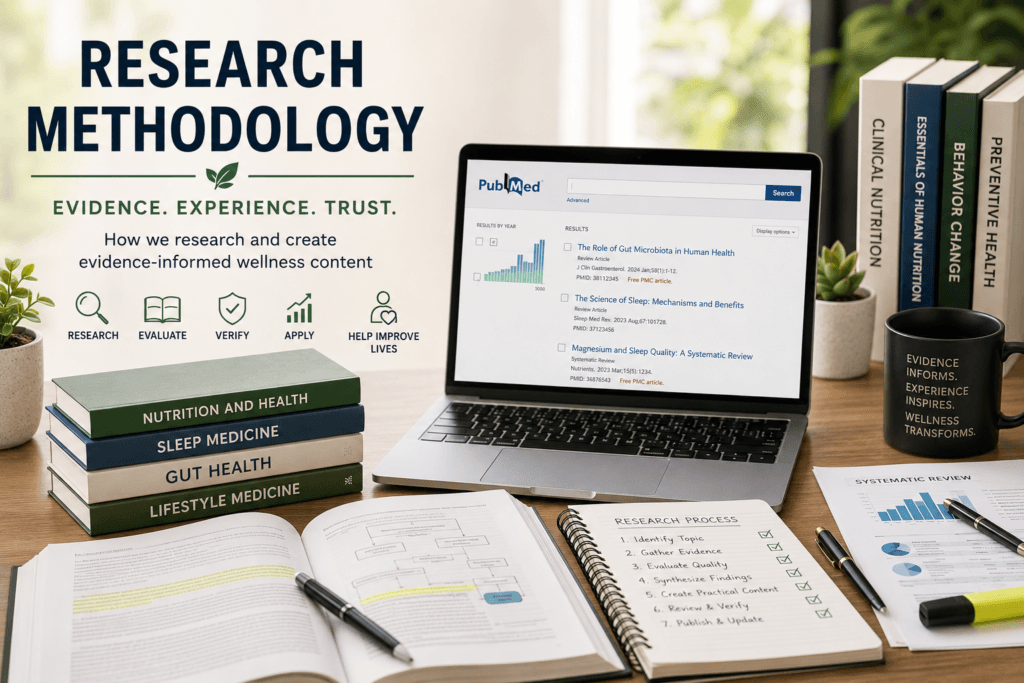
This page explains how we research, evaluate, and develop the content published on Purely Vital Living.
Our Research Philosophy
Health and wellness information can often be confusing, contradictory, and overwhelming.
Our goal is to simplify complex wellness topics while maintaining a strong commitment to accuracy, transparency, and practicality.
We believe that wellness content should:
- Be based on the best available evidence whenever possible.
- Incorporate established scientific understanding.
- Prioritize reader safety and transparency.
- Recognize that individual experiences and needs vary.
- Focus on sustainable, long-term health habits rather than quick fixes.
Sources We Use
Depending on the topic, our content may reference information from a variety of trusted sources, including:
Government Health Organizations
- National Institutes of Health (NIH)
- National Library of Medicine (PubMed)
- Centers for Disease Control and Prevention (CDC)
- National Institute of Diabetes and Digestive and Kidney Diseases (NIDDK)
- National Center for Complementary and Integrative Health (NCCIH)
Academic and Scientific Literature
Whenever appropriate, we review:
- Peer-reviewed scientific studies.
- Systematic reviews.
- Meta-analyses.
- Clinical practice guidelines.
- Consensus statements.
Scientific literature is frequently accessed through databases such as PubMed.
Medical and Health Institutions
We may also reference information published by respected healthcare organizations, including:
- Mayo Clinic
- Cleveland Clinic
- Harvard Health Publishing
- Sleep Foundation
- Johns Hopkins Medicine
- Academic medical centers and universities
Additional reputable sources may be used depending on the specific topic being discussed.
How We Evaluate Evidence
Not all health information carries the same level of scientific support.
Whenever possible, we prioritize higher-quality evidence, including:
- Systematic reviews and meta-analyses.
- Clinical practice guidelines.
- Randomized controlled trials.
- Large observational studies.
- Expert consensus statements.
Lower-quality evidence, anecdotal reports, or emerging research may occasionally be discussed when relevant, but these sources are interpreted cautiously.
Our Content Development Process
Each article published on Purely Vital Living typically follows a structured process:
Step 1: Topic Research
Topics are selected based on reader needs, wellness relevance, search trends, and educational value.
Step 2: Evidence Review
Relevant scientific literature, trusted medical resources, and authoritative health organizations are reviewed.
Step 3: Content Creation
Information is translated into practical, reader-friendly guidance designed for everyday application.
Step 4: Editorial Review
Content is reviewed for:
- Accuracy.
- Clarity.
- Readability.
- Consistency.
- Practical usefulness.
- Appropriate sourcing.
Step 5: Publication and Ongoing Updates
Articles are periodically reviewed and updated to reflect new evidence, revised recommendations, or improved educational value.
Use of Personal Experience
Many topics covered on Purely Vital Living are informed by the personal experiences of founder Walid Abdin.
Walid has lived with digestive health challenges, chronic fatigue, and sleep-related issues for more than two decades.
Personal experiences may be shared to provide practical context and real-world insights. However, personal experience should not be interpreted as medical advice.
Individual results and experiences vary significantly.
Product Research Methodology
Product reviews and recommendations are developed using a structured evaluation process.
Factors considered may include:
- Ingredient quality.
- Available scientific evidence.
- Product specifications.
- Brand reputation.
- Manufacturing standards.
- Customer feedback.
- Overall value.
- Relevance to specific wellness goals.
Unless explicitly stated, product reviews are based on research, analysis, and editorial evaluation rather than clinical testing.
Limitations of Wellness Research
Health and wellness science continues to evolve.
Research findings may change over time as new evidence becomes available.
Additionally:
- Individual responses vary.
- No single intervention works for everyone.
- Wellness information should not replace personalized medical advice.
Readers should consult qualified healthcare professionals regarding personal health concerns and medical decisions.
Our Commitment to Transparency
We are committed to:
- Clearly identifying affiliate relationships.
- Distinguishing personal experience from scientific evidence.
- Updating content when significant new information becomes available.
- Maintaining editorial independence.
- Prioritizing the needs of readers.
Questions About Our Research Process?
If you have questions regarding our research methodology or editorial standards, please contact us at: