
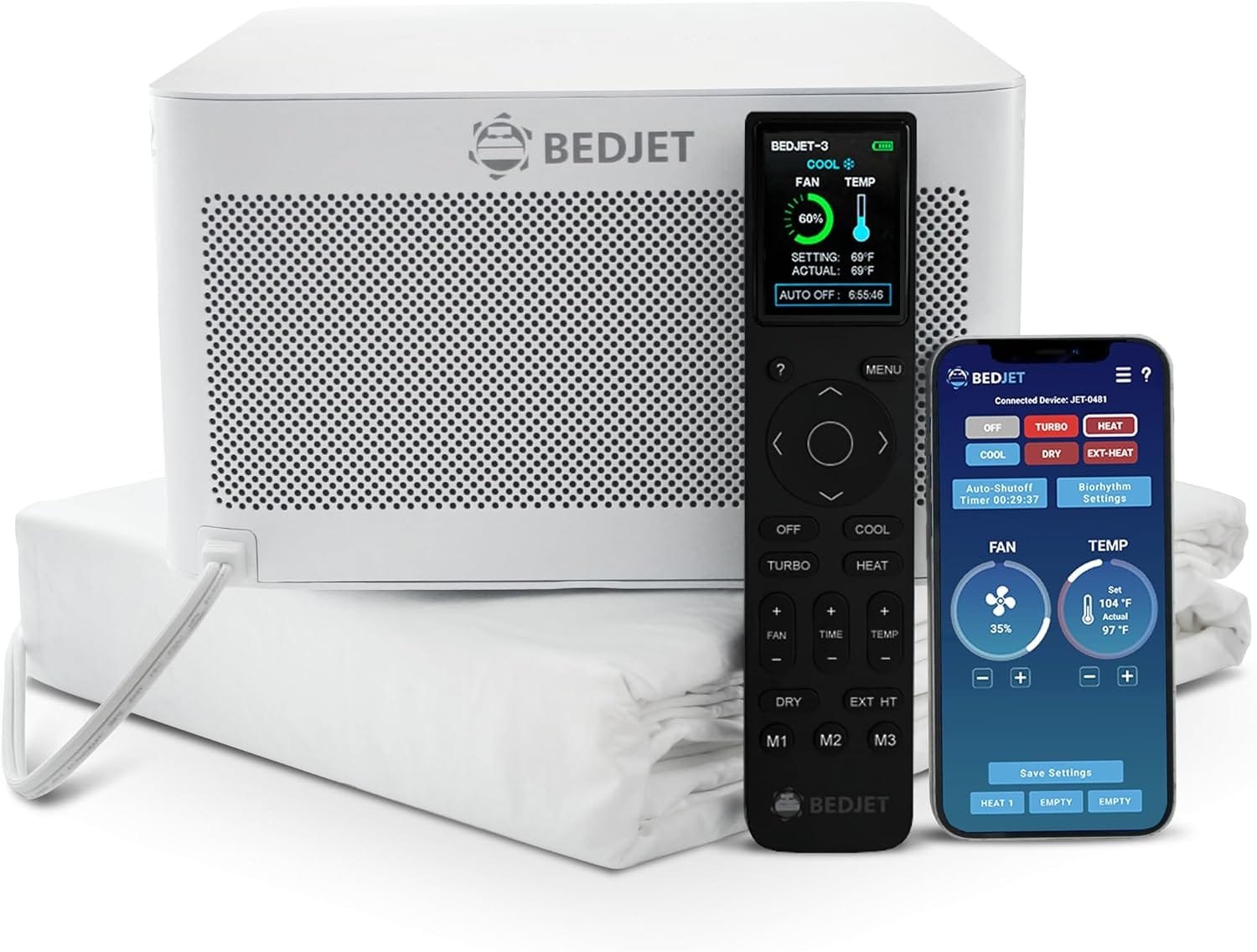
Quick verdict: The BedJet 3 with Cloud Sheet is one of the most responsive ways to change the microclimate under your covers without replacing your mattress. Its forced airflow can dry sweat, move trapped heat, pre-warm cold bedding, and follow an overnight temperature schedule. Cooling performance is strongest in rooms below about 79°F because the unit circulates room air rather than refrigerating it. The main drawbacks are the premium price, visible hose and base unit, fan sensation, noise at higher speeds, and the need for two units for independent dual-zone control.
In this BedJet review, we examine the BedJet 3 Cooling & Heating Climate Fan bundled with a Queen/Full Cloud Sheet. We focus on how the system actually moves heat and humidity, who benefits from its air-based design, how it compares with water-circulating systems, and whether its high price is justified. This is an evidence-aware editorial assessment based on specifications, published research, independent reporting, and practical ownership factors; we do not claim personal hands-on testing.
What Is the BedJet 3?
BedJet 3 is an under-bed or bedside climate-control unit that pushes filtered room air through a flexible hose and into the bedding. The supplied Cloud Sheet distributes that airflow more evenly around the sleeper than directing the nozzle beneath a conventional top sheet.
It is not an air conditioner. In cooling mode, BedJet does not use a compressor, refrigerant, chilled water, or thermoelectric plate. Instead, moving air increases evaporation and helps carry warm, humid air away from the body. In heating mode, an internal heater warms the airflow before it enters the bed.
The Amazon bundle supplied for this review includes the BedJet 3 base unit, color-screen remote, hose, nozzle, mattress bracket, and Queen/Full Cloud Sheet. Check the exact bundle contents before ordering because BedJet is also sold without a Cloud Sheet and in dual-zone packages.
Key specifications
| Feature | BedJet 3 details |
|---|---|
| Climate method | Forced room-air circulation with optional heat |
| Regulated range | Advertised 66–109°F, dependent on ambient conditions |
| Best cooling conditions | Rooms below approximately 79°F |
| Base dimensions | 15.5 × 10.5 × 5.75 inches |
| Under-bed clearance | About 6 inches; bedside placement is also possible |
| Cool-mode power | Up to 40 watts |
| Heat-mode power | Approximately 100–1,100 watts |
| Turbo heat | Up to 1,500 watts with a 10-minute maximum |
| Controls | Color-screen remote, Wi-Fi, and Bluetooth app |
| Scheduling | Biorhythm temperature and airflow programs |
| Filter | Washable lifetime air filter |
| Safety | UL-certified bedroom appliance |
| Warranty and trial | Manufacturer lists a 2-year warranty and 60-day trial; retailer terms may differ |
How BedJet Cooling Works
The system pulls in bedroom air and moves it through the hose beneath the covers. Airflow replaces the warm, humid pocket that can form around the sleeper. That can feel cooling for two reasons: moving air improves convective heat transfer, and drier airflow supports evaporation of perspiration.
This mechanism explains both BedJet’s strength and its limit. It responds almost immediately and can reduce the clammy feeling that passive cooling fabrics struggle to address. However, it cannot make bedroom air colder. In a very hot room, it circulates hot air; in extremely humid conditions, evaporation becomes less effective. BedJet itself advises that bedrooms regularly above about 79°F can overwhelm the cooling method.
The Cloud Sheet has internal airflow channels and a hose opening that spread air across more of the bed. Without it, airflow beneath ordinary covers may concentrate near the feet or escape around the edges. Some sleepers will love the lightly inflated, ventilated sensation; others may need time to adjust.
Heating Performance
Heating is the most powerful and predictable part of the system. The BedJet can pre-warm bedding quickly, direct heat toward cold feet, and reduce the need to heat an entire room. Turbo mode is designed for rapid short-term warming, while lower heat settings can maintain comfort more gently.
Unlike an electric blanket, the electrical heating element stays in the floor unit rather than in the bed. Only warmed air travels through the hose. That does not remove the need to follow electrical safety instructions, keep the intake unobstructed, and use the correct regional voltage.
Controls, App, and Biorhythm Scheduling
The included color-screen remote is a major advantage for people who do not want a phone beside the bed. It controls temperature, fan speed, operating time, cooling, heating, dry mode, and saved programs. BedJet also supports smartphone control through Wi-Fi and Bluetooth.
Biorhythm programming allows settings to change by time: for example, pre-warm the bed, shift to low airflow after sleep onset, increase cooling during the warmest part of the night, and trigger a gentle warm-air wake-up. This can be useful for consistent sleepers, though people with irregular bedtimes may prefer manual control.
App dependence is therefore optional rather than mandatory. The trade-off is a relatively large remote with more buttons and menus than a basic fan or mattress pad.
Noise and Sleep Sensation
At modest fan settings, the unit is designed to produce low, steady airflow noise that many sleepers may treat like white noise. Higher cooling speeds and Turbo heat are more audible. Noise sensitivity, placement, hard flooring, and nearby furniture can affect perception.
The air movement itself is equally personal. Some users find the dry breeze soothing, while others dislike drafts around their feet or the sheet lifting slightly. The Cloud Sheet improves distribution but does not make the airflow completely imperceptible. Starting at a low fan setting is the safest way to determine your comfort level.
Setup and Bed Compatibility
Installation normally requires no tools. The base needs open intake space and either six inches of clearance under the bed or room beside it. The hose runs to a bracket at the mattress edge, and the nozzle connects to the Cloud Sheet or directs air beneath conventional bedding.
- Choose an under-bed or bedside location with unobstructed airflow.
- Attach the hose to the base and route it without sharp bends.
- Secure the mattress bracket and nozzle near the foot or side of the bed.
- Connect the nozzle to the Cloud Sheet opening.
- Plug the unit directly into the recommended outlet and test low airflow first.
- Adjust temperature, fan speed, and timer before creating a Biorhythm schedule.
The base works with most mattress materials and adjustable frames, but low platform beds may lack clearance. Bed skirts, storage boxes, thick side rails, and pets can obstruct the intake or hose.
Cloud Sheet: Is It Worth Having?
For cooling, the Cloud Sheet is more than a cosmetic accessory. Its two-layer construction creates a controlled path for airflow, distributing it around the body rather than allowing it to escape immediately. The Queen/Full size in this bundle suits one-zone use across those bed sizes.
The sheet is machine washable, but it adds another bedding item to maintain and is typically available in limited colors. Pet hair and footprints can show on white fabric. The sheet can also feel unusual when inflated at higher fan speeds.
Couples with different temperature preferences should examine the dual-zone Cloud Sheet. One BedJet can serve one side while the other side remains unconditioned, but genuinely independent heating and cooling on both sides requires two BedJet units.
Pros and Cons
Pros
- Fast air-based cooling and sweat drying
- Very rapid preheating and strong warming performance
- Does not change mattress firmness or cushioning
- Cloud Sheet spreads airflow more evenly
- Full control from the remote without a phone
- Custom overnight Biorhythm schedules
- Low power draw in cooling mode
- No water reservoir, pump, or leak risk in the bed
Cons
- Expensive, especially with a Cloud Sheet or dual-zone setup
- Cooling does not lower room-air temperature
- Performance declines in very hot or humid bedrooms
- Fan noise and under-sheet airflow may bother sensitive sleepers
- Base unit, hose, and bracket require space
- Two units are needed for fully independent couple control
- Cloud Sheet adds laundry and is visually noticeable
- Medical claims are supported by limited, condition-specific evidence
Evidence Behind the “Clinically Proven” Claim
BedJet cites a 2018 study involving 46 perimenopausal and menopausal women experiencing hot flashes, night sweats, and sleep disturbance. Participants used the system for at least three weeks, and results were presented at the North American Menopause Society annual meeting and published as an abstract.
The reported outcomes are encouraging for that specific population, but the evidence should be interpreted cautiously. The publicly available material describes a small study with self-reported outcomes, and an abstract provides less methodological detail than a full peer-reviewed randomized controlled trial. It does not prove that every sleeper will experience better sleep or that BedJet treats the underlying cause of night sweats.
Persistent or newly severe night sweats can be associated with medications, hormonal changes, infections, sleep disorders, and other medical conditions. A bed climate device may improve comfort, but it should not replace medical evaluation.
BedJet vs. Other Bed-Cooling Systems
| System | How it works | Best for | Main drawback |
|---|---|---|---|
| BedJet 3 | Moves room air under bedding | Sweat drying, instant airflow, fast heat | No refrigeration; fan sensation |
| HydroSnooze | Circulates temperature-controlled water | Direct conductive cooling and heating | Water maintenance and pad feel |
| Adamson B10 | Water-based mattress pad | Lower-cost active cooling | More basic controls |
| Passive cooling topper | Breathable or moisture-wicking materials | Low cost and easy setup | Limited heat removal |
| Room fan or AC | Cools or circulates bedroom air | Whole-room comfort | May affect a partner and use more energy |
Read our HydroSnooze review, Adamson B10 review, and Sleep Zone cooling topper review for alternative approaches. You can also explore our sleep guides and Sleep Resources hub.
Who Should Buy the BedJet?
BedJet is best for sleepers who become hot and clammy under covers, people who want strong preheating without changing mattress feel, and couples willing to invest in targeted climate control. It is particularly appealing when airflow and humidity removal matter more than making the mattress surface physically cold.
It may also suit renters who cannot replace the HVAC system and mattress owners who do not want a thick cooling topper. The remote makes it practical for users who avoid nighttime phone use.
Who Should Skip It?
Skip or reconsider the BedJet if your room routinely exceeds 79°F without air conditioning, you strongly dislike drafts or fan noise, your bed lacks space for the base and hose, or the $739 bundle price strains the budget. A simple fan, breathable bedding, or a passive pad may solve milder overheating for much less.
People with reduced temperature sensation, limited mobility, or medical conditions affecting heat perception should seek professional guidance and use conservative settings. Do not rely on BedJet as treatment for hot flashes, insomnia, or unexplained night sweats.
Value for Money
The BedJet 3 + Cloud Sheet bundle sits at the premium end of sleep accessories. Its value comes from versatility: cooling airflow, sweat drying, powerful warming, remote control, app control, schedules, and compatibility with the mattress you already own. It may also reduce the need to cool or heat the entire bedroom, though actual utility savings vary widely.
Value is weaker for people who need cooling only a few nights per year or are satisfied with a room fan. Compare the Amazon price with BedJet’s direct pricing, bundle inclusions, trial period, return shipping, and warranty before buying. Retailer terms can differ from the manufacturer’s direct 60-day trial.
Final Verdict
BedJet 3 is a sophisticated and genuinely different bed climate system. It excels at rapid airflow, humidity removal, and strong heating while preserving the feel of the mattress. The Cloud Sheet makes cooling more even and is worth having for buyers committed to the system.
The important limitation is that BedJet is an air circulator, not a miniature air conditioner. It works best when the bedroom air is already within a reasonable range. If that matches your environment and you value instant, programmable comfort, BedJet is one of the strongest premium options. If you need the mattress surface cooled below room temperature, a water-based system may be a better fit.
Frequently Asked Questions
Does BedJet actually cool the bed?
Yes. BedJet can make the area under the covers feel cooler by circulating room air, removing trapped heat, and accelerating sweat evaporation. It does not refrigerate the air, so results depend on bedroom temperature and humidity; BedJet says its strongest cooling performance occurs when room temperature remains below approximately 79°F.
Is BedJet an air conditioner?
No. BedJet is an air-circulation system, not an air conditioner, because it has no compressor, refrigerant, or chilled-water loop. Cooling mode moves ambient room air through the bedding to release trapped heat and moisture, while heating mode electrically warms that airflow before distributing it beneath the covers.
Does BedJet work without the Cloud Sheet?
Yes. BedJet can direct air beneath an ordinary top sheet through its hose nozzle, so the system operates without the Cloud Sheet. However, the dual-layer Cloud Sheet spreads airflow more evenly across the bed, reduces the concentrated draft near the nozzle, and generally makes cooling and heating feel more consistent.
Is BedJet noisy?
BedJet is relatively quiet at lower fan settings, producing a steady background sound that many sleepers may tolerate. Higher cooling speeds and Turbo heating are more noticeable, however, and nearby placement can transmit some vibration. Light sleepers should begin at a low speed and increase airflow only as needed.
Can couples use one BedJet?
Yes. One BedJet can condition the whole bed, or it can direct airflow primarily toward one side when paired with the appropriate Cloud Sheet configuration. Couples who want fully independent temperatures and fan speeds need a dual-zone Cloud Sheet plus two BedJet units—one climate system for each sleeper.
Does BedJet change how the mattress feels?
No. BedJet does not place a cooling pad, heating wires, or water tubes beneath the sleeper, so the mattress’s firmness and cushioning remain essentially unchanged. Air enters above the mattress and may lift the top sheet slightly, creating a gentle airflow sensation rather than altering the sleep surface.
Can BedJet help with night sweats?
BedJet may help manage heat and moisture during night-sweat episodes by circulating air and using Dry mode to reduce damp bedding. A small 2018 study in 46 perimenopausal and menopausal women reported improvement, but it does not establish effectiveness for everyone. Persistent, severe, or unexplained night sweats warrant medical evaluation.
How much clearance does BedJet need?
BedJet recommends approximately six inches of under-bed clearance because the base unit is about 5.75 inches high. The unit measures roughly 15.5 by 10.5 inches across its footprint. If the bed frame is too low or storage blocks airflow, the base can instead be placed beside the bed.
Does BedJet use much electricity?
Cooling mode is relatively economical, drawing up to approximately 40 watts because it primarily runs a fan. Heating requires much more electricity, ranging from about 100 to 1,100 watts depending on the setting. Turbo heat can reach 1,500 watts, but the system limits that mode to a maximum of ten minutes.
Is the BedJet Cloud Sheet washable?
Yes. The BedJet Cloud Sheet is designed for machine washing, although owners should follow the current care label for water temperature, drying, and detergent instructions. Ensure the sheet is fully dry before reconnecting the hose, and periodically inspect the air opening so fabric or bedding does not obstruct airflow.

Reviews
There are no reviews yet.