
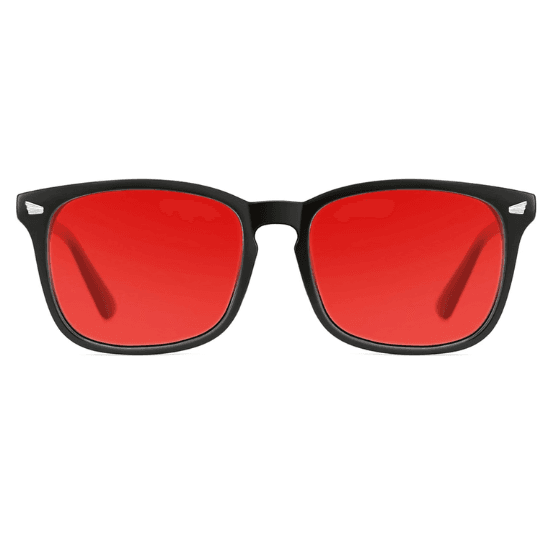
Quick Verdict
TIJN Sleep Glasses may be a reasonable evening light-management accessory if their red lenses substantially reduce short-wavelength light, but lens color alone does not prove the amount of circadian-relevant filtering. Research on blue-blocking glasses is mixed, and PVL did not identify a peer-reviewed trial of this finished TIJN model showing improved insomnia or objective sleep outcomes.
PVL Rating: 3.8/5
- Evening light-management concept: 4.2/5
- Sleep evidence: 3.4/5
- Product transparency: 3.4/5
- Ease of use: 4.2/5
- Value: 3.8/5
Best for: People who want a wearable way to reduce bright, short-wavelength-enriched light during the hours before bed and are comfortable with strongly tinted lenses.
Not ideal for: Anyone expecting glasses to treat chronic insomnia, cure digital eye strain, or provide predictable circadian filtering without verified spectral-transmission data.
What Are TIJN Sleep Glasses?
TIJN Sleep Glasses are non-prescription red-tinted glasses marketed for evening use around screens, gaming, reading, and other artificial-light exposure. Their intended sleep-related role is optical filtering: reducing some wavelengths reaching the eye before bedtime.
The key technical question is not simply whether the lenses look red. Buyers should check the current manufacturer’s spectral-transmission or wavelength-blocking specifications, because products with similar colors can differ in how much light they transmit across the visible spectrum.
Can TIJN Sleep Glasses Improve Sleep?
PVL did not identify a peer-reviewed trial of the finished TIJN glasses demonstrating better sleep. Blue- and short-wavelength-blocking glasses have been studied as a broader intervention, but findings vary by lens, timing, population, light environment, and outcome.
A 2025 meta-analysis restricted to actigraphy outcomes from randomized crossover trials found no statistically significant effects on sleep-onset latency, total sleep time, sleep efficiency, or wake after sleep onset. The analysis included only three small trials totaling 49 participants, so the evidence remains imprecise rather than proving that filtering can never help.
Why Can Evening Light Affect Sleep?
Light is a major input to the circadian system. Short-wavelength light can strongly stimulate melanopsin-containing retinal cells involved in circadian signaling, although biological response depends on intensity, spectrum, duration, timing, prior light exposure, and the individual.
Reducing evening light exposure can therefore be biologically plausible. That mechanism does not establish that every red, amber, orange, or “blue-blocking” lens produces a clinically meaningful sleep benefit.
Does a Red Lens Automatically Block the Right Wavelengths?
No. Visible color gives a rough clue, not a complete transmission profile. Two red-looking lenses can transmit different amounts of short-wavelength and melanopic light.
For a product making strong wavelength-blocking claims, a measured spectral-transmission curve or clearly defined wavelength range is more informative than lens color alone. PVL would not infer a precise percentage of blue or green light blocked without appropriate product-specific documentation.
What Do Clinical Trials of Blue-Blocking Glasses Show?
The literature is mixed. A small 2017 randomized crossover trial in 14 adults with insomnia symptoms found improvements in several subjective measures and actigraphic total sleep time after amber versus clear lenses. Earlier small studies also reported subjective benefits.
Broader reviews, however, highlight heterogeneous populations, lenses, protocols, and outcomes. A 2023 review of short-wavelength-reduction interventions found some favorable pooled effects but inconsistent individual studies, while the newer 2025 objective meta-analysis did not find significant actigraphic benefits.
Do TIJN Glasses Treat Insomnia?
No product-specific evidence establishes TIJN glasses as an insomnia treatment. Chronic insomnia is more than evening screen exposure and may involve behavioral, cognitive, circadian, medical, environmental, or psychological contributors.
Reducing excessive evening light can be one component of sleep hygiene or circadian management, but persistent insomnia deserves evidence-based assessment and treatment rather than reliance on tinted eyewear alone.
Do Blue-Light Glasses Reduce Digital Eye Strain?
Current evidence does not establish blue-light filtering as an effective general treatment for digital eye strain. A 2023 Cochrane review concluded that blue-light-filtering spectacle lenses may not reduce computer-related eye-strain symptoms over short-term follow-up compared with non-filtering lenses.
Screen discomfort can also involve reduced blinking, dry eye, prolonged near focus, glare, viewing distance, ergonomics, and long uninterrupted sessions. Those issues are separate from circadian light exposure.
Do TIJN Glasses Protect the Retina From Screens?
PVL would not recommend these glasses on the premise that ordinary screen exposure has been shown to damage the retina and therefore requires protective red lenses. A sleep-oriented light-management rationale is different from a medical retinal-protection claim.
When Should You Wear Blue- or Red-Blocking Glasses?
Research protocols vary, but many studies have used tinted lenses during the final hours before bedtime. The appropriate timing depends on the goal and circadian schedule; simply wearing them at random times does not guarantee benefit.
It is also worth addressing the light environment directly: dimming room lights and reducing unnecessary bright screen exposure may lower evening light without requiring glasses for every user.
Can Strong Red Lenses Affect Vision?
Yes. Strongly tinted lenses alter color perception and can reduce the amount and spectrum of visible light reaching the eye. That may be acceptable while relaxing at home but inappropriate for tasks requiring accurate color discrimination or optimal visibility.
Do not assume heavily tinted sleep glasses are appropriate for driving, operating machinery, navigating dark environments, or other safety-critical tasks unless the manufacturer specifically establishes suitability for that use.
What TIJN Sleep Glasses Have Not Been Shown to Do
- Treat chronic insomnia
- Reliably shorten sleep onset or increase total sleep time in every user
- Increase deep sleep or REM sleep
- Relieve digital eye strain simply because they filter blue light
- Protect the retina from ordinary screen use
- Block a precise percentage or wavelength range unless supported by product-specific transmission data
Pros and Cons
Pros
- Simple, non-drug approach to reducing evening light exposure
- Strong tint may be useful when the goal is substantial short-wavelength reduction
- Easy to combine with broader evening light hygiene
- No app, battery, or subscription required
Cons
- No finished-product sleep trial identified
- Sleep evidence for blue-blocking glasses remains mixed
- Lens color alone does not establish spectral performance
- Strong tint changes color perception and may be unsuitable for safety-critical tasks
- Blue-light filtering is not a proven general remedy for digital eye strain
Who Should Consider Them?
TIJN may suit someone who is intentionally reducing bright evening light and wants a wearable filter while still reading or using devices. The purchase is easier to evaluate if the current product documentation provides meaningful spectral-transmission information.
Who Should Choose Something Else?
If the main problem is eye discomfort, address ergonomics, blinking, dryness, glare, and screen habits rather than assuming blue light is the cause. If chronic insomnia persists, evidence-based insomnia care is more appropriate than treating tinted glasses as a stand-alone therapy.
Frequently Asked Questions
Do TIJN red sleep glasses actually improve sleep?
There is no good product-specific evidence that TIJN sleep glasses reliably improve sleep. Short-wavelength-blocking glasses have a plausible circadian mechanism and some small positive trials, but the broader evidence is mixed. A 2025 meta-analysis of objective actigraphy outcomes found no significant improvements in sleep onset, total sleep time, sleep efficiency, or nighttime wakefulness.
Are red lenses better than clear blue-light glasses for sleep?
A darker red or amber appearance can indicate stronger filtering, but color alone cannot establish which lens is better for sleep. What matters is the measured spectral transmission across circadian-relevant wavelengths, plus when and under what lighting the glasses are worn. Product-specific transmission data are more informative than labels such as “red” or “blue blocking.”
Do TIJN glasses block blue and green light?
The current product documentation should be checked for the exact wavelengths and transmission percentages rather than inferring performance from the red tint. Different red-looking lenses can have different spectral profiles. PVL would not assign a precise blue- or green-light blocking percentage to TIJN without appropriate product-specific laboratory or manufacturer transmission data supporting that figure.
Can TIJN blue-light glasses treat insomnia?
No, TIJN glasses should not be presented as a stand-alone treatment for chronic insomnia. Reducing evening short-wavelength light may be useful in selected circumstances, but insomnia can have behavioral, cognitive, circadian, medical, and psychological contributors. Persistent symptoms are better addressed with evidence-based evaluation and treatment, including CBT-I when clinically appropriate.
Do TIJN glasses help digital eye strain?
Blue-light filtering is not well supported as a general treatment for digital eye strain. A 2023 Cochrane review found that blue-light-filtering lenses may not meaningfully reduce short-term computer-related eye-strain symptoms compared with non-filtering lenses. Dryness, reduced blinking, prolonged near focus, glare, ergonomics, and uninterrupted screen time can also contribute to discomfort.
Should I wear red sleep glasses while driving at night?
Strongly tinted red sleep glasses should not be assumed safe for nighttime driving. They alter color perception and reduce portions of visible light, which can matter during safety-critical visual tasks. Unless the manufacturer specifically establishes that a particular model is suitable and compliant for driving, reserve heavily tinted sleep lenses for appropriate non-driving evening use.
Final Verdict
PVL Rating: 3.8/5. TIJN Sleep Glasses have a plausible role as an evening light-management accessory, particularly if their current lenses have documented strong short-wavelength filtering. But the finished product has not been shown to treat insomnia, and newer objective evidence for blue-blocking glasses is less convincing than some early small trials. Spectral data matter more than red color or marketing language.
References
- 2025 systematic review and meta-analysis of actigraphic sleep outcomes with blue-light-blocking glasses. PMID 41341515.
- Systematic review and meta-analysis of short-wavelength light reduction and sleep. PMID 37192881.
- Randomized crossover trial of amber blue-blocking lenses in adults with insomnia symptoms. PMID 29101797.
- Cochrane review of blue-light-filtering spectacle lenses. PMID 37593770.


Reviews
There are no reviews yet.