
Quick Verdict
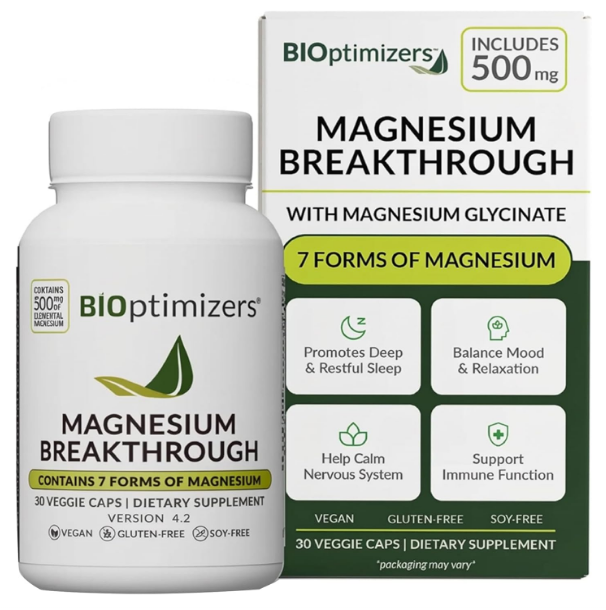
Magnesium Breakthrough is a high-dose, seven-form magnesium supplement, but “seven forms” is a formulation feature—not evidence that it improves sleep, stress, or recovery more than a simpler magnesium product. The current U.S. product provides 500 mg of elemental magnesium per two-capsule serving. That is above the NIH adult upper limit of 350 mg per day from supplements and medications, so the dose deserves more attention than the number of magnesium forms.
PVL Rating: 3.9/5
- Formula quality: 4.3/5
- Evidence: 3.2/5
- Ease of use: 4.3/5
- Transparency and safety: 3.6/5
- Value: 3.8/5
Best for: Adults who specifically want a multi-form magnesium capsule and have confirmed that a 500 mg supplemental dose is appropriate for them.
Consider another option if: You want a lower supplemental dose, a fully disclosed amount of each magnesium form, or a supplement with direct clinical evidence for insomnia.
What Is Magnesium Breakthrough?
Magnesium Breakthrough is a BIOptimizers magnesium supplement built around seven magnesium forms: chelate, bisglycinate, Sucrosomial magnesium, malate, orotate, taurate, and citrate. The current U.S. manufacturer page lists 500 mg of elemental magnesium per two-capsule serving, along with vitamin B6, manganese, and additional ingredients.
The multi-form concept sounds comprehensive, but consumers should separate formulation variety from clinical superiority. PVL did not identify a human randomized trial showing that this seven-form finished product improves sleep, stress, exercise recovery, or other health outcomes more than an appropriate single-form magnesium supplement.
Are Seven Forms of Magnesium Better Than One?
Not proven. Different magnesium compounds can differ in solubility, tolerability, elemental-magnesium content, and absorption characteristics. That does not establish that combining seven forms produces seven distinct benefits or superior clinical outcomes.
The manufacturer presents the seven-form blend as a way to support broad magnesium needs. However, the current marketing materials do not provide human comparative evidence showing that the finished blend outperforms magnesium glycinate, citrate, or another suitable form at an appropriate dose. More ingredients should not automatically be interpreted as more effectiveness.
Does Magnesium Breakthrough Help With Sleep?
Magnesium is biologically important for normal nerve and muscle function, but that mechanism is not the same as evidence that supplementation treats insomnia. Reviews of randomized trials have found inconsistent results, with the certainty of evidence generally low or very low.
A randomized trial of magnesium bisglycinate has reported a modest improvement in insomnia severity in a studied population, but Magnesium Breakthrough contains several forms and does not disclose enough form-specific dosing information to assume that result transfers directly to this product.
PVL did not identify a randomized controlled trial of the finished Magnesium Breakthrough product demonstrating improved insomnia, sleep efficiency, total sleep time, stress, or recovery in humans. It should therefore be viewed primarily as a magnesium supplement, not a proven sleep treatment.
Dose: Is 500 mg of Supplemental Magnesium High?
Yes. The current U.S. serving provides 500 mg of elemental magnesium from supplements. The NIH Office of Dietary Supplements sets an adult upper limit of 350 mg per day from magnesium supplements and medications. This limit does not include magnesium naturally present in food and is based largely on the risk of gastrointestinal adverse effects.
The upper limit is not a toxicity threshold and clinicians may sometimes recommend higher amounts for specific reasons. Still, a 500 mg serving is not a trivial dose. Buyers should account for magnesium from multivitamins, antacids, laxatives, electrolyte products, and other supplements before adding it.
Side Effects, Interactions, and Who Should Be Cautious
Supplemental magnesium can cause diarrhea, nausea, and abdominal cramping. Very high magnesium exposure can become dangerous, particularly when kidney function is impaired because the kidneys are responsible for clearing excess magnesium.
Magnesium can also interfere with absorption of some tetracycline and quinolone antibiotics and oral bisphosphonates. People with kidney disease, those taking interacting medicines, and anyone already using other magnesium products should discuss the dose and timing with a clinician or pharmacist.
Pros and Cons
Pros
- Seven magnesium forms in one product
- 500 mg elemental magnesium clearly stated per current U.S. serving
- Two-capsule serving
- Includes vitamin B6 and manganese
- Suitable for buyers specifically seeking a multi-form formula
Cons
- 500 mg supplemental magnesium exceeds the NIH adult supplemental upper limit
- No finished-product human RCT identified for sleep or recovery
- Seven forms are not proven superior to one appropriate form
- Formulation complexity can create stronger expectations than the evidence supports
- May cause GI side effects and has medication considerations
Is Magnesium Breakthrough Worth It?
Magnesium Breakthrough is most defensible as a premium multi-form magnesium supplement—not as a clinically proven sleep or recovery product. The seven-form blend is distinctive, but PVL would not pay a premium solely because seven forms sound more comprehensive.
For someone who simply needs supplemental magnesium, a lower-dose, transparent single-form product may be easier to evaluate and may cost less. If a clinician has recommended a higher supplemental intake and you specifically prefer a multi-form capsule, Magnesium Breakthrough becomes more reasonable.
Frequently Asked Questions
How much magnesium is in Magnesium Breakthrough?
The current U.S. manufacturer page lists 500 mg of elemental magnesium per two-capsule serving. Check the bottle you receive because formulations and serving directions can change.
Does Magnesium Breakthrough contain seven forms?
Yes. The manufacturer currently lists magnesium chelate, bisglycinate, Sucrosomial magnesium, malate, orotate, taurate, and citrate.
Is seven-form magnesium better than magnesium glycinate?
There is no good human evidence showing that this finished seven-form blend produces superior clinical outcomes to an appropriate single-form magnesium supplement.
Is Magnesium Breakthrough good for sleep?
Magnesium may influence sleep in some people, but clinical evidence is inconsistent. PVL did not identify a finished-product randomized trial showing that Magnesium Breakthrough treats insomnia or reliably improves sleep.
Is 500 mg of magnesium too much?
It is above the NIH adult upper limit of 350 mg per day for magnesium from supplements and medications. That limit does not include food magnesium. Ask a clinician if a higher supplemental dose is appropriate for you.
Can magnesium interact with medication?
Yes. Magnesium can reduce absorption of some antibiotics and bisphosphonates, among other considerations. A pharmacist can advise on appropriate spacing.
Final Verdict
PVL Rating: 3.9/5. Magnesium Breakthrough offers a distinctive seven-form blend, but the number of forms should not be confused with stronger clinical evidence. The 500 mg supplemental dose is the feature that deserves the most scrutiny. Buy it if the multi-form format and dose fit an identified need—not because seven forms have been proven to deliver better sleep, recovery, or stress outcomes.
References
- BIOptimizers: Magnesium Breakthrough product information
- NIH Office of Dietary Supplements: Magnesium — Health Professional Fact Sheet
- Systematic review: magnesium supplementation and sleep outcomes in adults. 2026. PMID 42661485.
- Systematic review/meta-analysis: oral magnesium supplementation for insomnia in older adults. 2021. PMID 33865376.


Reviews
There are no reviews yet.