
Quick Verdict
Muse S Athena combines unusually sophisticated consumer sensing with guided meditation and sleep features, but sensing brain-related signals is not the same as proving that the device improves cognition, stress, recovery, or sleep. Muse-S sleep technology has meaningful validation against laboratory polysomnography, which makes the sleep-tracking case stronger than for many consumer wearables. Athena’s newer fNIRS-based cognitive features should still be treated as wellness feedback rather than clinical brain assessment.
PVL Rating: 4.2/5
- Sensor platform: 4.6/5
- Sleep-validation evidence: 4.2/5
- Sleep-stage interpretation: 4.0/5
- Cognitive/neurofeedback evidence: 3.3/5
- Value: 3.8/5
Best for: Data-oriented meditation users and sleep trackers who specifically want forehead EEG-based feedback and understand the distinction between wellness metrics and clinical testing.
Not ideal for: Anyone expecting diagnosis, treatment of insomnia or anxiety, laboratory-grade brain assessment, or proven long-term cognitive enhancement.
What Is Muse S Athena?
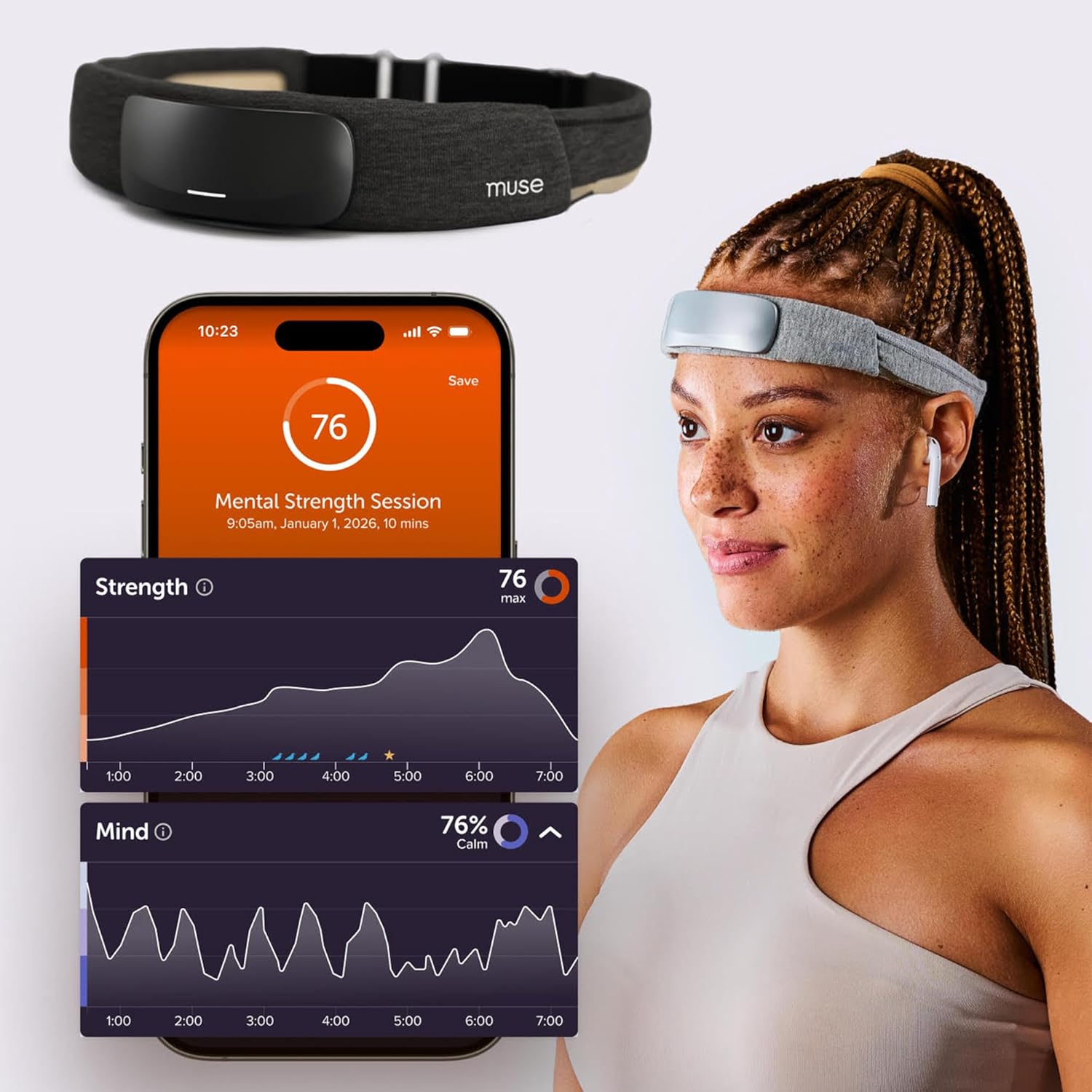
Muse S Athena is a consumer headband in the Muse family that combines forehead sensing with app-based meditation, neurofeedback, and sleep experiences. Athena adds fNIRS-related sensing to the EEG-centered platform, expanding the types of physiological signals the device can use for consumer feedback.
The presence of EEG and fNIRS sensors is technically meaningful, but sensor modality alone does not establish clinical accuracy or health benefit. The important questions are what signal is captured, how algorithms convert it into a user-facing metric, how that metric has been validated, and whether using the feedback actually improves an outcome that matters.
How Well Has Muse-S Sleep Tracking Been Validated?
There is meaningful product-family-specific validation. A study comparing the Muse-S headband with simultaneous Level-1 polysomnography enrolled 56 adults; usable paired data were available for 47 participants. Full-night epoch-by-epoch agreement was substantial, with Cohen’s kappa of 0.76. Reported sleep-stage accuracy ranged from 88% to 96%, sensitivity from 79% to 92%, and specificity from 90% to 99%.
On average, Muse-S estimated about six minutes more total sleep time, 15 minutes more N3 sleep, six minutes more REM sleep, and 1.5 percentage points higher sleep efficiency than PSG, while estimating slightly less sleep latency, wake after sleep onset, and light sleep.
Those are encouraging results for a consumer EEG headband. The study authors nevertheless noted that further validation is needed in more diverse populations, including different ages, neurological conditions, and sleep profiles.
Is Muse S Athena the Same Device That Was Validated?
Evidence should be transferred carefully across product generations. The published validation supports the Muse-S sleep-monitoring platform studied by the researchers. Athena is a newer member of the product family with additional sensing and features.
PVL would not automatically assume that every Athena algorithm, fNIRS metric, cognitive score, firmware update, or app-derived insight has independently demonstrated the same validity simply because an earlier or related Muse-S configuration performed well against PSG.
Is Muse Equivalent to Polysomnography?
No. Clinical PSG records a broader physiological signal set and is interpreted within a diagnostic framework. Muse’s forehead EEG gives it access to brain electrical activity that many wrist wearables do not measure, but the consumer headband remains a reduced-channel system using automated algorithms.
The Muse-S validation is evidence that the system can estimate sleep macroarchitecture well under the studied conditions. It is not evidence that Athena can replace a clinical sleep study or diagnose every sleep disorder.
Can Muse Accurately Measure Deep and REM Sleep?
The PSG comparison is encouraging: agreement was substantial for NREM2 and NREM3 and near-perfect for REM and wake in the analyzed dataset. That makes Muse’s stage estimates more evidence-supported than stage estimates from many movement- or heart-rate-only trackers.
Still, individual nightly values can differ from PSG, and signal quality matters. In the validation study, usable paired data were obtained from 47 of the 56 enrolled participants. A consumer should therefore interpret stage values as validated estimates with known error—not as exact laboratory truth.
What Does fNIRS Add?
Functional near-infrared spectroscopy uses near-infrared light to detect changes related to blood oxygenation in superficial cortical tissue. It is a legitimate research technique, but consumer implementation and interpretation require their own validation.
The presence of fNIRS does not by itself prove that Athena can measure “mental effort,” cognitive performance, recovery, or brain health with clinical precision. A proprietary score derived from physiological signals is only as useful as the evidence connecting that score to a clearly defined and validated outcome.
Does Muse Improve Focus or Cognitive Performance?
Neurofeedback and meditation training are active research areas, but PVL did not identify evidence establishing that the finished Muse S Athena reliably produces long-term improvements in attention, productivity, memory, or general cognitive performance in typical consumers.
Real-time feedback may make meditation practice more engaging or structured. That behavioral benefit should be kept separate from a claim that the device itself enhances the brain.
Can Muse Reduce Stress or Anxiety?
Guided meditation and slow, attentive practice can help some people feel calmer, and biofeedback may support self-regulation. But “calm scores” or changes in sensor-derived metrics are not equivalent to diagnosing or treating an anxiety disorder.
PVL would not describe Athena as a treatment for chronic stress, anxiety, depression, or another mental-health condition without appropriate product-specific clinical evidence.
Does Athena Improve Sleep?
Accurately measuring sleep is different from improving it. Muse can provide guided content and feedback that some users may find useful in a bedtime routine, but the strong PSG-validation findings concern measurement performance—not proof that wearing Athena treats insomnia or improves sleep architecture.
PVL did not identify a peer-reviewed randomized controlled trial demonstrating that the finished Muse S Athena reliably improves chronic insomnia, total sleep time, sleep efficiency, deep sleep, REM sleep, or daytime functioning.
What Muse S Athena Has Not Been Shown to Do
- Replace clinical polysomnography for diagnosis
- Diagnose neurological or psychiatric conditions
- Treat chronic insomnia
- Treat anxiety, depression, or chronic stress
- Reliably enhance long-term cognitive performance
- Measure a single clinically validated state called “mental recovery”
- Make every proprietary EEG or fNIRS-derived score medically meaningful
Pros and Cons
Pros
- EEG-based sleep sensing has meaningful product-family validation against PSG
- More direct sleep-related signal than movement-only consumer trackers
- Combines tracking with guided meditation and neurofeedback experiences
- Strong option for users interested in longitudinal brain-signal-based wellness data
- Published validation provides concrete performance data rather than marketing claims alone
Cons
- Athena-specific fNIRS and cognitive claims require separate evidence
- Not equivalent to full clinical PSG
- Signal quality and fit can affect usable data
- No identified finished-Athena RCT demonstrating insomnia treatment or cognitive enhancement
- Premium price may be difficult to justify for users who only want basic sleep trends or meditation guidance
Who Should Consider Muse S Athena?
Athena is most compelling for people who enjoy meditation or neurofeedback and specifically value EEG-based consumer data. It can also appeal to sleep-data enthusiasts who want a more physiologically direct signal than wrist movement alone and are comfortable treating the outputs as estimates.
Who Should Choose Another Approach?
If you need evaluation for suspected sleep apnea, seizures, persistent insomnia, unusual nighttime behavior, cognitive decline, or a mental-health condition, a consumer wellness headband should not substitute for appropriate clinical assessment. If you simply want basic sleep duration trends, less expensive wearables may be sufficient.
Is Muse S Athena Worth It?
Muse S Athena is technologically interesting and benefits from unusually good validation of the Muse-S sleep platform. That justifies taking its sleep data more seriously than generic “brain wellness” marketing.
The value proposition becomes weaker when EEG and fNIRS terminology is used to imply proven cognitive enhancement, stress treatment, or recovery optimization. PVL therefore rates Athena highly as an advanced consumer sensing and feedback platform while keeping its clinical and performance claims tightly bounded.
Frequently Asked Questions
Is Muse S accurate for sleep tracking?
A Muse-S validation against Level-1 PSG reported substantial full-night agreement (kappa 0.76) and stage accuracies of 88% to 96% in participants with usable paired data. Individual estimates can still differ from PSG.
Does Muse measure real brain waves?
Muse uses EEG electrodes to record electrical signals from the head. Recording EEG is real measurement, but the meaning and accuracy of each app-derived score still depend on signal quality, algorithms, and validation.
Is Muse as accurate as a sleep lab?
No. Its published performance is encouraging, but a consumer forehead EEG headband does not record the full physiological signal set or replace the diagnostic framework of polysomnography.
Does fNIRS prove Athena measures cognitive performance?
No. fNIRS is a legitimate physiological sensing method, but a consumer score derived from it needs independent validation against the specific cognitive outcome being claimed.
Can Muse treat insomnia?
PVL did not identify a finished-Athena randomized trial demonstrating treatment of chronic insomnia. Sleep measurement and guided relaxation should not be confused with insomnia therapy.
Final Verdict
PVL Rating: 4.2/5. Muse S Athena is one of the more technically sophisticated consumer sleep and meditation headbands, and Muse-S sleep staging has meaningful validation against polysomnography. Its strongest evidence supports sleep measurement—not broad claims of cognitive enhancement, stress treatment, mental recovery, or clinical brain assessment.
Reviews
There are no reviews yet.