
Quick Verdict
The Withings Sleep Analyzer is one of the better-studied contactless consumer sleep trackers, but it is still not interchangeable with polysomnography. Its under-mattress design makes long-term monitoring unusually low-friction, and validation studies show useful performance for sleep detection and selected respiratory measures. The important limitation is that it can mistake quiet wakefulness for sleep and its sleep-stage estimates remain algorithmic estimates rather than direct measurements of brain activity.
PVL Rating: 4.2/5
- Low-burden design: 4.7/5
- Validation evidence: 4.2/5
- Sleep/wake accuracy: 3.8/5
- Sleep-stage accuracy: 3.4/5
- Value: 4.0/5
Best for: People who want passive, multi-night sleep trends without wearing a watch or ring.
Not ideal for: Anyone who needs laboratory-grade sleep staging or wants to diagnose or rule out a sleep disorder from consumer data alone.
What Is the Withings Sleep Analyzer?
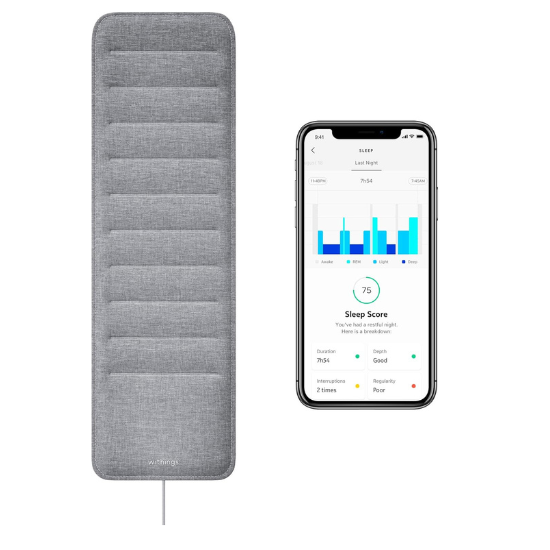
The Withings Sleep Analyzer is a sensor placed beneath the mattress. Rather than measuring brain waves, eye movements, and muscle activity like clinical polysomnography (PSG), it uses signals captured through the mattress plus algorithms to estimate sleep, wake, sleep stages, heart rate, snoring, and respiratory events.
The major practical advantage is adherence: once installed, the sensor can collect data without requiring the user to remember to wear or charge a device each night. That makes it particularly suited to observing trends across many nights.
Product names and regional features have varied between “Sleep,” “Sleep Tracking Mat,” and “Sleep Analyzer.” Buyers should verify the features enabled for the exact model and country rather than assuming every listing provides identical respiratory or sleep-apnea functions.
How Accurate Is Withings for Sleep and Wake?
It detects sleep well, but wake detection is a more important weakness. A large validation study involving 183 participants and more than 400 nights compared the Withings Sleep Analyzer with simultaneous PSG. Overall sleep/wake classification accuracy was 83%, sleep sensitivity was 95%, but wake specificity was only 37%.
The device overestimated total sleep time by an average of 48 minutes and sleep efficiency by 9 percentage points, while underestimating wake after sleep onset by 54 minutes. Performance was also more variable during daytime sleep and in participants with sleep disorders.
This pattern is common in consumer sleep technology: lying still while awake can be interpreted as sleep. For someone with insomnia who spends long periods quietly awake in bed, a reassuring-looking sleep score may therefore overstate actual sleep.
Can It Accurately Measure Deep, Light, and REM Sleep?
Sleep-stage outputs should be treated as estimates, not direct measurements. PSG identifies stages using physiological signals including EEG brain activity, eye movements, and muscle tone. An under-mattress sensor does not record the same signal set.
A 2024 laboratory comparison of several consumer devices, including the Withings Mat, found device-dependent and proportional biases across sleep measures. A 2026 study comparing consumer trackers in younger and older adults also reported poor identification of individual sleep stages, with particularly important deep-sleep errors in older adults.
For practical use, nightly stage percentages are better treated as approximate trend data than as precise measurements of how many minutes of “deep sleep” your brain produced.
Can Withings Detect Sleep Apnea?
There is meaningful product-specific research here, but it requires careful interpretation. In a 2021 clinical validation involving 118 patients suspected of obstructive sleep apnea, the Withings Sleep Analyzer was compared with PSG. At an apnea-hypopnea index (AHI) threshold of 15 events per hour, reported sensitivity was 88.0% and specificity 88.6%; at 30 events per hour, sensitivity was 86.0% and specificity 91.2%.
That is promising evidence for identifying moderate-to-severe sleep apnea in the studied clinical population. However, several study authors were Withings employees and another was a consultant for Withings, and the devices were provided by the company. Those relationships do not invalidate the findings, but they are relevant when weighing the evidence.
A consumer sleep tracker should not be used on its own to diagnose, exclude, or manage obstructive sleep apnea. Loud habitual snoring, witnessed breathing pauses, gasping, marked daytime sleepiness, or other concerning symptoms warrant appropriate clinical evaluation even if a tracker appears reassuring.
What Does the Pad Measure Directly vs Estimate?
The under-mattress sensor detects mechanical and physiological signals such as body movement and cardiorespiratory activity transmitted through the mattress. Software then converts those signals into consumer-facing metrics.
Sleep stages, sleep scores, awakenings, and respiratory-event metrics therefore involve algorithmic inference. The app’s labels should not be interpreted as direct observation of the brain’s sleep state.
Is Heart-Rate Tracking Useful?
Contactless under-mattress technology can estimate nighttime heart rate reasonably well under studied conditions. A 2024 evaluation in older adults found acceptable heart-rate and breathing-rate accuracy for several contactless technologies, including the Withings Sleep Analyzer.
That can make longitudinal trends useful, but the pad is not a replacement for an ECG, cardiac monitor, or medical evaluation when symptoms or clinically important rhythm questions are present.
Can Tracking Improve Your Sleep?
Measurement is not treatment. Seeing consistent bedtime, duration, or wake-time patterns may help a user recognize habits and test behavioral changes. But collecting more sleep data does not itself improve insomnia, recovery, or sleep architecture.
For some people, repeatedly checking sleep scores can also increase preoccupation with sleep. If tracker data makes you more anxious or causes you to chase nightly stage scores, stepping back from the metrics may be more helpful.
What Withings Has Not Been Shown to Do
- Replace polysomnography for sleep staging
- Measure deep or REM sleep with laboratory-level precision
- Diagnose or rule out every case of sleep apnea by itself
- Treat chronic insomnia
- Improve sleep simply by generating a sleep score
- Measure “recovery” as a single validated physiological state
Pros and Cons
Pros
- Completely passive once installed under the mattress
- Strong sleep sensitivity in a large PSG comparison
- Useful for multi-night trend monitoring
- Meaningful product-specific respiratory validation research exists
- No wrist or finger device required overnight
Cons
- Poor wake specificity in a large validation study
- Can overestimate total sleep and underestimate nighttime wakefulness
- Sleep-stage estimates are not equivalent to PSG
- Accuracy can vary by population and sleep context
- Clinical respiratory findings should not be interpreted without appropriate medical context
Who Should Consider It?
The Withings pad is especially attractive for someone who dislikes wearing trackers but wants passive longitudinal data. Its strength is repeated low-burden measurement, where patterns across weeks may be more informative than obsessing over a single night’s stage breakdown.
Who Should Choose Clinical Testing Instead?
Anyone with suspected sleep apnea, significant unexplained daytime sleepiness, persistent insomnia, unusual nighttime behaviors, or another possible sleep disorder should not rely on a consumer tracker as the deciding test. Clinical evaluation and appropriate validated diagnostic testing remain the relevant standard.
Is the Withings Sleep Analyzer Worth It?
For passive trend tracking, it is one of the more compelling consumer options because the product class has been evaluated against PSG and requires almost no nightly effort. Its limitations become important when users interpret algorithmic stages and scores as clinical facts.
PVL therefore rates it highly as a low-burden longitudinal monitoring tool, while keeping a clear boundary between consumer trends and medical sleep measurement.
Frequently Asked Questions
Is the Withings Sleep Analyzer accurate?
It has high sensitivity for detecting sleep, but a large PSG study found much lower specificity for detecting wake. It can therefore overestimate sleep when a person lies quietly awake.
Can it accurately measure deep sleep?
Deep-sleep values are algorithmic estimates. They should not be treated as equivalent to EEG-based sleep staging from polysomnography.
Can Withings detect sleep apnea?
Clinical validation has shown promising performance for moderate-to-severe sleep apnea in studied patients, but the device should not be used alone to diagnose or rule out sleep apnea.
Is it better than a wearable?
Its major advantage is passive use: there is nothing to wear or charge nightly. Accuracy varies across devices and metrics, so “better” depends on whether convenience, sleep staging, exercise tracking, or other features matter most.
Can a sleep tracker improve insomnia?
Tracking may reveal patterns, but measurement itself is not insomnia treatment. Persistent insomnia is better addressed with evidence-based evaluation and treatment such as CBT-I when appropriate.
Final Verdict
PVL Rating: 4.2/5. The Withings Sleep Analyzer combines exceptionally low-friction overnight monitoring with more product-specific validation than many consumer sleep devices. Its strongest role is following trends across many nights. Treat sleep stages and scores as estimates, and do not use the pad as a substitute for polysomnography or clinical diagnosis.
References
- Performance evaluation of an under-mattress sleep sensor versus polysomnography in more than 400 nights. PMID 40017337.
- Edouard P, et al. Validation of the Withings Sleep Analyzer for detection of moderate-severe sleep apnea syndrome. J Clin Sleep Med. 2021. PMID 33590821.
- Kainec KA, et al. Accuracy of commercial sleep-tracking devices compared with actigraphy and polysomnography. Sensors. 2024. PMID 38276327.
- Performance evaluation of consumer sleep-tracking wearables and nearables in healthy young and older adults. 2026. PMID 41768372.
- Contactless monitoring of heart rate, breathing rate, and breathing disturbance during sleep in aging. PMID 39190477.


Reviews
There are no reviews yet.