
Quick Verdict
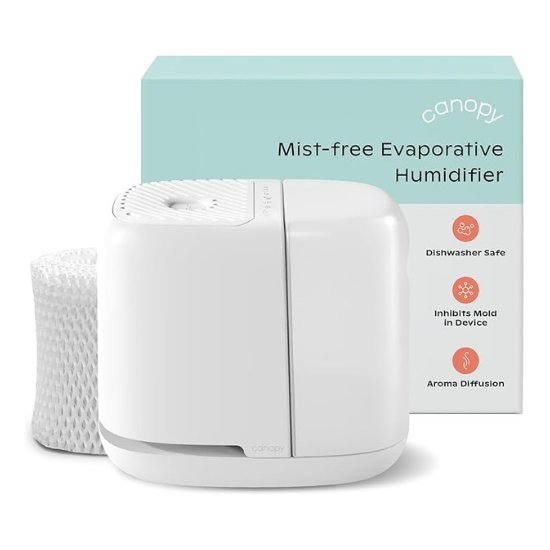
The Canopy Bedside Humidifier 2.0 is best viewed as a premium tool for managing dry indoor air—not as a device proven to improve sleep, immunity, allergies, or respiratory disease. Its evaporative design and maintenance-oriented features may be attractive for bedrooms where humidity is genuinely low, but adding moisture is beneficial only when the room actually needs it.
PVL Rating: 4.1/5
- Humidification design: 4.5/5
- Comfort rationale: 4.1/5
- Sleep evidence: 3.0/5
- Maintenance and safety: 4.3/5
- Value: 3.8/5
Best for: People living or sleeping in genuinely dry indoor environments who want an evaporative bedside humidifier with maintenance-focused design features.
Not ideal for: Already-humid bedrooms, people expecting treatment for allergies or congestion, or anyone looking for a proven sleep-improvement device.
What Is the Canopy Bedside Humidifier 2.0?
Canopy’s Bedside Humidifier uses evaporative humidification: water is absorbed into a filter and airflow carries moisture into the room without producing the visible mist associated with many ultrasonic humidifiers. The current product generation also incorporates convenience and maintenance features intended for bedroom use.
Evaporative humidification has a practical advantage: output naturally becomes less efficient as surrounding humidity rises, which can make excessive humidification less likely than with an uncontrolled high-output mist device. That does not eliminate the need to monitor room humidity or clean the unit properly.
Specifications, filter designs, lighting, sound functions, runtime, and other features can change between product generations. Buyers should verify the current manufacturer’s specifications rather than relying on older listings.
Can a Humidifier Improve Sleep?
There is no strong evidence that adding a humidifier to an otherwise comfortable bedroom directly improves normal sleep architecture or treats insomnia. Humidification may indirectly improve comfort when very dry air contributes to dry nasal passages, throat irritation, skin dryness, or other discomfort that interferes with rest.
PVL did not identify a peer-reviewed randomized controlled trial of the finished Canopy Bedside Humidifier demonstrating improvements in chronic insomnia, total sleep time, sleep efficiency, deep sleep, REM sleep, or nighttime recovery.
The practical question is therefore not “Is humidification good for sleep?” but “Is this bedroom too dry, and is dryness contributing to discomfort?”
What Indoor Humidity Should You Aim For?
The U.S. Environmental Protection Agency generally recommends keeping indoor relative humidity below 60%, ideally around 30% to 50% when possible. Humidity that is too low can be uncomfortable, but excessive moisture can encourage mold growth and dust mites.
A simple hygrometer can help determine whether humidification is actually needed. Running a humidifier automatically every night without knowing the room’s humidity can solve one problem while creating another.
Can Canopy Help With Dry Nose, Throat, or Skin?
Adding moisture to genuinely dry air can reduce environmental dryness and may make the nose, throat, eyes, or skin feel more comfortable. That is a reasonable comfort claim, not evidence that the humidifier treats an underlying medical condition.
Persistent nasal obstruction, wheezing, shortness of breath, recurrent sinus symptoms, severe skin problems, or chronic cough should not simply be attributed to dry air.
Does It Treat Congestion or Allergies?
A humidifier is not an allergy treatment or decongestant. Some people may find appropriately humidified air more comfortable when nasal tissues feel dry, but excessive humidity can increase dust mites and support mold—both important indoor allergens.
For that reason, “allergy support” should not be interpreted as “more humidity is better.” People with allergies or asthma should pay attention to measured humidity, cleaning, filter maintenance, and their individual triggers.
Evaporative vs Ultrasonic Humidification
Ultrasonic humidifiers create fine droplets that can carry dissolved minerals from tap water into the air, sometimes leaving visible “white dust.” Evaporative units use a wetted filter or wick and fan, which changes how water and minerals are dispersed.
This design difference can be useful, but it does not make an evaporative humidifier maintenance-free or sterile. Water-contact surfaces and filters still require appropriate cleaning and replacement according to the manufacturer’s current instructions.
What About UV-C and “Mold-Resistant” Features?
Features intended to reduce microbial growth or dry internal components may improve product hygiene, but they should not be interpreted as guaranteeing a mold-free or germ-free humidifier. Real-world cleanliness still depends on water quality, cleaning frequency, filter replacement, room conditions, and how the unit is stored.
PVL would therefore avoid describing Canopy as providing “mold prevention” or healthier air without qualification. Maintenance remains essential.
Humidifier Hygiene and Safety
Dirty humidifiers can disperse microorganisms or contribute to unhealthy indoor conditions. Follow the current cleaning and filter-replacement instructions, empty stagnant water as directed, and do not allow visible film, odor, or contamination to accumulate.
Monitor room humidity rather than assuming continuous operation is beneficial. If condensation forms on windows, walls, bedding, or nearby surfaces, the room may be too humid or ventilation may be inadequate.
Anyone with asthma, significant allergies, chronic lung disease, or immune compromise should be particularly attentive to humidifier hygiene and should seek individualized medical advice when appropriate.
White Noise and Bedtime Features
Extra sound or lighting functions may make the device convenient at the bedside, but they should be evaluated separately from humidification. Evidence for continuous noise as a sleep aid is mixed and low certainty, and a bedside light feature does not itself improve sleep.
These are usability features—not proof that the Canopy is a sleep treatment.
What Canopy Has Not Been Shown to Do
- Treat chronic insomnia
- Increase deep sleep or REM sleep
- Accelerate nighttime or exercise recovery
- Treat allergies, asthma, sinus disease, or respiratory infections
- Guarantee mold-free operation
- Create “healthier air” regardless of starting humidity
Pros and Cons
Pros
- Evaporative approach avoids a conventional visible mist plume
- Useful when measured indoor humidity is genuinely low
- Maintenance-oriented design can make routine care easier
- May improve comfort related to dry indoor air
- Bedroom-oriented controls and features may reduce clutter from separate devices
Cons
- No finished-product RCT identified for meaningful sleep outcomes
- Premium price for a fundamentally environmental-comfort device
- Filters and water-contact components still require maintenance
- Excess humidity can encourage mold and dust mites
- Does not treat allergies, congestion, asthma, or insomnia
Who Should Consider Canopy?
It makes the most sense for someone who has measured low bedroom humidity or consistently experiences dry-air discomfort and wants a polished evaporative system with straightforward maintenance features.
Who May Not Need It?
If bedroom humidity is already in a comfortable range, adding more moisture is unlikely to provide a meaningful benefit. In humid climates or poorly ventilated rooms, additional moisture may be counterproductive.
Is the Canopy Bedside Humidifier Worth It?
Canopy can be worthwhile for users who specifically want an evaporative humidifier and value its design, controls, and maintenance approach. Its premium is harder to justify when a simpler well-maintained humidifier can maintain the same appropriate room-humidity range.
PVL rates it primarily as a dry-air comfort and humidity-management device—not as a proven sleep, allergy, respiratory, or recovery intervention.
Frequently Asked Questions
Does the Canopy Humidifier improve sleep?
It may improve comfort if excessively dry air is disturbing you, but PVL did not identify a finished-product randomized trial showing that Canopy improves insomnia or objective sleep outcomes.
What humidity is best for a bedroom?
The EPA advises keeping indoor relative humidity below 60%, ideally around 30% to 50% when possible. Measure the room rather than assuming it needs more moisture.
Can Canopy help allergies?
It is not an allergy treatment. Excess humidity can actually promote dust mites and mold, so people with allergies should avoid over-humidifying the room.
Is an evaporative humidifier mold-proof?
No. Evaporative design and drying or antimicrobial features do not remove the need for regular cleaning, appropriate water management, and filter replacement.
Does it help congestion?
Appropriately humidified air may feel more comfortable when nasal passages are dry, but a humidifier does not treat the underlying causes of persistent congestion.
Final Verdict
PVL Rating: 4.1/5. The Canopy Bedside Humidifier 2.0 is a thoughtfully designed option for managing genuinely dry bedroom air. Its legitimate value is environmental comfort and humidity control—not unproven promises of better sleep, recovery, allergy treatment, or universally “healthier” air.
Reviews
There are no reviews yet.