

Quick verdict: The Levoit Core 300-P is a strong small-room air purifier for shoppers who want verified particle-cleaning performance, simple controls, and a compact bedroom-friendly design without paying for Wi-Fi or an air-quality sensor. Its independently verified CADR is more meaningful than oversized one-air-change coverage claims. The main compromises are noticeable fan noise at maximum speed, recurring filter costs, limited gas and odor capacity, and no automatic mode.
Editorial note: Purely Vital Living has not performed hands-on laboratory testing of this unit. This review compares Levoit’s current specifications, independently verified CADR data, third-party testing, operating costs, and authoritative indoor-air guidance. Price and availability can change.
Levoit Core 300-P at a glance
| Type | Portable mechanical air purifier |
|---|---|
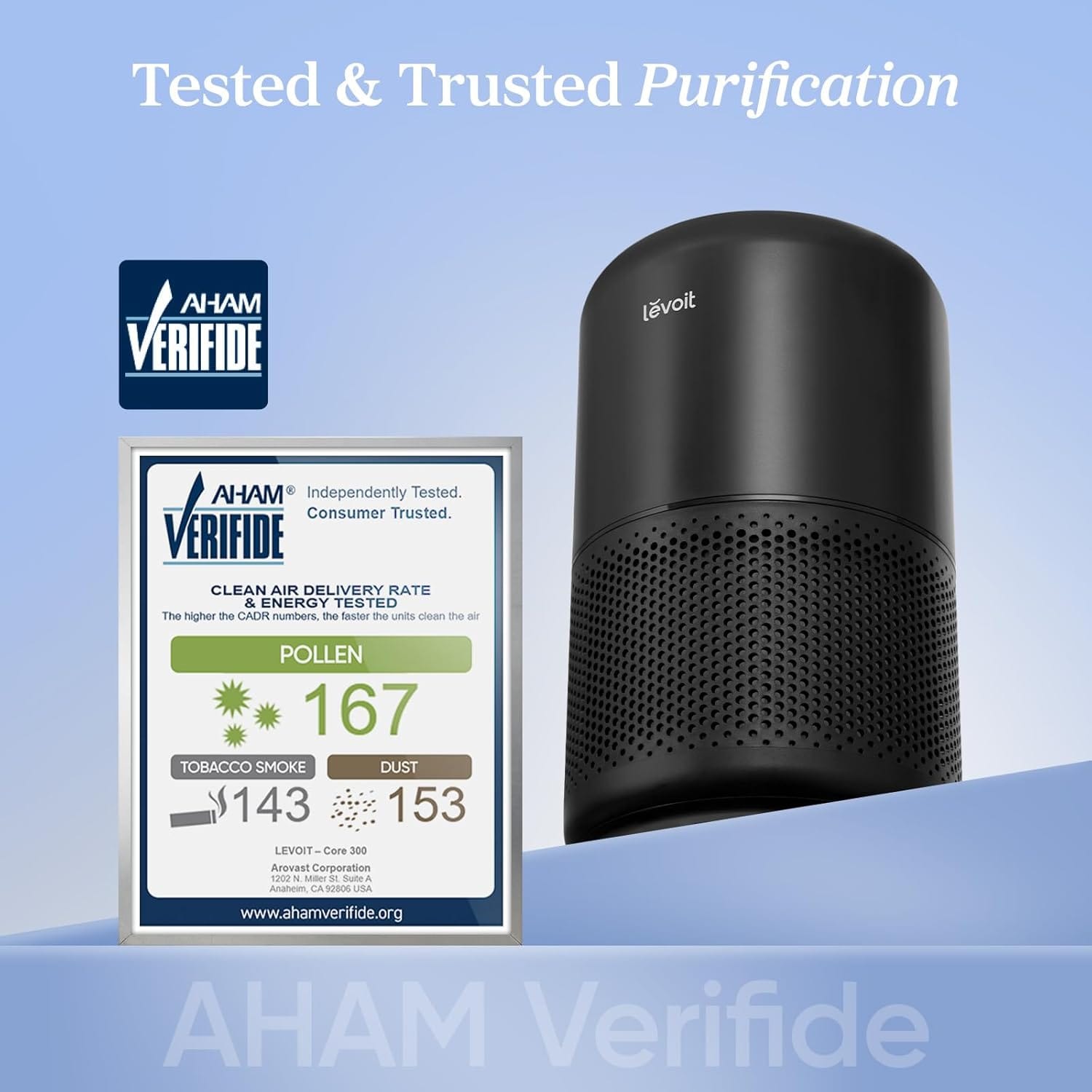
| Verified CADR | Smoke 143 CFM; dust 153 CFM; pollen 167 CFM |
| Practical room rating | 222 sq ft at 4.8 air changes per hour |
| Manufacturer large-room figure | Up to 1,066 sq ft at one air change per hour |
| Filtration | Washable-free pre-filter layer, particle filter, and activated-carbon layer |
| Noise range | Approximately 24–54.5 dB |
| Rated power | 56 W |
| Dimensions | 8.7 × 8.7 × 14.2 in |
| Weight | Approximately 7.9 lb |
| Smart features | No Wi-Fi, app, air-quality sensor, or automatic mode |
| Typical filter interval | Levoit recommends approximately every 6–8 months, depending on use and conditions |
Pros and cons
Pros
- AHAM-verified smoke, dust, and pollen CADR
- Good size-to-performance ratio for bedrooms and offices
- Quiet sleep setting and display-off control
- Simple touch controls, timer, and control lock
- Compact cylindrical design draws air from all sides
- No ionizer or ozone-generating feature in normal operation
Cons
- High speed is clearly audible in a quiet bedroom
- No automatic fan adjustment or real-time air-quality display
- Replacement filters create an ongoing ownership cost
- Small carbon layer has limited capacity for gases and persistent odors
- Large-room marketing reflects only one air change per hour
- Not a substitute for ventilation or pollutant-source removal
Best for
- Bedrooms, home offices, nurseries, and other enclosed small rooms
- Households managing ordinary dust, pollen, pet dander, or fine particles
- People who prefer physical controls rather than an app
- Budget-conscious buyers who still want verified CADR figures
- Light sleepers who can run a higher setting before bed and switch to sleep mode overnight
Who should choose something else
Choose a higher-CADR purifier for a large open-plan room, very high ceilings, or demanding wildfire-smoke conditions. Consider a model with a substantial sorbent bed if gases, formaldehyde, or persistent chemical odors are the primary concern. Buyers who want app scheduling, automatic fan control, or live particulate readings should compare the Core 300S-P or another sensor-equipped model.
Design and everyday use
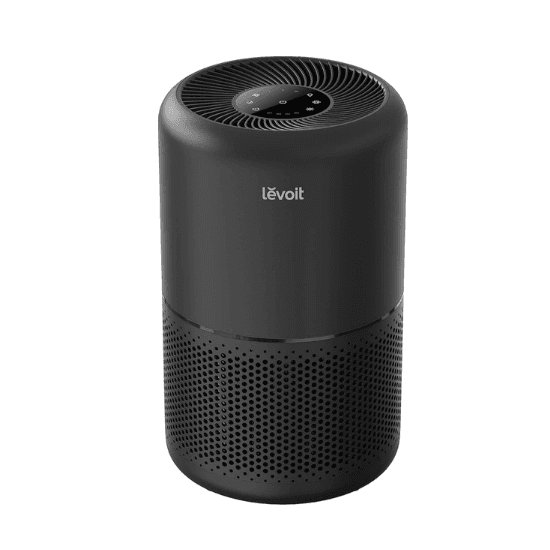
The Core 300-P uses a compact cylindrical body with a 360-degree intake around its lower section and a clean-air outlet on top. Its 8.7-inch footprint is easy to place beside a bed or desk, although it needs open space around the intake and should not be pushed tightly against a wall or curtain. At roughly 7.9 pounds, it is portable between rooms but has no dedicated carrying handle.
The top panel offers three fan speeds, sleep mode, a two-, four-, six-, or eight-hour timer, display control, filter-life indicator, and control lock. There is no app, automatic mode, or particle sensor. That makes the purifier less flexible than a smart model, but also easier for anyone who wants predictable manual controls without account setup or connectivity.
Room size: use CADR, not the biggest coverage number
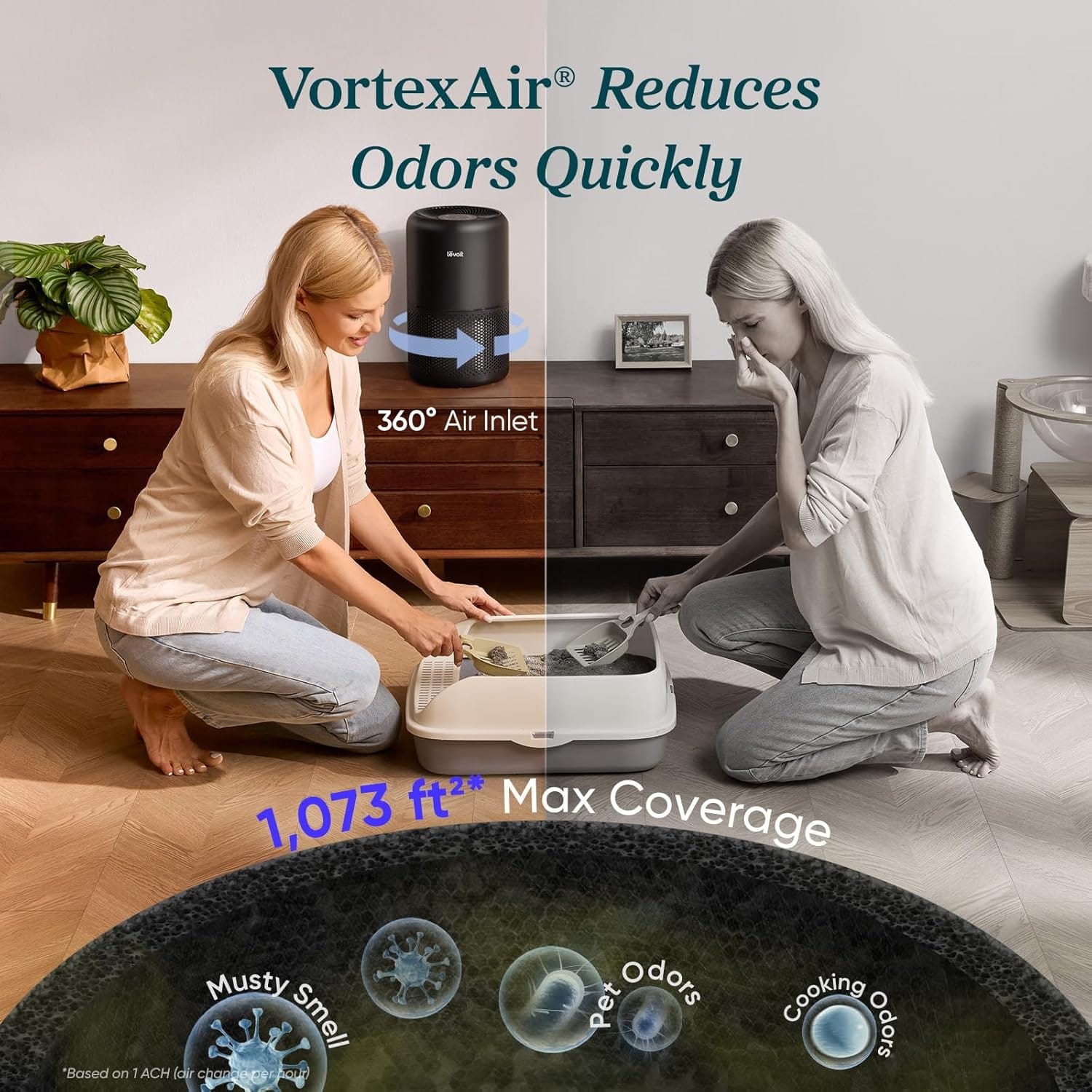
Levoit lists coverage up to about 1,066 square feet, but that figure represents only one air change per hour. For meaningful continuous particle control, the more useful specification is 222 square feet at 4.8 air changes per hour. That makes the Core 300-P best suited to a small or medium bedroom rather than a whole floor or large open-plan space.
Its AHAM-verified ratings are 143 CFM for smoke, 153 CFM for dust, and 167 CFM for pollen. The EPA recommends choosing a smoke CADR at least two-thirds of the room’s area in square feet. On that basis, 143 CFM corresponds to roughly 214 square feet for smoke—a close match to the 222-square-foot high-air-change rating.
Filtration and the HEPA-label question
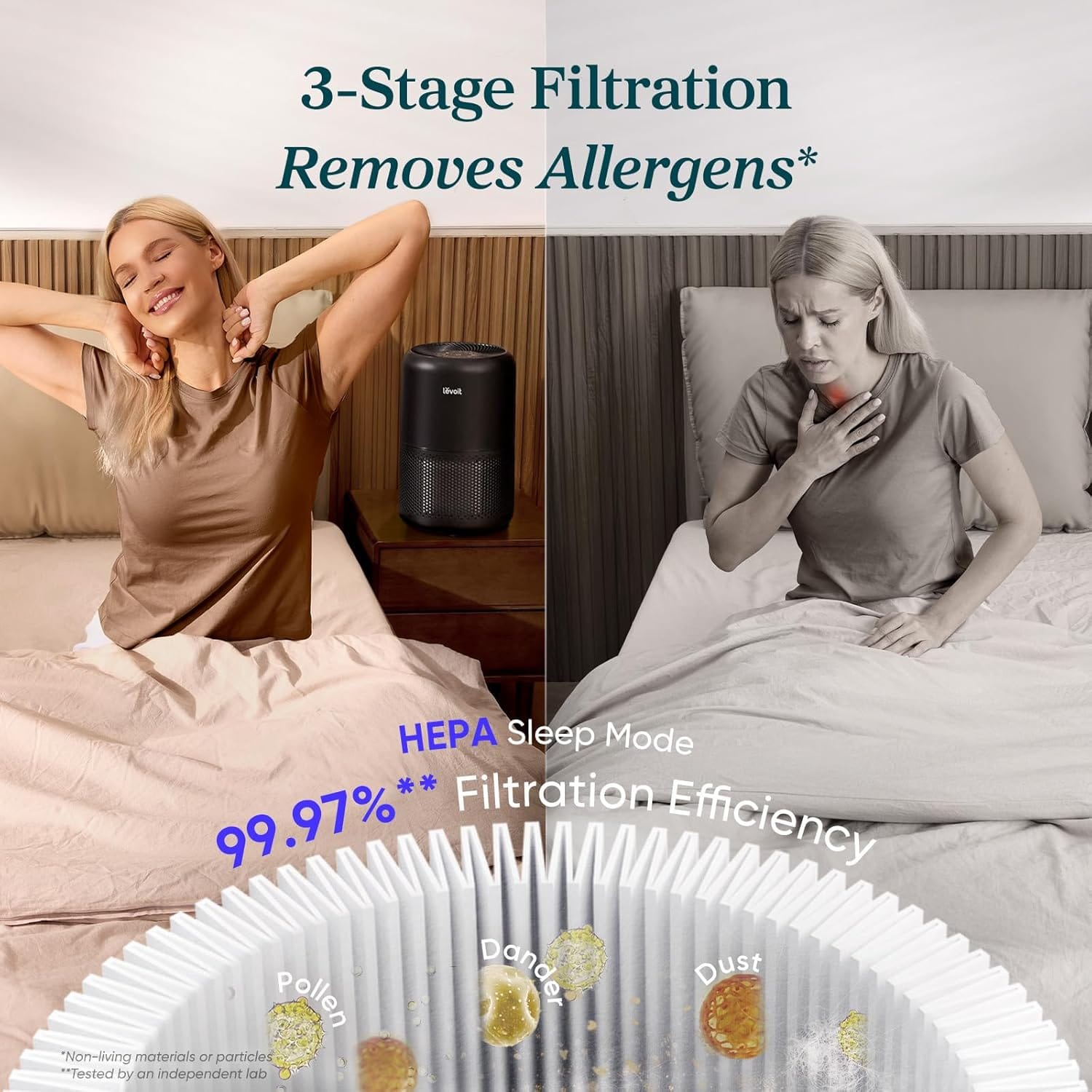
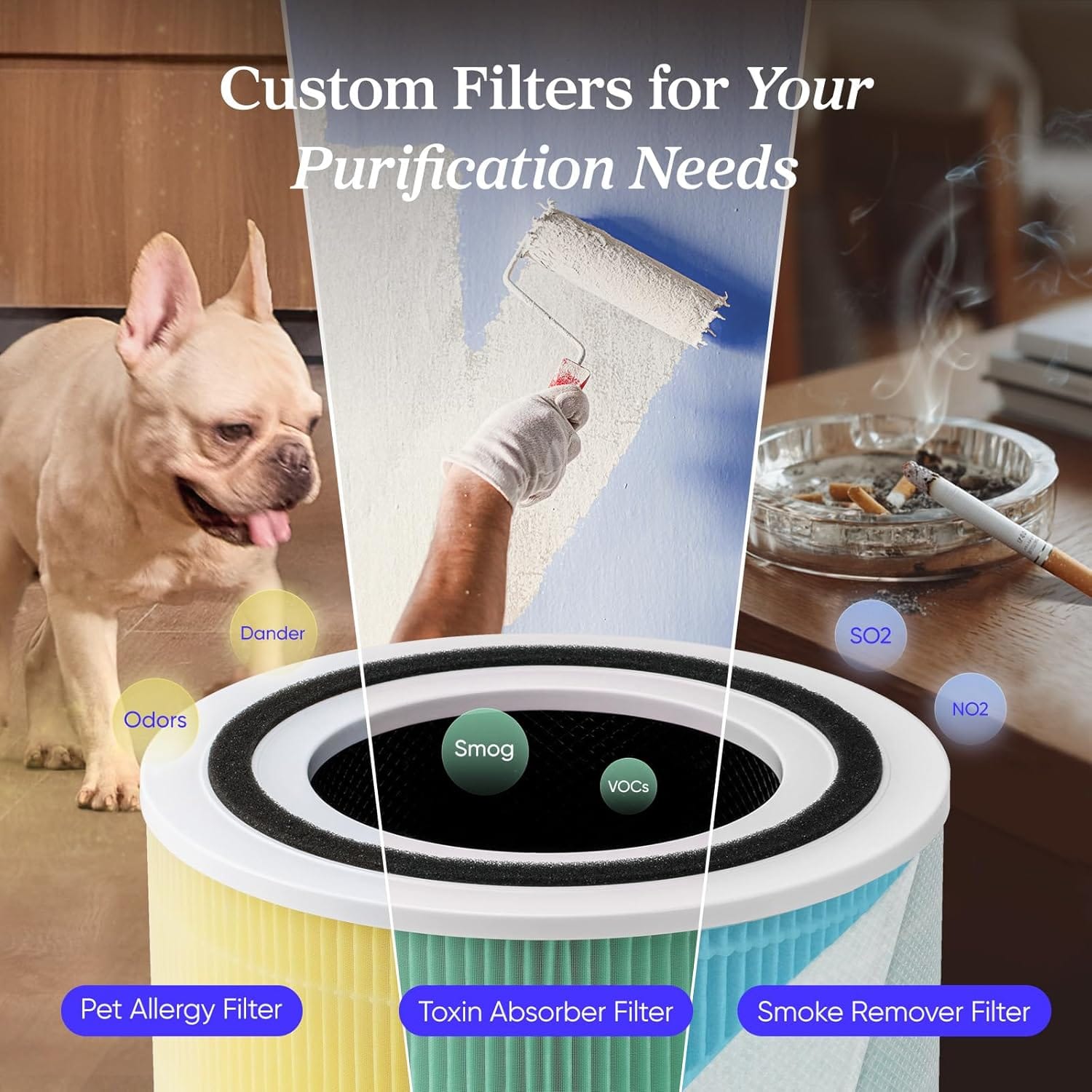
The Core 300-P uses a three-stage cylindrical filter: an outer pre-filter layer for larger debris, a fine-particle filter, and activated carbon for some odors and gases. Levoit previously marketed this model with “True HEPA” language but no longer uses that description in its current U.S. marketing after an advertising challenge. That change concerns certification and marketing terminology; it does not erase the independently measured CADR.
For buyers, the clearest performance evidence is the verified clean-air delivery rate and credible third-party particle testing. It is safer to describe the unit as a high-efficiency particle purifier than to imply a certification Levoit no longer claims. The carbon layer can reduce some everyday odors, but its limited mass should not be confused with a deep carbon bed designed for heavy chemical or gas removal.
Noise and bedroom performance
Levoit specifies approximately 24 dB in sleep mode and up to 54.5 dB at the highest setting. Sleep mode is quiet enough for many bedrooms, but it also moves less air. A practical approach is to run the purifier at medium or high speed before sleep, then reduce the fan if the sound is distracting. Maximum speed is useful when pollution is elevated, but it will be audible in a quiet room.
The display can be switched off, which helps in dark bedrooms. There is no automatic mode, so the purifier will not increase its speed when particle levels rise. Consistent performance depends on selecting a useful speed and running it for long enough rather than leaving it on the quietest setting regardless of room conditions.
Independent evidence: what an air purifier can and cannot do
What the product is designed to do: move room air through a particle filter and carbon layer, reducing the concentration of airborne particles that pass through the unit. Verified CADR shows how quickly it delivers filtered air under standardized conditions.
What authoritative guidance says: the EPA considers portable filtration a useful supplement to source control and ventilation. Research has found small, inconsistent improvements in some cardiovascular, respiratory, allergy, or asthma outcomes. An air purifier does not remove every pollutant, cure allergies or asthma, prevent all infections, or correct the source of mold.
The Core 300-P can capture airborne pet dander and some hair or lint that reaches the intake, but it does not remove pet allergens already settled on carpets, bedding, and furniture. Cleaning, ventilation when outdoor air is suitable, humidity control, and addressing pollutant sources remain important.
Ozone and safety
The Core 300-P is a mechanical filtration device without an ionizer control. It appears on California’s certified air-cleaning-device listings, which require applicable devices to meet electrical-safety requirements and electronic models to remain below the state’s ozone-emission limit. This does not mean the purifier makes indoor air risk-free; it means it is not designed to intentionally generate ozone as its cleaning method.
Place the purifier on a stable, dry surface with the intake and outlet unobstructed. Keep it away from water, heat sources, curtains, and areas where children can insert objects. Unplug it before cleaning or changing the filter. Do not add essential oils, fragrances, powders, or liquids to the filter or air outlet, and follow the manual’s electrical and clearance instructions.
Filter replacement and operating cost
Levoit recommends replacing the filter approximately every six to eight months, although heavy smoke, pet dander, dust, or long daily runtimes may shorten that interval. The indicator estimates use; it does not directly measure how dirty the filter is. Check the filter periodically and replace it when airflow falls, odors persist, or the filter is heavily loaded.
Do not wash the main filter. Vacuuming the exterior pre-filter surface can remove loose debris, but washing or aggressively cleaning the media may damage it. Genuine filters cost more than generic alternatives, so include at least one or two replacements per year in the buying decision. Running at maximum speed also uses more electricity than sleep mode.
Levoit Core 300-P vs. Core 300S-P
The Core 300-P is the simpler choice: manual controls, no app, no air-quality sensor, and no automatic fan response. The Core 300S-P adds Wi-Fi, app scheduling, voice-assistant support, sensor readings, and automatic mode. Air-cleaning capacity is in a similar small-room class, so the upgrade decision is mainly about convenience and monitoring rather than a dramatic change in purification.
Alternatives
- Levoit Core 300S-P: better for buyers who want app control, scheduling, and automatic adjustment.
- Winix 5500-2: larger and less compact, but often preferred for higher airflow and more substantial odor control.
- Coway Airmega AP-1512HH: a proven medium-room option with an air-quality sensor and automatic mode.
- DIY box-fan filter: a lower-cost emergency particle-filtration option when commercial purifiers are unavailable, provided current EPA safety guidance is followed.
Bottom line
The Levoit Core 300-P remains a sensible small-room purifier because its CADR is independently verified, its controls are easy to use, and its compact form fits bedrooms and offices. Buy it for particle filtration—not as a cure for allergies, a solution for mold, or a heavy-duty gas filter. Its value is strongest when the room is near 220 square feet or smaller and the recurring filter cost fits your budget.
Frequently asked questions
Is the Levoit Core 300-P a true HEPA air purifier?
Levoit previously used “True HEPA” language for this model but no longer makes that claim in current U.S. marketing after an advertising challenge. The safest assessment is to rely on its independently verified CADR and particle-removal testing rather than an old label. Its measured particle-cleaning performance remains competitive for a small room.
What room size is the Levoit Core 300-P suitable for?
The most useful rating is about 222 square feet at 4.8 air changes per hour. The larger 1,066-square-foot figure represents only one air change per hour and can overstate practical performance. For smoke and routine particle control, treat the Core 300-P primarily as a bedroom or small-office purifier.
Does the Levoit Core 300-P remove pet hair and dander?
It can capture airborne dander, dust, and some loose pet hair that reaches the intake. It cannot remove allergens already settled on furniture, bedding, or floors. Regular vacuuming, washing pet bedding, and cleaning surfaces remain necessary. The purifier should supplement household cleaning rather than replace it.
Does the Levoit Core 300-P remove odors and VOCs?
Its activated-carbon layer may reduce some light household or pet odors, but the small amount of carbon has limited capacity for persistent gases and volatile organic compounds. Source removal and ventilation are more important. For significant chemical odors, choose a purifier with a much deeper, heavier sorbent filter.
How often should the Levoit Core 300-P filter be replaced?
Levoit generally recommends replacement every six to eight months. Actual life depends on fan speed, daily runtime, pets, smoke, dust, and local air quality. Inspect the filter periodically instead of relying only on the indicator. Reduced airflow, persistent odor, or visibly heavy loading can justify earlier replacement.
Is the Levoit Core 300-P quiet enough for sleeping?
Sleep mode is rated at approximately 24 dB and the display can be turned off, making it suitable for many bedrooms. Airflow is lower at that setting. Running medium or high speed before bedtime and switching to sleep mode overnight can balance particle removal with noise sensitivity.
Does the Levoit Core 300-P produce ozone?
The Core 300-P uses mechanical filtration and does not include an ionizer control. It is listed under California’s air-cleaner certification program, which sets electrical-safety and applicable ozone-emission requirements. It should not be confused with devices that intentionally generate ozone, which the EPA advises consumers to avoid.
Can the Levoit Core 300-P help with allergies or asthma?
By reducing airborne particles, it may help some people reduce exposure to pollen, dander, or dust. Studies of portable filtration show possible but generally modest and inconsistent symptom improvements. It does not treat asthma or allergies, replace medication, or remove settled allergens. Discuss persistent symptoms with a qualified clinician.
Reliable references
- Levoit Core 300-P: current product information
- Levoit: Core 300-P user manual and safety instructions
- AHAM Verifide: certified room-air-cleaner directory
- U.S. EPA: Guide to Air Cleaners in the Home
- U.S. EPA: What is a HEPA filter?
- California Air Resources Board: certified air-cleaning devices
Relevant PVL reads
- Environmental Wellness Guide
- Dyson V15 Detect Origin review
- Branch Basics Cleaning Essentials Kit review
As an Amazon Associate, Purely Vital Living may earn from qualifying purchases.

Reviews
There are no reviews yet.