
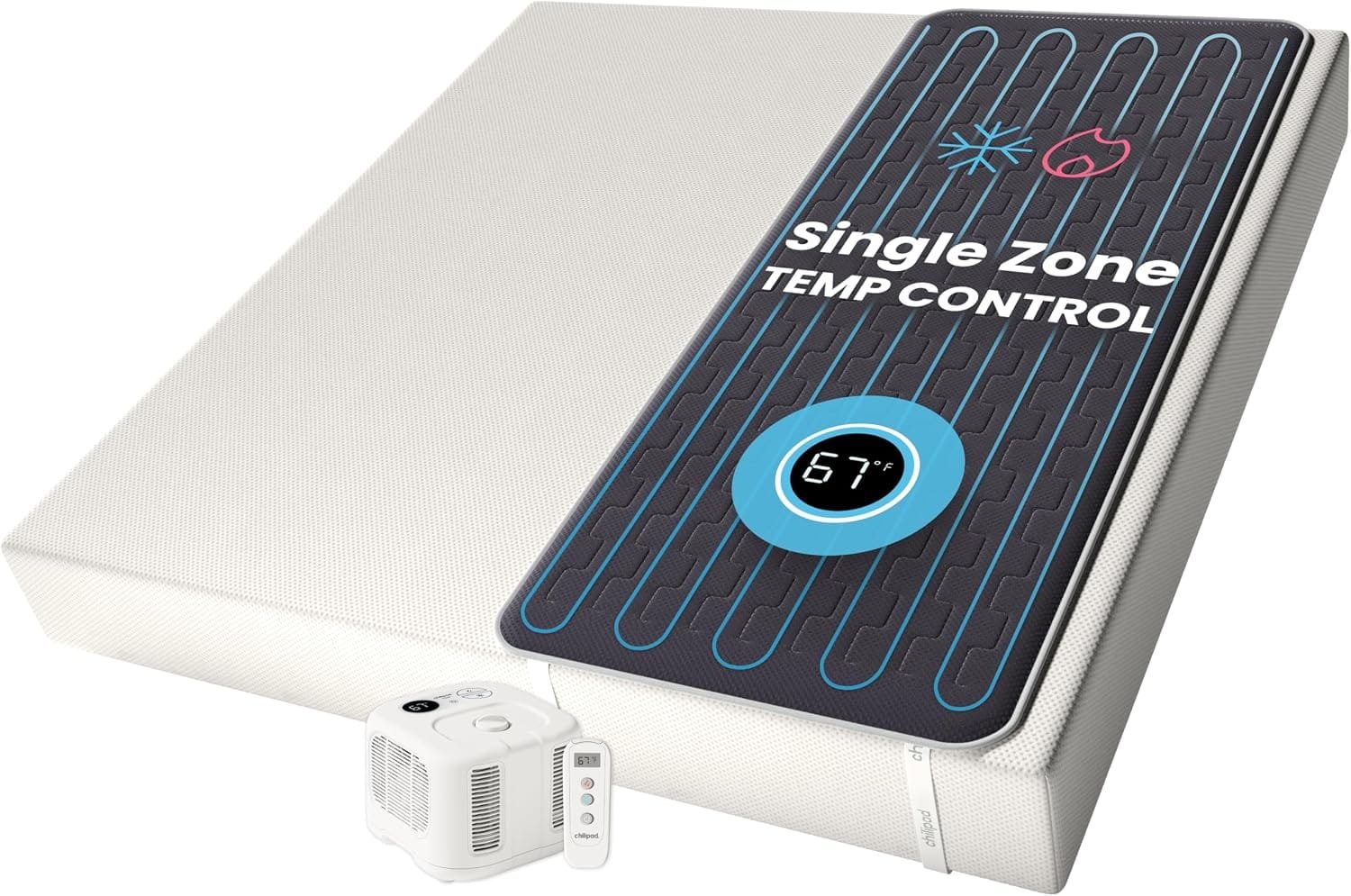
Quick verdict: The Chilipad Cube CP500 is a straightforward water-based mattress temperature system for one sleeper who wants direct cooling or warming without replacing a mattress. It can feel more targeted than a fan because water circulates through the pad beneath you, but it requires regular filling and cleaning, produces pump noise, and lacks the app controls and automatic schedules found on newer systems.
PVL Rating: 4.1/5
Editorial score by Purely Vital Living. We assessed this chili pad across temperature control, comfort, controls, setup, maintenance, noise, durability, and value.
- Cooling performance: 4.4/5
- Heating performance: 4.5/5
- Sleep-surface comfort: 4.1/5
- Controls: 3.7/5
- Setup and maintenance: 3.6/5
- Value: 3.9/5
In this chili pad review, we examine the Sleepme Chilipad Cube Bed Cooling System in the ME half-queen CP500 configuration. We focus on realistic temperature performance, comfort, maintenance, noise, ownership costs, and how this legacy system compares with newer water- and air-based alternatives. This is an evidence-aware editorial assessment based on published specifications, support documentation, research, and practical ownership factors; we do not claim personal hands-on testing.
What Is the Chilipad Cube?
The Chilipad Cube is a compact control unit connected to a thin mattress pad by water tubes. The Cube heats or cools water, then circulates it through channels in the pad to change the temperature at the sleep surface. Unlike a passive cooling-gel topper, its temperature control remains active while the unit runs.
The supplied Amazon model is the CP500 ME system for one side of a queen or full bed. Its pad measures approximately 30 by 80 inches, so it is intended to give one sleeper an individually controlled zone while leaving the other side largely unchanged. A remote adjusts temperature without requiring an app or internet connection.
Key specifications
| Feature | Chilipad Cube CP500 details |
|---|---|
| System type | Water-circulating cooling and heating mattress pad |
| Listed temperature range | 60–115°F |
| Coverage | ME half-queen/full zone, approximately 30 x 80 inches |
| Controls | Cube buttons and wireless remote |
| Connectivity | No app, Wi-Fi, sleep tracking, or automatic schedule |
| Maintenance | Water refills, circulation-system cleaning, and pad care |
| Current supplied price | $699 |
How Does a Chili Pad Work?
A pump inside the Cube moves temperature-controlled water through narrow channels distributed across the mattress pad. Heat transfers between the sleeper, pad, water, and surrounding room. That conductive design differs from BedJet, which moves room air under the covers, and from passive toppers that depend only on breathable fabrics or cooling finishes.
The number shown on the control unit is a water-temperature setting, not a guarantee that your skin, mattress, or bedroom will reach the same temperature. Room conditions, bedding thickness, mattress insulation, body heat, hose placement, and water flow all influence the sensation at the sleep surface.
Cooling Performance
The Cube’s strongest advantage is continuous, close-contact cooling. Because the water channels sit directly beneath the sleeper, the system can remove heat from the mattress surface without blowing air across the body. Hot sleepers who dislike a draft may prefer this sensation to an air-based bed fan.
The listed minimum is 60°F, but reaching or sustaining that setting depends on ambient temperature and thermal load. A warm bedroom, heavy duvet, thick mattress protector, restricted airflow around the Cube, or a person who produces substantial body heat can reduce practical cooling. The system cools the bed zone; it does not air-condition the bedroom.
Research supports the broader idea that thermal conditions affect sleep, but it does not prove that every Chilipad owner will sleep longer or reach more deep sleep. Studies of temperature-controlled sleep surfaces have reported changes in thermal comfort and some sleep measures, yet device designs, protocols, and study populations differ. The most defensible benefit is improved control over how warm or cool the bed feels.
Heating Performance
The Chilipad Cube can also warm the pad to a listed maximum of 115°F. Preheating a cold bed may be especially appealing during winter because the warmth is delivered at the mattress surface rather than heating the entire room. The remote lets you reduce the setting after getting into bed.
High settings may feel excessive for continuous overnight use, and more heat is not automatically better for sleep. A comfortable setting should feel neutral rather than hot. People with reduced temperature sensation, impaired circulation, neuropathy, or difficulty moving should ask a clinician whether a heated sleep surface is appropriate and use conservative settings.
Comfort and Mattress Feel
The pad is thinner than most foam toppers, so it is designed to change temperature rather than add cushioning. Many users may notice the fabric and channel structure less after fitting a sheet over it, but sensitivity varies. Those who strongly prefer a perfectly smooth mattress surface may detect the tubes, seams, or connection area.
Because the ME pad covers only half of the bed, the edge of the pad may be noticeable near the center line. A secure fitted sheet and careful hose routing help prevent bunching. The system should not substantially change mattress firmness, but it is more physically present than BedJet’s airflow-only design.
Controls and Everyday Use
The Cube favors simplicity: choose a temperature using the unit or included remote and let the water circulate. There is no required account, subscription, Wi-Fi setup, firmware update, or phone beside the bed. That can be a benefit for buyers who want uncomplicated controls and fewer connected devices.
The tradeoff is limited automation. The CP500 does not provide app-based schedules, automatic temperature changes, sleep tracking, or biometric adjustments. If you want the bed warmer at bedtime and cooler later, you must change the setting manually. Newer Chilipad systems offer broader control features but cost more and are not identical to this legacy Cube.
Noise and Bedroom Placement
The Cube contains a pump, fan, and water circuit, so it is not silent. Expect a steady mechanical hum and occasional water-flow sounds. Perceived noise depends on fan speed, room acoustics, floor type, distance from the pillow, and whether the unit contacts furniture that transmits vibration.
Place the Cube on a firm, level surface with open space around its vents. Do not bury it beneath loose bedding or push it tightly against a wall. Routing the hose without sharp bends supports water flow and reduces strain on the connectors. A vibration-damping mat may help on hard flooring, provided it does not obstruct ventilation.
Setup and Maintenance
Installation involves placing the pad on the mattress, routing and connecting its hose, positioning the Cube, filling the reservoir as instructed, and running the system until water circulates without persistent air pockets. Protect the hose from kinks and confirm that all connections are secure before covering the pad with bedding.
Water-based systems require more care than passive toppers or air-only fans. Owners should monitor the reservoir, use the water type specified by Sleepme, clean the circulation system on the recommended schedule, and inspect connections for moisture. Sleepme’s current support pages provide model-specific cleaning instructions, including different pad-washing directions for attached-tail and quick-connect versions.
The pad is machine washable when the correct instructions for its connector type are followed. Never assume that guidance for a current Dock Pro or Chilipad 2.0 applies to an older Cube. Retain the manual, use official support documentation, and fully drain and dry the system before long-term storage.
Pros and Cons
Pros
- Active water-based cooling and heating
- Direct temperature control without replacing the mattress
- No cooling draft across the body
- Simple remote with no app or subscription required
- Half-bed format suits couples with different preferences
- Can pre-warm cold bedding quickly
Cons
- High $699 price for a legacy model
- Requires water refills and scheduled cleaning
- Pump and fan noise may bother light sleepers
- No app, schedules, or automatic adjustment
- Pad channels or center edge may be noticeable
- Cooling performance depends on room conditions
Chilipad Cube vs. Alternatives
| System | Climate method | Best for | Main compromise |
|---|---|---|---|
| Chilipad Cube CP500 | Water-circulating half-bed pad | Direct cooling or heating with simple controls | Maintenance and limited automation |
| BedJet 3 | Airflow under bedding | Sweat drying, fast heating, and no pad beneath the body | Cooling depends on room air and creates airflow |
| HydroSnooze | Water-circulating mattress pad | Buyers comparing lower-cost water systems | Brand support and long-term track record require scrutiny |
| SLEEP ZONE topper | Passive quilted pad | Affordable softness and moisture management | No powered temperature control |
Chilipad’s water circulation can feel more direct and stable than passive cooling fabric. BedJet responds quickly and requires less water-system maintenance, but it circulates ambient air and may create a noticeable draft. The better choice depends on whether you prefer conductive contact cooling or moving air.
Who Should Consider the Chilipad Cube?
- Hot sleepers who want active cooling directly beneath the body
- One partner who sleeps warmer or colder than the other
- People who dislike fan air blowing under the covers
- Buyers who prefer a physical remote over an app
- Cold sleepers who want to pre-warm one side of the bed
- Owners willing to follow a regular water-maintenance routine
Who Should Avoid It?
- Buyers expecting air-conditioning-level cooling
- People who want silent operation or dislike mechanical equipment near the bed
- Anyone unwilling to refill, clean, inspect, and occasionally drain a water system
- Shoppers who want app scheduling, sleep tracking, or automatic adjustment
- People sensitive to texture or tubing beneath a fitted sheet
- Couples needing two independently controlled zones from this single ME package
Safety and Practical Limitations
Use the system only with intact hoses, connectors, power cords, and pads. Stop operation and disconnect power if you notice leaking, damaged wiring, unusual odors, repeated errors, or abnormal noise. Keep the Cube ventilated and follow the manual’s electrical, filling, cleaning, and storage instructions.
A temperature-controlled mattress pad is a comfort device, not a treatment for insomnia, hot flashes, infection, thyroid disease, medication effects, or other causes of night sweating. Seek medical advice for persistent or unexplained symptoms. Users with impaired sensation, mobility limitations, vascular conditions, or heat sensitivity should obtain individualized guidance before using high or low settings.
Is the Chili Pad Worth $699?
At the supplied price, value is the Cube’s hardest category. The system provides genuine active heating and cooling, but $699 is substantial for a legacy single-zone product without app controls or scheduling. Buyers should compare the exact warranty, return terms, replacement-pad availability, and seller support before ordering.
The purchase makes the most sense when nighttime temperature discomfort is frequent, passive bedding changes have not helped enough, and a one-person water-cooled zone matches your needs. It is less compelling for occasional warm nights, shoppers who resist maintenance, or buyers who can obtain a newer supported system for a similar total cost.
Final Verdict
The Chilipad Cube CP500 remains a practical concept: circulate temperature-controlled water beneath one sleeper and leave the mattress itself in place. It offers stronger, more sustained surface-temperature control than a passive topper and avoids BedJet’s draft. Its weaknesses are equally clear—maintenance, audible hardware, limited automation, a noticeable pad, and a premium price for older technology.
We recommend it most cautiously to dedicated hot or cold sleepers who want direct half-bed temperature control, understand the maintenance commitment, and confirm current seller support before purchasing.
Frequently Asked Questions
Does a chili pad actually cool the bed?
Yes. A chili pad actively circulates temperature-controlled water through channels beneath the sleeper, allowing it to remove heat from the mattress surface more consistently than passive cooling fabric. It does not cool the entire bedroom, and practical performance still depends on room temperature, bedding, body heat, water flow, and system placement.
What temperature does the Chilipad Cube reach?
The supplied CP500 listing specifies a temperature range of 60–115°F. That figure describes the system’s water-temperature setting rather than a guaranteed skin or mattress temperature. Room conditions, bedding insulation, body heat, reservoir level, airflow around the Cube, and circulation efficiency influence how cool or warm the sleep surface actually feels.
Is the Chilipad Cube the same as Chilipad 2.0?
No. The Cube CP500 is an older Chilipad system with simpler controls and no current-generation app or scheduling features. Chilipad 2.0 uses newer hardware and a broader advertised specification set. Buyers should not assume that warranties, accessories, manuals, temperature ranges, replacement parts, or maintenance instructions are interchangeable between the two generations.
Can couples use one Chilipad Cube?
Yes, but this ME half-queen package controls only one approximately 30-by-80-inch side of the bed. That works when one partner wants active cooling or heating while the other prefers the regular mattress. Two independently controlled water zones require a compatible dual-zone configuration or separate control systems, depending on the selected product generation.
Is the Chilipad Cube noisy?
The Cube is audible because it contains a water pump and ventilation fan. Most users should expect a steady mechanical hum plus occasional water-flow sounds rather than silent operation. Perceived noise varies with distance, fan demand, room acoustics, floor type, trapped air, and whether the unit touches furniture that can transmit vibration.
Does the chili pad need regular maintenance?
Yes. Water-circulating sleep systems require reservoir monitoring, periodic cleaning, unobstructed ventilation, and inspection of hoses and connectors. Use the water type and cleaning method specified for the Cube rather than borrowing instructions from a newer model. Proper maintenance supports water flow, thermal performance, hygiene, and the service life of the pump and pad.
Can the Chilipad mattress pad be washed?
Yes, Sleepme states that the Cool Mesh Pad is machine washable, but instructions differ between pads with an attached tail and pads using a quick-connect fitting. Identify your connector type before washing, follow the current official procedure, and ensure the pad is completely dry before reconnecting it to the Cube or restoring power.
Can a chili pad help with night sweats?
A chili pad may improve comfort during night-sweat episodes by cooling the sleep surface and reducing heat trapped around the body. Evidence on temperature-controlled mattress covers is promising but does not prove that this specific Cube treats an underlying condition. Persistent, severe, or unexplained night sweating should be discussed with a qualified healthcare professional.
Does the Chilipad Cube change mattress firmness?
The thin water pad is designed primarily for temperature control, so it should not transform mattress firmness like a thick foam topper. Nevertheless, sensitive sleepers may notice the fabric, seams, water channels, hose connection, or center edge of a half-bed pad. A secure fitted sheet can reduce shifting but cannot eliminate every texture difference.
Does the Chilipad Cube require Wi-Fi or a subscription?
No. The CP500 Cube uses onboard controls and a wireless remote, so normal temperature adjustment does not require Wi-Fi, an app, an account, or a paid subscription. The tradeoff is limited automation: this legacy model does not provide app schedules, biometric adjustments, remote internet control, or integrated sleep tracking found on some newer systems.
Related Reading
- Best sleeping temperature and bed microclimate guide
- PVL Sleep Resources
- Sleep guidance and product reviews

Reviews
There are no reviews yet.