


Quick Verdict
This lightweight cooling comforter may be a practical option for hot sleepers who mainly want less insulation, but its “cooling” claims should be interpreted as passive comfort rather than active temperature control. PVL did not identify product-specific clinical evidence showing that the finished comforter improves sleep quality, deep sleep, REM sleep, recovery, or the medical causes of night sweats.
PVL Rating: 3.8/5
- Lightweight comfort: 4.2/5
- Hot-sleeper rationale: 4.0/5
- Product transparency: 3.3/5
- Sleep evidence: 3.0/5
- Value: 3.8/5
Best for: Hot sleepers who want a lightweight passive comforter and are comfortable verifying the current material and care specifications before buying.
Not ideal for: Anyone seeking precise temperature control, a clearly documented premium textile system, or treatment for persistent night sweats or sleep problems.
What Is This Cooling Comforter?
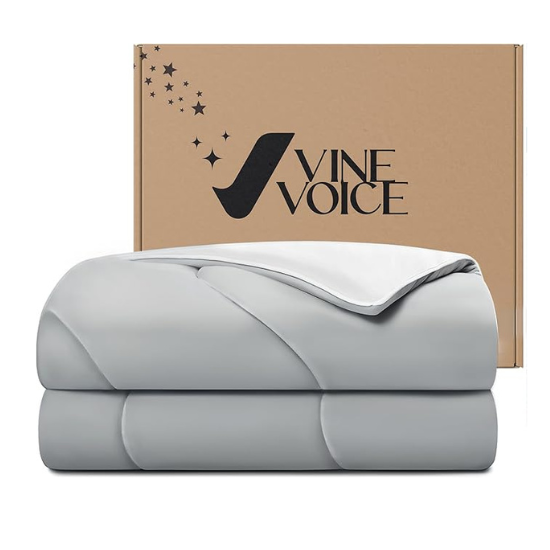
The product is marketed as a lightweight, double-sided cooling comforter for hot sleepers. The existing PVL listing identifies a queen size of approximately 90 × 90 inches and a silver-gray color, but it does not provide enough reliable detail to establish the exact textile composition or a clinically validated cooling mechanism.
That matters because phrases such as “cooling fabric technology” can refer to very different materials, finishes, yarn structures, or simply lightweight construction. Buyers should verify the current manufacturer or retailer listing for fiber content, fill, dimensions, care instructions, certifications, and warranty before purchase.
Does a Cooling Comforter Actually Lower Temperature?
Not in the way an active bed-cooling system does. A passive comforter does not refrigerate the bed, circulate temperature-controlled water, or blow conditioned air. Its practical role is to retain less unwanted heat or manage moisture more comfortably than warmer bedding.
How cool it feels depends on room temperature, humidity, mattress, protector, sheets, sleepwear, body heat, airflow, and the amount of insulation in the comforter itself.
What Does “Double-Sided Cooling Fabric” Mean?
The phrase is a product-description claim, not a standardized clinical category. Without clear current textile specifications and comparative testing, PVL would not translate it into a precise claim about degrees of cooling, heat transfer, or sleep improvement.
The useful consumer question is simpler: does the fabric and fill feel less warm or clammy than your existing comforter under your normal bedroom conditions?
Can a Cooler Bed Help You Sleep?
Thermal conditions can affect sleep, but general thermoregulation research does not validate this specific comforter. Sleep interacts with changes in core and skin temperature, and excessive warmth can interfere with comfort and sleep under some conditions.
If heavy bedding is repeatedly waking you or making you uncomfortable, reducing insulation is reasonable. That does not prove this product increases total sleep time, sleep efficiency, deep sleep, or REM sleep.
Does This Comforter Improve Deep Sleep or Recovery?
PVL did not identify finished-product evidence showing increased deep sleep, REM sleep, or physiological recovery. “Recovery-focused” is marketing language unless a clearly defined recovery outcome has been measured in appropriate product-specific research.
A sleeper who wakes less often because the bed feels more comfortable may report a better night. Subjective comfort is valuable, but it should not be converted into an unsupported claim about sleep architecture.
Is It Good for Night Sweats?
A lightweight comforter may reduce heat trapping and feel less uncomfortable during occasional overheating. It does not treat the underlying cause of true night sweats.
Persistent, drenching, new, or unexplained night sweats—especially when accompanied by fever, unexplained weight loss, pain, medication changes, or other symptoms—deserve appropriate medical evaluation rather than being managed only with cooling bedding.
Is This Better Than a Buffy or Lyocell Comforter?
There is not enough product-specific comparative evidence to say that it is better. A more transparent product may provide clearer information about fiber composition, fill, manufacturing, certifications, warranty, and care.
This comforter’s potential appeal is straightforward lightweight comfort. Buyers who care strongly about a particular material should verify exactly what they are purchasing rather than relying on the word “cooling.”
How Should Hot Sleepers Evaluate Bedding?
Look at the whole bed rather than one product. A heat-retaining foam mattress, waterproof protector, dense sheets, warm sleepwear, or poorly ventilated bedroom can overwhelm the effect of a lightweight comforter.
Start by identifying the source of discomfort. If removing a heavy blanket already makes a large difference, a lighter comforter may be a sensible upgrade without needing claims about advanced cooling technology.
What This Comforter Has Not Been Shown to Do
- Treat insomnia
- Increase deep sleep or REM sleep
- Improve physiological recovery as a validated outcome
- Actively lower room or body temperature
- Treat the underlying causes of night sweats
- Outperform specific competing cooling comforters in clinical sleep outcomes
Pros and Cons
Pros
- Lightweight concept is sensible for sleepers who dislike heavy insulation
- Passive design requires no electricity, pump, tubing, or app
- Potentially useful in warm bedrooms or climates
- Simple bedding change compared with an active cooling system
Cons
- Current PVL copy does not establish detailed textile composition
- “Cooling fabric” does not quantify real-world temperature reduction
- No finished-product sleep-outcome evidence identified
- Not a treatment for night sweats
- Harder to assess value without stronger product/material transparency
Who Should Consider It?
Consider it if your current comforter simply feels too heavy or insulating and you want a lighter passive alternative. Verify the current materials, return policy, care requirements, and dimensions before ordering.
Who Should Choose Something Else?
Choose a better-documented bedding product if fiber composition and certifications matter to you. If you need precise temperature control, an active bed-cooling system is a different category. Persistent unexplained overheating or night sweats should be medically evaluated when appropriate.
Frequently Asked Questions
Does this cooling comforter actually keep you cool?
It may feel cooler than a heavier comforter, but it does not actively lower your temperature. Lightweight passive bedding can reduce insulation and may handle heat or moisture more comfortably. Actual results depend on room temperature, humidity, mattress, protector, sheets, sleepwear, body heat, airflow, and the comforter’s verified materials and construction.
What is the cooling fabric made from?
The existing PVL product copy does not provide enough reliable detail to confirm the exact textile composition. “Cooling fabric” is a broad marketing term that can describe different fibers, finishes, or constructions. Check the current manufacturer or retailer label for fiber content, fill material, care instructions, certifications, and other specifications before purchasing.
Does a cooling comforter improve sleep quality?
There is no good product-specific evidence that this comforter directly improves sleep quality. Excessive warmth can interfere with sleep comfort, so using lighter bedding may remove one source of disruption for a hot sleeper. That rationale does not prove improvements in insomnia, total sleep time, sleep efficiency, deep sleep, REM sleep, or daytime functioning.
Can this comforter increase deep sleep or recovery?
No product-specific evidence shows that this comforter increases deep sleep, REM sleep, or physiological recovery. A less heat-trapping bed may feel more comfortable and could reduce temperature-related disruption for some sleepers. Subjective comfort should not be interpreted as proof that a particular sleep stage or a defined recovery process has measurably improved.
Is this cooling comforter good for night sweats?
It may feel more comfortable during occasional overheating, but it does not treat the cause of night sweats. Lighter bedding can reduce heat trapping for some sleepers. Persistent, drenching, new, or unexplained night sweats—especially when accompanied by other symptoms—should be appropriately evaluated rather than managed only by purchasing a cooling comforter.
Is a cooling comforter better than an active bed-cooling system?
Neither is universally better because they solve different levels of temperature discomfort. A passive comforter is simpler, quieter, and requires no power, while an active system can provide more direct temperature control. If lighter bedding already solves your overheating problem, paying for pumps, water circulation, or powered airflow may be unnecessary.
Final Verdict
PVL Rating: 3.8/5. This comforter’s lightweight concept is reasonable for hot sleepers, but the current product information does not justify strong claims about proprietary cooling performance, sleep optimization, or recovery. Treat it as passive bedding, verify the current material specifications, and buy it for comfort rather than expected changes in sleep architecture.
Reviews
There are no reviews yet.