
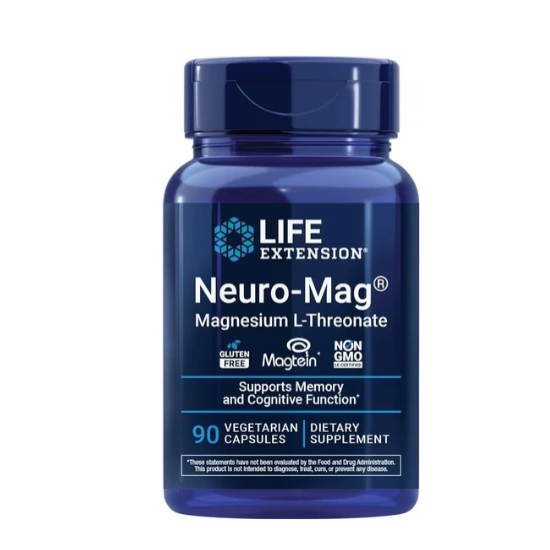
PVL editorial rating: 3.5/5 — transparent ingredient information and a vegetarian format, balanced against three capsules per serving, a higher serving cost and uncertain real-world cognitive or sleep benefits. This is an editorial buying assessment, not an Amazon customer rating or clinical effectiveness score.
Quick Answer
Life Extension Neuro-Mag is worth comparing if you specifically want Magtein magnesium L-threonate and understand its evidence limits. Three capsules provide 2,000 mg of the compound but only 144 mg of elemental magnesium. The 90-capsule bottle contains 30 servings. At the supplied $30.78 reference price, that is approximately $1.03 per serving. We would not choose it as a guaranteed solution for morning fatigue, insomnia or memory problems.
This Life Extension Neuro-Mag review covers the 90 vegetarian capsules supplied for review, ASIN B006P536E6. PVL checked manufacturer information and human research; we have not taken these capsules, independently assayed the product or tested cognitive outcomes. As an Amazon Associate, Purely Vital Living earns from qualifying purchases.
PVL Verdict: A Specific Formulation With a Price Trade-off
The buying case rests on wanting this particular magnesium ingredient, rather than on maximizing elemental magnesium per dollar. Readers comparing ordinary magnesium intake may find a lower-cost formulation more practical. Readers attracted to brain-health claims should look closely at what the trials measured before paying a premium.
| Editorial criterion | Score | Reason |
|---|---|---|
| Label clarity | 4.5/5 | Compound and elemental amounts are disclosed. |
| Formulation transparency | 4.0/5 | Named ingredient and excipient list are available; no independent PVL assay. |
| Reference value | 2.5/5 | Higher daily-serving cost than the glycinate example below. |
| Format convenience | 3.0/5 | Three capsules per serving. |
| Equal-weight average | 3.5/5 | Buying assessment, not a treatment score. |
Advantages
- Clearly identified Magtein formulation.
- Elemental amount is available for comparison.
- Vegetarian capsule format on the reviewed label.
- Ingredient has been examined in human trials.
Limitations
- Three capsules make one serving, so 90 capsules are not a 90-day supply.
- Higher cost does not establish a better individual outcome.
- Research findings do not establish treatment of dementia, insomnia or unexplained fatigue.
- Desk research cannot assess swallowing comfort, digestive tolerance or personal response.
Supplement Facts: 2,000 mg Magtein vs 144 mg Magnesium
| Product | Life Extension Neuro-Mag Magnesium L-Threonate |
|---|---|
| Reviewed bottle | 90 vegetarian capsules; 30 servings |
| Serving | 3 capsules |
| Magtein compound | 2,000 mg per serving |
| Elemental magnesium | 144 mg per serving; approximately 48 mg per capsule |
| Other ingredients listed by manufacturer | Vegetable cellulose, microcrystalline cellulose, stearic acid, vegetable stearate and silica |
| Manufacturer dietary descriptions | Vegetarian, gluten free, non-GMO |
| Product identifiers | Item 01603; ASIN B006P536E6 |
The compound includes magnesium plus the rest of the L-threonate structure. Its total mass is not interchangeable with elemental magnesium. This is why comparing a “2,000 mg” compound against a “200 mg” elemental label can be misleading. Use the mineral amount and number of servings for a fair comparison.
Check the current bottle’s seal, expiry and full ingredient panel before use. A branded ingredient or non-GMO description is not a measurement of your nutritional needs. We have not independently verified a batch certificate or laboratory-tested the capsules.
Does Neuro-Mag Work for Memory or Sleep?
What the human evidence can tell us
A randomized trial published in 2026 studied 100 adults aged 18–45 with dissatisfied sleep, using 2 g of Magtein daily for six weeks. Some cognitive measures improved relative to placebo, while another reasoning test did not. Some subjective sleep-related impairment improved, but wearable-derived sleep outcomes did not differ between groups. The conflict statement discloses Threotech funding and involvement in study design, alongside investigator commercial relationships.
These mixed results are more useful than treating “clinically studied” as a guarantee. They concern an ingredient, a defined population and a short observation period. They do not establish that every purchaser will think faster, wake refreshed or notice a memory change. A cognitive test score also does not establish prevention or treatment of a neurological disease.
A 2024 systematic review of magnesium and cognitive health found too little randomized evidence to draw firm conclusions about supplementation. It predates the newer trial, but illustrates why the overall evidence should not be reduced to one favorable result. Another trial used a multi-ingredient Magtein-based formula; its results cannot isolate magnesium L-threonate or establish the performance of this plain Neuro-Mag bottle.
How this relates to waking up tired
NCCIH describes limited and inconsistent magnesium research for insomnia. Magnesium’s role in normal nerve function is not proof that a supplement treats unrefreshing sleep. Persistent fatigue, sleepiness or changes in memory can have different causes. A supplement comparison should follow, rather than replace, appropriate assessment.
Do not use claims about brain uptake as a shortcut to assuming a clinical benefit. We did not establish that this bottle outperforms glycinate or other forms for sleep. Nor did we establish a dependable deadline for noticing an effect. Seek assessment for worsening symptoms instead of raising the amount because a promotional timeline has passed.
Directions and Who Might Consider It
The manufacturer lists three capsules daily or a healthcare practitioner’s recommendation. That is the product direction, not individualized prescribing. Its listed directions do not require a universal bedtime interval. Consider medicine spacing, tolerance and the reason for supplementation before selecting a schedule.
This product may suit someone who has specifically chosen magnesium L-threonate after reviewing the uncertainty and accepts its cost and capsule burden. It may be a less practical option for someone simply trying to improve dietary magnesium intake, seeking fewer pills, or expecting a treatment for memory loss or insomnia.
Review food intake as well. Beans, nuts, seeds, whole grains and leafy greens contribute magnesium with other nutrients. Feeling tired does not by itself diagnose a deficiency. A clinician can help assess a suspected nutritional problem or a medical reason for poor sleep.
Side Effects and Medication Checks
Supplemental magnesium can cause diarrhea, nausea or abdominal cramps. Kidney disease increases the risk of magnesium accumulating. Ask a clinician about suitability before use with kidney problems, pregnancy, breastfeeding or a medical condition under treatment. A modest elemental amount does not make interactions irrelevant.
NIH ODS lists a US adult upper limit of 350 mg daily from supplements and magnesium-containing medicines unless a clinician advises otherwise; magnesium naturally present in food is excluded. Add multivitamins, separate minerals, antacids and laxatives to your total. The upper limit is not a target amount for sleep or cognition.
Magnesium can interfere with some antibiotics and osteoporosis medicines. Ask a pharmacist about the spacing required for your specific prescription. Do not stop or reschedule prescribed treatment on your own. Keep the bottle away from children and do not use it if the seal is damaged.
Loud snoring, witnessed breathing pauses or dangerous daytime sleepiness require assessment. New, progressive memory problems also deserve clinical attention. Do not drive when dangerously sleepy. Supplement use should not delay finding the cause.
Price: About $0.34 Per Capsule and $1.03 Per Serving
Using the supplied $30.78 reference price, 90 capsules cost approximately $0.34 each. The three-capsule serving costs approximately $1.03. One bottle supplies 30 label servings. This calculation is dated November 11, 2026; it is not a live price or availability guarantee.
Confirm the size, seller and final checkout total. Review subscription terms before choosing a discount. A lower per-capsule price can hide a higher per-serving cost when several capsules are required. Amazon purchase badges and changing customer-review totals are not evidence that the supplement is appropriate for your symptoms.
Neuro-Mag vs Magnesium Glycinate
| Option | Buying consideration |
|---|---|
| Neuro-Mag | 144 mg elemental magnesium per three capsules; approximately $1.03 per serving at supplied price. |
| Nature Made glycinate | 200 mg per two capsules; approximately $0.36 per serving at the supplied $31.99/180-capsule price. |
| NOW glycinate | Compare tablet count, elemental amount and current serving cost. |
| No supplement | Consider when intake is adequate or assessment is the more appropriate next step. |
Our Nature Made review and NOW review explain those alternatives. These are purchasing comparisons, not proof that one form treats insomnia or cognitive symptoms better. Do not combine products solely to pursue several advertised benefits.
Frequently Asked Questions
Does Neuro-Mag contain 2,000 mg of magnesium?
No. The 2,000 mg figure refers to the Magtein magnesium L-threonate compound in a three-capsule serving. That serving supplies 144 mg of elemental magnesium, or approximately 48 mg per capsule. Compare the elemental amount on Supplement Facts rather than treating compound weight as the amount of magnesium you receive.
How many Neuro-Mag capsules are in one serving?
The manufacturer lists three vegetarian capsules as one serving, providing 144 mg of elemental magnesium from 2,000 mg of Magtein. A 90-capsule bottle therefore contains 30 servings. The label directions describe the product; they are not a personalized recommendation to use it daily or to increase your magnesium intake.
Does Life Extension Neuro-Mag improve memory?
Magnesium L-threonate has some encouraging short-term human research, but that does not guarantee noticeable memory improvement from this bottle. Trial populations, outcomes and formulations differ, and longer-term evidence remains limited. New or worsening memory problems need clinical assessment rather than an assumption that a supplement can correct their underlying cause.
Is Neuro-Mag good for sleep or morning tiredness?
It is not an established treatment for insomnia or unexplained morning fatigue. A recent ingredient trial reported benefits on some subjective measures but no between-group improvement in wearable-measured sleep outcomes. Persistent unrefreshing sleep deserves evaluation, especially with snoring, breathing pauses or significant daytime sleepiness, rather than relying on magnesium alone.
When should I take Neuro-Mag?
Life Extension directs users to take three capsules daily or follow a healthcare practitioner’s recommendation. Its listed directions do not establish one universal bedtime interval. Ask a pharmacist about timing alongside your medicines because magnesium can interfere with absorption. Do not assume that taking a supplement at night prevents interactions.
What are Neuro-Mag’s possible side effects?
Magnesium supplements can cause nausea, diarrhea or abdominal discomfort, and individual tolerance varies. Kidney disease increases concern about magnesium accumulation. Check suitability with a clinician if pregnant, breastfeeding, managing a health condition or taking medicines. Count other magnesium sources and seek advice about persistent symptoms instead of simply changing the timing.
Is Neuro-Mag better value than magnesium glycinate?
That depends on your purpose. At the supplied $30.78 price, Neuro-Mag costs about $1.03 per three-capsule serving, compared with about $0.36 for the supplied Nature Made glycinate example. Those are reference calculations, not live prices. A higher ingredient price does not establish better sleep, cognition or personal suitability.
Key Takeaway
Neuro-Mag is a specific magnesium L-threonate option with a clearly stated elemental amount. Buy it only with realistic expectations about the research, three-capsule serving and cost. It is not a substitute for evaluating persistent tiredness, sleep problems or memory changes.
Related Reads
Make Informed Wellness Choices
Get practical routines and research-informed product comparisons from PVL.
References and Review Method
Reviewed November 11, 2026. PVL used the supplied product identity, image and price, checked the manufacturer’s label, and assessed published research. We have not performed hands-on testing or an independent laboratory assay.


Reviews
There are no reviews yet.