
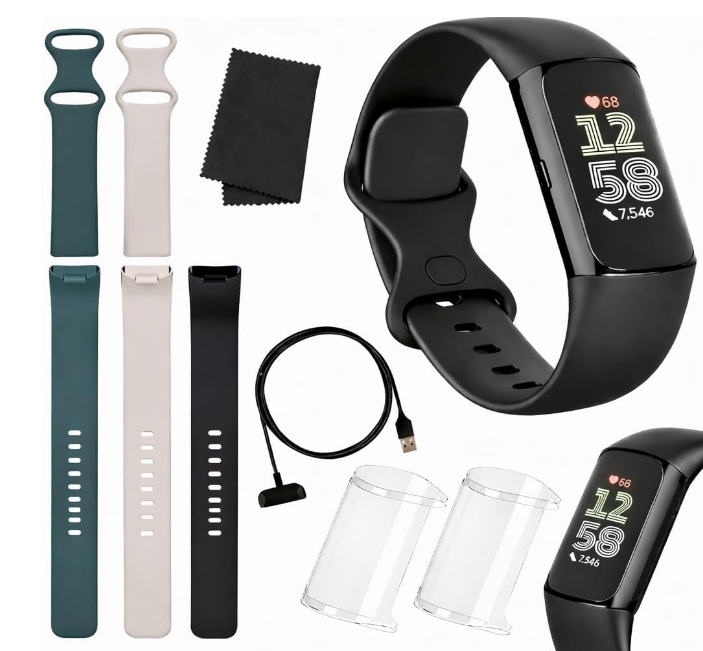


Quick Verdict
PVL editorial rating: 4.3/5
Best for: Adults who want a compact fitness tracker with strong activity and sleep features, built-in GPS, a bright color display, ECG capability where supported, and useful Google services without wearing a full-size smartwatch.
Bottom line: The Fitbit Charge 6 remains one of the most complete slim fitness trackers. Its combination of built-in GPS, heart-rate tracking, sleep metrics, Google Maps and Wallet, exercise modes, ECG and EDA features is unusually broad for this format. Its main drawbacks are the small screen, uneven GPS performance when worn tightly, subscription-gated insights, limited smartwatch functions, and health readings that should not be treated as medical diagnoses.
This Fitbit Charge 6 review examines its activity tracking, heart-rate features, GPS, sleep and recovery tools, battery life, smart functions, accuracy limitations, subscription requirements, and value. We did not conduct hands-on testing. Specifications and feature availability were checked against current Google and Fitbit documentation; the existing PVL price and Amazon offer may change.
Important: Fitbit Charge 6 is a consumer wellness and fitness device. Heart rate, sleep stages, oxygen-related trends, ECG, stress, readiness, calorie, and fitness estimates should not replace professional evaluation, diagnostic testing, or prescribed monitoring. Availability of health features varies by country, age, device setup, and regulatory authorization.
Fitbit Charge 6 at a Glance
| Feature | Details |
|---|---|
| Device type | Slim touchscreen fitness and health tracker |
| Activity tracking | Steps, distance, calories, Active Zone Minutes, exercise modes and automatic activity recognition |
| Location | Built-in and connected GPS support |
| Health sensors and tools | Optical heart rate, ECG app where available, EDA scan, SpO2 trends, skin-temperature variation and related wellness metrics |
| Sleep | Sleep duration, stages, score and additional insights depending on account or subscription level |
| Smart features | Google Maps directions, Google Wallet, notifications and YouTube Music controls subject to compatibility and service requirements |
| Battery claim | Up to 7 days; GPS, always-on display, SpO2 and other use can shorten runtime |
| Water resistance | Rated water resistant to 50 meters; not permanently waterproof |
| Account and phone | Requires a compatible phone, Google account and Google Health/Fitbit app setup |
| Existing PVL pricing | $189.92 regular; $169.95 sale price |
Prices, supported phones, subscription names, app branding, country availability, and feature requirements can change. Check the current Google Store, support documentation, and Amazon listing before purchase.
Pros and Cons
Pros
- Compact and lighter than most full-size smartwatches
- Bright color display with a physical haptic side button
- Built-in GPS for phone-free route, pace, and distance recording
- Broad fitness, sleep, stress, and heart-rate feature set
- Google Maps and Google Wallet integration
- ECG app and EDA scan where supported
- Heart-rate broadcasting to compatible exercise equipment
- Up to seven days of claimed battery life
- Water-resistant design suitable for swim tracking under stated conditions
Cons
- Small display limits map, notification, and workout-detail visibility
- Built-in GPS can be less reliable when the band fit interferes with the antenna or optical sensor placement
- Some advanced readiness, coaching, or historical insights require Google Health/Fitbit Premium
- No third-party app ecosystem comparable with Apple Watch or Wear OS watches
- Music feature is a remote control rather than offline music storage
- Battery life falls with GPS and always-on display use
- Health and sleep estimates are not diagnostic measurements
- Existing PVL price is high compared with typical tracker-class devices and should be checked before buying
Who Is the Fitbit Charge 6 Best For?
- Adults who want more health and fitness tools than a basic step counter
- Walkers, runners, cyclists, gym users and recreational athletes who want built-in GPS
- People who find a full smartwatch too large or distracting
- Users who value Fitbit’s sleep, activity, heart-rate and readiness ecosystem
- Android or iPhone users with a compatible phone and Google account
- Google Wallet and Google Maps users who want limited wrist-based convenience
- People willing to review trends rather than treating a single reading as definitive
Who Should Avoid It?
- People who want a large display, keyboard, calls, voice assistant, or a broad app ecosystem
- Serious runners or cyclists who prioritize highly consistent GPS, advanced navigation, training load, or multisport analytics
- Anyone unwilling to create and use a Google account
- Users who want every recovery and coaching feature without a subscription
- People who need medical-grade heart-rhythm, oxygen, sleep, or exercise monitoring
- Anyone with skin sensitivity to watch bands or who cannot keep the device and skin clean and dry
- People whose clinician advises against wrist-worn sensors or magnets because of an implanted medical device or another individual concern
Design, Display, and Comfort
The Charge 6 keeps Fitbit’s narrow tracker format rather than adopting a square smartwatch body. That makes it less obtrusive during sleep and everyday wear. The color touchscreen shows workout data, heart rate, notifications, timers, Maps prompts, and other basic information, but the compact display requires more scrolling and is less suitable for reading long messages.
A haptic side button improves navigation compared with an entirely touch-controlled interface. Band comfort remains personal. A fit tight enough for stable heart-rate readings can become uncomfortable over long periods, while a loose fit may create erratic sensor contact. Google recommends adjusting fit by activity and keeping the band and skin clean and dry.
Fitness and Activity Tracking
Charge 6 tracks common daily metrics including steps, distance, calories, heart rate, active time, and exercise. Automatic recognition can capture certain activities after they occur, while the Exercise app provides on-device workout modes and real-time metrics.
Active Zone Minutes use heart-rate zones to quantify moderate and vigorous activity. This can be more useful than steps alone, but calorie burn and exercise intensity remain estimates influenced by profile information, sensor contact, movement type, and individual physiology.
The tracker can broadcast heart rate through the Bluetooth Heart Rate Profile to compatible gym equipment and apps. Compatibility is not universal, so buyers should confirm support for their treadmill, bike, rowing machine, or training platform.
Heart-Rate Accuracy and Limitations
Google describes Charge 6 as using its most accurate heart-rate tracking on a Fitbit tracker at launch. Independent device-specific evidence is encouraging but still shows meaningful error. In a 2026 validation study comparing 10 commercial wearables with ECG-derived heart rate from a chest-worn reference, the Fitbit Charge 6 had a mean absolute error of 4.5 beats per minute, a mean absolute percentage error of 5.5%, and a concordance correlation coefficient of 0.93.
Accuracy still depended on activity. The study found that activity type significantly affected measurement error across devices, with intermittent walking increasing errors for multiple wearables. Optical wrist sensors can also be influenced by sensor contact and movement, so a strong overall validation result does not guarantee that every individual workout reading will be exact.
For everyday heart-rate trends and many workouts, Charge 6 can provide useful data. When precise real-time heart rate is critical for structured training, an appropriate chest-strap monitor remains a stronger reference. Do not use a fitness tracker reading to diagnose a heart condition or change medication. Seek medical care for chest pain, fainting, severe shortness of breath, or persistent palpitations regardless of what the tracker displays.
Built-In GPS Performance
Built-in GPS lets the Charge 6 record pace, distance, and route without carrying a phone. Connected GPS can instead use the paired phone’s location signal. This flexibility is valuable, but it introduces setup and battery tradeoffs.
The Charge series places multiple components in a small wrist device, and GPS performance can vary with band tightness, arm position, buildings, tree cover, weather, and satellite visibility. Before beginning an outdoor workout, allow time for a GPS lock. If route accuracy matters, compare several sessions rather than judging one recording.
Frequent GPS workouts substantially shorten battery life compared with ordinary all-day tracking.
Sleep Tracking and Recovery Insights
Charge 6 estimates sleep duration and stages using movement, heart rate, and related sensor data. The app organizes these signals into a nightly sleep score and longer-term trends. This can help identify patterns such as inconsistent bedtimes, short sleep duration, or changes that coincide with stress, illness, alcohol, travel, or training.
Sleep stages from a wrist tracker are estimates, not a clinical sleep study. The device does not directly measure brain waves in the way laboratory polysomnography does. In peer-reviewed PSG comparisons of earlier Fitbit generations, sleep detection has generally been stronger than precise sleep-stage classification; for example, a 2025 study of the Fitbit Charge 5 found fair-to-moderate overall agreement for sleep-stage scoring (Cohen’s kappa 0.41). That evidence is useful context but should not be presented as direct validation of the Charge 6.
A “good” Charge 6 sleep score therefore does not rule out sleep apnea or another disorder, and a low score alone does not diagnose one. Use the device primarily for personal trends and consistency rather than treating individual stage estimates as clinical measurements.
Daily Readiness and related recovery features combine recent activity, sleep, heart-rate variability, and other inputs. Google currently places some readiness and coaching functions behind Google Health/Fitbit Premium, and access can change. These scores should guide reflection, not override symptoms, injury, or professional advice.
ECG, EDA, SpO2, and Other Health Features
ECG app
The ECG app can record a short single-lead electrocardiogram and classify certain rhythms as normal sinus rhythm, possible atrial fibrillation, or inconclusive where the feature is authorized. It cannot detect every rhythm problem, heart attack, blood clot, stroke, or other condition. Availability depends on location and eligibility.
EDA scan
The electrodermal activity scan detects small changes in skin conductance that may accompany sympathetic nervous-system activity. Fitbit uses this as a stress-response input. It does not directly measure emotions or diagnose anxiety.
SpO2 and breathing-related trends
Overnight oxygen-saturation estimates and breathing-rate trends may provide useful context, but they are not substitutes for a pulse oximeter used under appropriate conditions, medical assessment, or a sleep study. Seek evaluation for loud snoring, gasping, witnessed breathing pauses, persistent daytime sleepiness, or unexplained low readings.
Google Maps, Wallet, and Music Controls
Google Maps can provide turn-by-turn prompts for supported walking, cycling, or driving directions initiated through the connected ecosystem. The small screen is best suited to brief cues rather than detailed map exploration.
Google Wallet enables contactless payments where the service, card issuer, bank, and terminal are supported. Availability varies by country and financial institution.
YouTube Music controls can manage playback on a compatible phone but do not turn the Charge 6 into an offline music player. Service or subscription requirements may apply.
Battery Life and Charging
Google advertises up to seven days of battery life. Actual runtime depends on screen brightness, notification volume, heart-rate use, GPS duration, always-on display, SpO2 tracking, app interaction, temperature, battery age, and synchronization.
Users who enable the always-on display or record frequent outdoor GPS sessions should expect substantially less than the maximum claim. Charging before the battery becomes critically low can reduce missed sleep or workout data.
Water Resistance and Swimming
Charge 6 is rated water resistant to 50 meters and supports swim tracking. Water resistance is not permanent and can diminish through wear, impact, soap, cosmetics, heat, and aging. Google recommends drying the band and skin after exposure.
Avoid assuming that a 50-meter rating makes the device appropriate for high-speed water sports, scuba diving, hot tubs, saunas, or all forms of immersion. Follow the current safety and care documentation.
Fitbit Premium and Ongoing Costs
Core tracking remains useful without a paid membership, including everyday activity, heart rate, basic sleep information, workouts, and device functions. However, some deeper readiness, coaching, historical, or wellness insights may require Google Health/Fitbit Premium.
Trials usually convert to paid subscriptions unless canceled under the applicable terms. Confirm current pricing, included trial length, renewal rules, and whether a feature you value is part of the free or premium tier before purchasing.
Privacy and Data Considerations
Using Charge 6 involves syncing personal activity, location, sleep, heart-rate, and other wellness data to a Google account and companion app. Google documents the categories of data collected and provides account controls, but buyers should review current privacy settings rather than accepting every optional feature automatically.
Consider whether route history, health trends, notifications, contactless payments, and third-party integrations match your comfort level. Use strong account security and review sharing permissions regularly.
Fitbit Charge 6 vs Alternatives
| Device | Main advantage | Best fit |
|---|---|---|
| Fitbit Charge 6 | Broad health, sleep, GPS and Google features in a slim tracker | Users wanting more capability than a basic band without a full smartwatch |
| Garmin Vivosmart 5 | Straightforward wellness tracking and Garmin ecosystem | Users who can accept connected rather than built-in GPS and fewer smart features |
| Samsung Galaxy Ring | Screen-free overnight comfort and passive tracking | Compatible Android users who dislike wrist displays and prioritize sleep/recovery trends |
| Apple Watch Series 11 | Larger app ecosystem and deeper smartwatch functions | iPhone users willing to charge more often and wear a larger device |
Is the Fitbit Charge 6 Worth It?
The Charge 6 is worth considering when its compact size and balanced feature set matter more than advanced smartwatch apps or specialist sports analytics. Built-in GPS, ECG availability, heart-rate broadcast, Google Maps, Wallet, sleep trends, and several-day battery life make it unusually capable for a narrow tracker.
Value becomes less convincing at the existing PVL sale price of $169.95, especially when full smartwatches or discounted competitors are available nearby. Check the live Amazon price. It is also a weaker choice if the features you want require a continuing Premium subscription.
Frequently Asked Questions
Is Fitbit Charge 6 worth buying?
It is worth considering for people who want built-in GPS, strong everyday activity and sleep tracking, heart-rate tools, ECG where available, and selected Google services in a slim device. It offers less value for users who want full smartwatch apps or advanced sports analytics.
How accurate is the Fitbit Charge 6?
It can provide useful activity, heart-rate, sleep, and GPS trends, but all consumer wearable measurements have limitations. Accuracy varies with fit, movement, workout type, skin contact, environment, and the metric being estimated. It should not replace medical equipment.
Does Fitbit Charge 6 have built-in GPS?
Yes. It can record outdoor pace, distance, and routes without a phone. It can also use connected GPS from a paired phone. Satellite conditions, band fit, buildings, trees, and battery settings can affect results.
Can Fitbit Charge 6 detect atrial fibrillation?
The ECG app and irregular-rhythm features may identify signs consistent with atrial fibrillation in eligible users and supported regions. They cannot detect every episode or diagnose all heart conditions. Discuss symptoms or concerning results with a healthcare professional.
Does Fitbit Charge 6 track sleep?
Yes. It estimates sleep duration, stages, and a sleep score, with additional insights depending on the service tier. These are consumer estimates based on wrist sensors and are not equivalent to a clinical sleep study.
Does Fitbit Charge 6 require a subscription?
A subscription is not required for basic device use and core tracking, but some readiness, coaching, historical, or advanced insights may require Google Health/Fitbit Premium. Check current feature access before purchasing.
How long does the Fitbit Charge 6 battery last?
Google states up to seven days. Always-on display, GPS workouts, SpO2 use, notifications, screen interaction, temperature, and battery age can reduce real-world runtime.
Can you swim with Fitbit Charge 6?
It is water resistant to 50 meters and supports swim tracking. Water resistance is not permanent. Dry the device and skin afterward and avoid uses excluded by Google’s current water-resistance guidance.
Does Fitbit Charge 6 work with iPhone?
It works with supported iPhones and Android phones through the companion app and a Google account. Minimum operating-system requirements can change, so check the current compatibility list for your exact phone.
Can Fitbit Charge 6 answer calls?
No. It can display supported phone notifications, but it does not provide the full on-wrist calling experience offered by some smartwatches.
Does Fitbit Charge 6 play music?
It offers YouTube Music playback controls for a compatible phone, subject to service requirements. It does not provide general offline music storage on the tracker.
Is Fitbit Charge 6 a medical device?
It is primarily a consumer fitness and wellness tracker. Certain software features may be regulated in supported regions, but the device and its metrics should not be used as a general substitute for diagnosis, treatment, or professional monitoring.
Related PVL Reviews and Guides
- Garmin Vivosmart 5 Review
- Samsung Galaxy Ring Review
- Apple Watch Series 11 Review
- How to Improve Sleep Quality Naturally
- PVL Sleep Score Calculator
- PVL Wellness Scorecard
Reliable References
- Google Store: Fitbit Charge 6 technical specifications.
- Google Store: Fitbit Charge 6 features.
- Google Health Help: Get started with Fitbit Charge 6.
- Fitbit Help: Google ECG app information and limitations.
- Google: Data collected for Fitbit and Google account users.
- Google Health Help: Premium subscription information.
- JMIR Formative Research – Fitbit Charge 6 heart-rate validation against ECG-derived reference (2026).
- Sleep Advances – Consumer wearable sleep-stage validation against polysomnography, including Fitbit Charge 5 (2025).
Bottom Line
Fitbit Charge 6 is a strong all-round fitness tracker for adults who want activity, heart-rate, sleep, GPS, stress, and selected Google features in a small wearable. It offers considerably more than a basic band while remaining lighter and less distracting than most smartwatches.
Its metrics are best used for personal trends, not diagnoses. GPS and sensor readings vary, advanced insights may add subscription costs, and the small display limits smartwatch-style interaction. Compare the current price with Garmin, Fitbit Inspire, Pixel Watch, and Apple Watch alternatives before deciding.
Existing PVL sale price: $169.95. Price and availability may change. This page contains an affiliate link, which means Purely Vital Living may earn a commission at no additional cost to you.

Reviews
There are no reviews yet.