
Quick Verdict
The Chirp Wheel can be a useful self-massage and mobility tool for people who enjoy controlled pressure and back-extension movements, but it should not be treated as a proven method for spinal decompression, posture correction, or treating back pain. General foam-rolling research supports some short-term range-of-motion and soreness effects, but those findings do not validate this finished product or every back-related claim.
PVL Rating: 4.0/5
- Mobility-tool design: 4.4/5
- Self-massage convenience: 4.3/5
- General evidence rationale: 3.7/5
- Product-specific evidence: 3.0/5
- Value: 4.0/5
Best for: Generally healthy adults who enjoy self-massage or controlled mobility work and want a compact curved tool for a home routine.
Not ideal for: People with severe or unexplained back pain, recent spinal injury or surgery, fracture risk, significant osteoporosis, progressive neurological symptoms, or anyone seeking a substitute for medical assessment or rehabilitation.
What Is the Chirp Wheel?
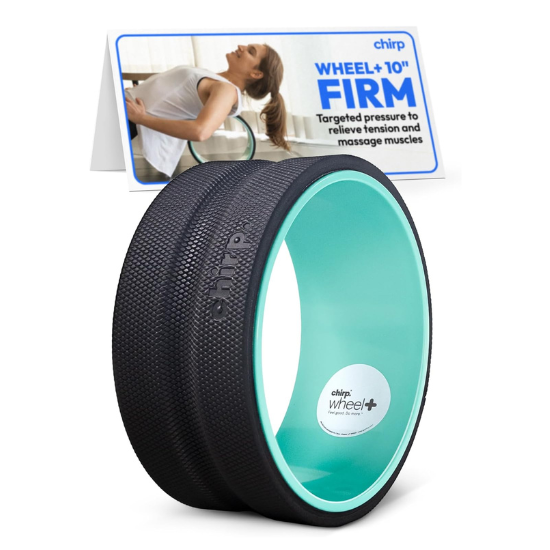
The Chirp Wheel is a rigid circular mobility tool covered with cushioning material. Unlike a conventional cylindrical foam roller, its narrower curved profile is designed to roll along the back while the user controls body weight and movement.
The product information reviewed by PVL describes a 10-inch model and a high load capacity. Size, padding, construction, weight limits, and available wheel options can change, so buyers should verify the current manufacturer specifications for the exact model.
Does the Chirp Wheel Actually Help Back Pain?
PVL did not identify a peer-reviewed randomized trial showing that the finished Chirp Wheel treats acute or chronic low-back pain. Some users may experience temporary comfort from pressure, movement, or stretching, but symptom relief is not the same as treating the underlying cause of back pain.
Back pain has many possible contributors. Persistent, recurrent, severe, or unexplained symptoms should not be self-diagnosed from whether rolling feels good.
Does Foam Rolling Improve Mobility?
General foam-rolling research supports short-term increases in range of motion, but the size and practical importance of the effect vary. Meta-analyses have found acute ROM improvements compared with doing nothing, while more recent comparisons suggest foam rolling is not necessarily superior to other warm-up activities.
Those studies mostly involve conventional rolling protocols and different body regions. They provide context for self-massage and mobility work, not direct validation of the Chirp Wheel’s curved design.
Does the Chirp Wheel Decompress the Spine?
“Spinal decompression” is too strong as an evidence-based claim for this consumer wheel. Rolling over a curved device can place the trunk into extension and may create a subjective feeling of stretching or reduced stiffness.
That does not demonstrate clinically meaningful separation of spinal structures, correction of disc problems, or therapeutic decompression. PVL would describe the movement as supported back extension or mobility work rather than proven spinal decompression.
Can It Correct Posture?
No good evidence shows that using a Chirp Wheel permanently corrects posture. A session may temporarily change how the back feels or make an upright position feel easier, but posture is influenced by anatomy, task demands, strength, endurance, movement habits, pain, and individual variation.
A passive or self-massage tool should not be presented as mechanically “putting the spine back into alignment.”
Does It Release Trigger Points or Fascia?
Pressure from rolling can change sensation and pain tolerance temporarily, and users may describe tender areas as “knots” or trigger points. However, terms such as “myofascial release” can imply a precise structural mechanism that is difficult to establish from consumer self-massage.
The safer description is that the wheel applies external pressure and movement that some users find temporarily comfortable or mobility-enhancing.
Does the Chirp Wheel Speed Muscle Recovery?
Evidence for foam rolling and recovery is mixed. A 2024 meta-analysis reported reductions in exercise-induced muscle-soreness ratings at several time points, while other reviews found small, inconsistent, or unclear effects on recovery and performance.
Reduced soreness perception does not necessarily mean faster tissue repair. PVL did not identify product-specific evidence showing that Chirp accelerates muscle healing or physiological recovery.
Is the 10-Inch Wheel Better Than a Foam Roller?
Not universally. The curved, narrower design changes how pressure is distributed and may make back-extension movements easier to perform. A conventional roller is more versatile for large muscle groups such as the quadriceps, calves, hamstrings, and glutes.
Preference depends on the movement, body size, pressure tolerance, and intended use rather than one design being clinically superior.
How Much Pressure Should You Use?
Start conservatively and keep the movement controlled. Pressure can feel intense without being beneficial, and more discomfort does not mean more effective treatment.
Avoid forcing the body into painful ranges or repeatedly rolling directly over an area that produces sharp, electrical, radiating, or worsening pain. The goal of a general mobility routine should not be to “push through” neurological or injury symptoms.
When Should You Avoid a Back-Rolling Wheel?
Do not use self-rolling as a substitute for assessment when symptoms suggest a potentially significant back problem. Seek prompt medical care for new bowel or bladder dysfunction, saddle-area numbness, major or progressive leg weakness, significant trauma, or other concerning neurological symptoms.
People with known osteoporosis or fracture risk, recent spinal surgery or injury, significant bone disease, or clinician-imposed movement restrictions should obtain individualized guidance before applying substantial pressure or extension to the back.
What the Chirp Wheel Has Not Been Shown to Do
- Treat chronic or acute low-back pain
- Clinically decompress the spine
- Correct spinal alignment or permanently fix posture
- Repair discs or other spinal structures
- Release fascia through a proven structural mechanism
- Accelerate tissue healing or physiological recovery
- Outperform conventional foam rollers or appropriate exercise rehabilitation
Pros and Cons
Pros
- Compact tool for controlled self-massage and mobility work
- Curved shape can support back-extension movements
- Simple to use without batteries, apps, or subscriptions
- General rolling research supports some short-term ROM effects
- May feel comfortable after training for some users
Cons
- Limited product-specific clinical evidence
- “Spinal decompression” and posture claims can overstate the evidence
- Pressure can aggravate some back conditions or injuries
- Not a diagnostic or rehabilitation substitute
- General foam-rolling evidence does not prove faster tissue recovery
Who Should Consider It?
The Chirp Wheel makes the most sense for a generally healthy person who enjoys self-massage and controlled mobility work and prefers the feel of a curved wheel to a standard foam roller. It can be one optional tool within a broader movement routine.
Who Should Choose Something Else?
Choose professional assessment when pain is persistent, worsening, unexplained, neurological, or associated with significant injury. A standard foam roller may be more versatile for whole-body muscle rolling, while exercise-based rehabilitation may be more appropriate when the goal is restoring function after a back problem.
Frequently Asked Questions
Does the Chirp Wheel actually help back pain?
Some users may experience temporary comfort, but the Chirp Wheel is not proven to treat low-back pain. Pressure, stretching, and movement can change how the back feels, yet PVL did not identify a finished-product randomized trial establishing pain-treatment effectiveness. Persistent, severe, recurrent, or unexplained back pain deserves appropriate assessment rather than relying on self-rolling alone.
Does the Chirp Wheel decompress your spine?
PVL would not describe the Chirp Wheel as clinically proven spinal decompression. Rolling over the curved surface can place the back into extension and create a stretching sensation, but that does not establish therapeutic separation of spinal structures, correction of disc problems, or lasting decompression. “Supported back extension” is a more defensible description.
Can the Chirp Wheel improve posture?
There is no good evidence that the Chirp Wheel permanently corrects posture. A mobility session may temporarily change stiffness or make an upright position feel more comfortable, but posture reflects anatomy, strength, endurance, habits, task demands, pain, and normal individual variation. A self-massage tool does not mechanically realign the spine.
Does foam rolling speed muscle recovery?
Foam rolling may modestly reduce perceived post-exercise soreness, but that does not prove faster tissue recovery. Reviews report small or inconsistent effects across soreness, performance, and recovery outcomes. The broader evidence also comes from many rolling methods and devices, so it cannot establish that the Chirp Wheel specifically accelerates muscle healing or recovery.
Is the Chirp Wheel safe for everyone?
No, a back-rolling wheel is not appropriate for every person or condition. People with significant osteoporosis or fracture risk, recent spinal surgery or injury, major trauma, or clinician-imposed movement restrictions should seek individualized guidance. Stop and seek assessment for sharp or radiating pain, progressive weakness, saddle numbness, or bowel or bladder changes.
Is the Chirp Wheel better than a regular foam roller?
Neither design is universally better. The Chirp Wheel’s curved profile may suit controlled back-extension and self-massage movements, while a conventional cylindrical roller is generally more versatile for large muscle groups. PVL did not identify comparative clinical evidence showing that Chirp produces superior pain, mobility, posture, or recovery outcomes versus an appropriate standard foam roller.
Final Verdict
PVL Rating: 4.0/5. The Chirp Wheel is a useful optional mobility accessory for people who enjoy its curved shape and controlled pressure. General foam-rolling evidence supports modest short-term effects on range of motion and sometimes soreness, but that should not be inflated into claims of spinal decompression, posture correction, structural “release,” or accelerated healing.
References
- Systematic review and meta-analysis of foam rolling and exercise-induced muscle soreness. PMID 39593540.
- Meta-analysis of foam rolling, performance, flexibility, and recovery. PMID 31024339.
- Systematic review of chronic foam rolling, flexibility, recovery, and performance. PMID 35409995.
- Systematic review and meta-analysis of acute foam rolling and range of motion. PMID 31628662.
Reviews
There are no reviews yet.