
Quick Verdict
The HOTWAVE Push Up Board may be a convenient way to vary hand positions during bodyweight pressing exercises at home. Its foldable, color-coded design and removable handles can make workouts feel more structured, but different handle positions do not isolate individual muscles or guarantee better results. The existing PVL listing describes a “20-in-1” system without confirming its exact configuration, weight capacity, dimensions, or included accessories.
PVL Rating: 3.9/5 (provisional)
- Upper-body workout variety: 4.3/5
- Compact storage potential: 4.4/5
- Beginner-friendly exercise options: 4.0/5
- Grip and board stability certainty: 3.1/5
- Verified model-specific specifications: 2.7/5
What Is the HOTWAVE Push Up Board?
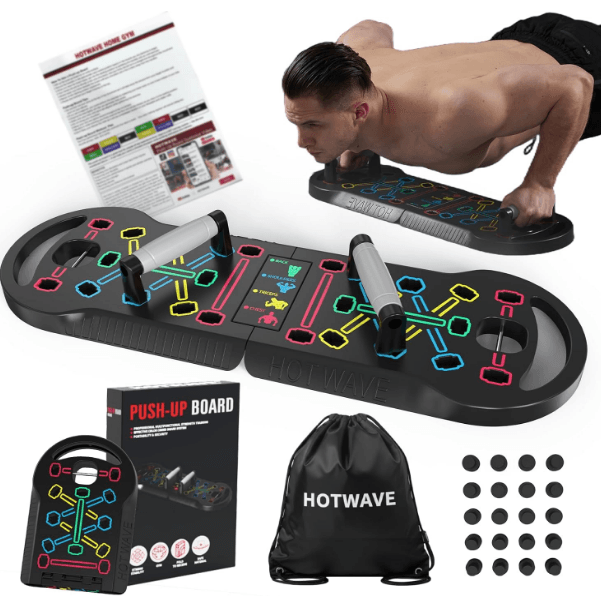
It is a portable platform with slots for push-up handles at different positions. The board is intended to help users perform pressing variations without a large piece of gym equipment. The exact number of positions, accessories, and configurations may differ by bundle or model, so check the current retailer listing.
How Does the Color-Coded Push-Up Board Work?
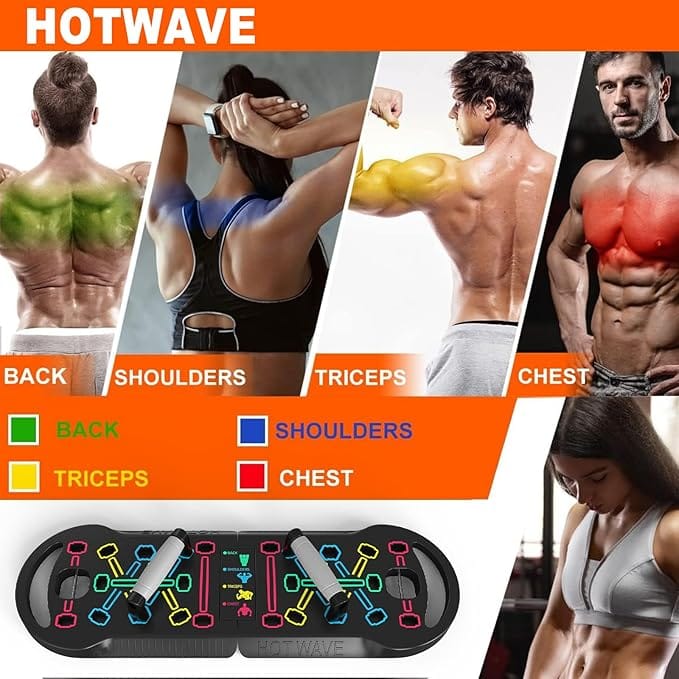
Color markings are intended to suggest handle placements for different exercise emphases. Changing hand position can affect joint angles, range of motion, and relative muscle demand. However, a colored slot does not turn a compound push-up into an isolated chest, shoulder, triceps, or back exercise.
Does the HOTWAVE Board Really Offer 20 Exercises?
The original description uses “20-in-1,” but that phrase has not been independently verified as 20 distinct exercises. Multiple handle positions may be variations of the same pressing pattern. Assess the board by how securely it supports useful movements rather than the marketing count alone.
Which Muscles Do Push-Ups Work?
Push-ups mainly train the chest, triceps, and front of the shoulders, with the trunk helping maintain alignment. Hand position may shift the emphasis, but most variations remain compound pushing exercises. A complete strength routine also needs pulling and lower-body movements.
Can a Push-Up Board Build Muscle?
Push-up variations can help develop upper-body strength and muscle when they provide sufficient challenge and are progressed over time. Results depend on exercise difficulty, training volume, recovery, and consistency. The board itself does not add a measured resistance load or guarantee greater growth than floor push-ups.
Can It Improve Push-Up Form?
Fixed handle locations may offer a repeatable setup, but correct form still depends on the user’s control. Maintain a stable trunk, move through a comfortable range, and avoid flaring the elbows excessively. A board cannot automatically correct poor technique.
Are the Handles Better for Your Wrists?
Handles can allow a more neutral wrist position than palms-flat floor push-ups, which some people find comfortable. However, wrist comfort varies, and a raised handle may increase the available movement range. PVL has not tested this model’s handle geometry or demonstrated that it reduces wrist injury risk.
Does Handle Width Matter?
Yes. Wider and narrower hand positions can change the exercise’s feel and joint demands. Extremely wide or awkward positions are not necessary for progress and may be uncomfortable. Choose slots that let you keep the shoulders controlled and wrists aligned without pain.
Is It Suitable for Beginners?
It may be suitable if the board is stable and the user can perform controlled repetitions. Beginners can reduce difficulty with an elevated push-up surface, provided that surface and equipment are specifically suitable for that use. Do not place the board on unstable furniture or improvise unsupported setups.
How Can You Progress From Beginner Push-Ups?
Start with a manageable push-up variation and build consistent repetitions. Gradually increase the difficulty through lower incline, greater range of motion, slower lowering, or additional repetitions. Progress should not require changing handle positions every session. Quality and repeatability matter more than variety alone.
How Should You Position Your Body?
Keep your head, torso, and hips aligned and avoid letting the lower back sag. Place the handles symmetrically and grip them firmly. Lower under control through a comfortable range, then press upward without jerking. Stop when fatigue makes the board shift or form deteriorate.
Can You Target the Chest With the Board?
Different grip positions can change how a push-up feels across the chest, shoulders, and arms, but no board position exclusively trains the chest. The chest remains involved in standard pressing variations. A broader resistance program may provide more options for progressive chest loading.
Can You Target the Triceps?
Some closer-hand pressing variations may emphasize the triceps, but they also involve the chest and shoulders. Do not force the hands unnaturally close if the position strains your wrists or elbows. Choose a grip that supports smooth, pain-free repetitions.
Does It Train the Back?
Push-ups are primarily pushing movements, not substitutes for rows or pull-ups. The upper back helps stabilize the shoulders, but color-coded “back” positions should not be interpreted as equivalent to dedicated pulling exercises. Include rows, pulldowns, or suitable band pulls for balanced training.
Can You Train Shoulders With It?
The front of the shoulders contributes to push-ups. Some pressing variations may increase shoulder demands, but changing handle positions does not replace all overhead or lateral shoulder training. Avoid painful positions and maintain control at the bottom of each repetition.
How Stable Is the Board?
Stability depends on the floor surface, board construction, handle engagement, and user movement. The existing listing does not provide independent stability testing or verified anti-slip specifications. Place it on a level, nonslip surface and check that every handle locks securely before loading it.
What Is the Weight Capacity?
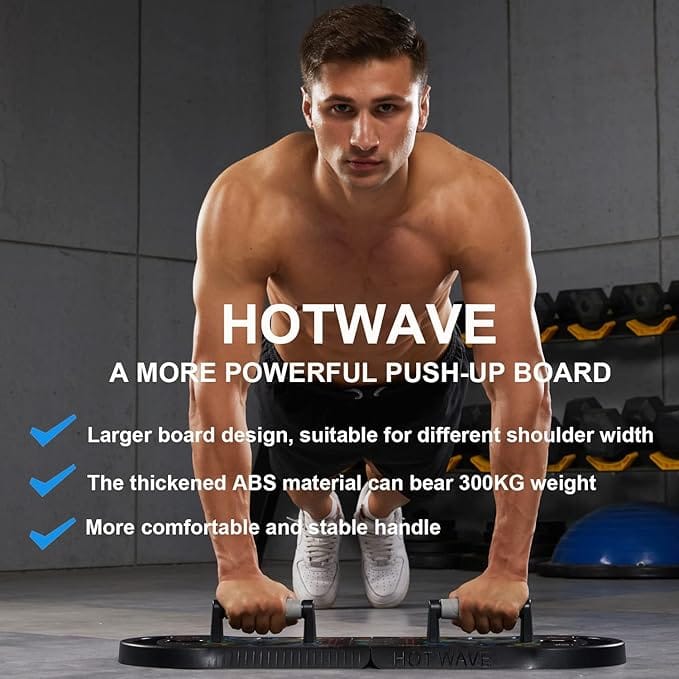
The original listing does not verify a maximum supported user weight or dynamic load rating. Do not assume the board can support any user simply because it is marketed for strength training. Check the selected model’s specifications and avoid sudden impact or explosive movements unless explicitly approved.
Is the HOTWAVE Board Foldable?
The original description identifies a foldable design, but PVL has not independently checked the hinge mechanism, folded dimensions, or storage accessories. Verify that the board opens fully, locks or seats as instructed, and remains flat during exercise. Never use it with a damaged hinge.
Can You Travel With It?
A foldable board may be easier to transport than bulky equipment, but actual convenience depends on its size, weight, and package contents. Inspect the handles and board after travel. A simple floor push-up routine may be even more portable if equipment is not essential.
Can You Use It on Carpet?
Some carpets may allow a board to rock, twist, or shift, depending on pile height and backing. Use only surfaces permitted by the manufacturer and test stability before beginning. Avoid uneven flooring, slippery tile, and any setup where the board moves under load.
Can You Do Explosive Push-Ups?
Do not assume the board is designed for jumping, clapping, or other explosive push-ups. Sudden loading can increase the chance of handle movement or board damage. Unless the manufacturer explicitly approves dynamic exercises, stick to controlled repetitions.
How Often Should You Use It?
Training frequency depends on your current ability, overall program, and recovery. Include enough rest between demanding upper-body sessions and vary the workload gradually. Daily maximal-effort push-ups are not necessary for progress. Add pulling and leg exercises to avoid relying on pressing alone.
How Do You Clean and Maintain It?
Follow the manufacturer’s instructions for cleaning and storage. Check the handles, slots, hinge, and underside for wear before each session. Stop using the board if plastic cracks, handles loosen, or the surface no longer sits flat. Keep the board away from excessive heat and sharp objects.
Who Should Use Extra Caution?
People with wrist, elbow, or shoulder symptoms may need modified push-ups or professional guidance. Stop for sharp pain, numbness, dizziness, or instability. Users with limited upper-body strength should begin with easier stable-surface variations rather than forcing full push-ups on raised handles.
How Does It Compare With Standard Push-Up Handles?
Separate push-up handles may offer neutral-grip comfort without a large slotted platform. The HOTWAVE board adds fixed positions and visual workout prompts, but those are convenience features rather than proof of superior results. Compare handle stability, range of motion, storage, and price.
How Does It Compare With Floor Push-Ups?
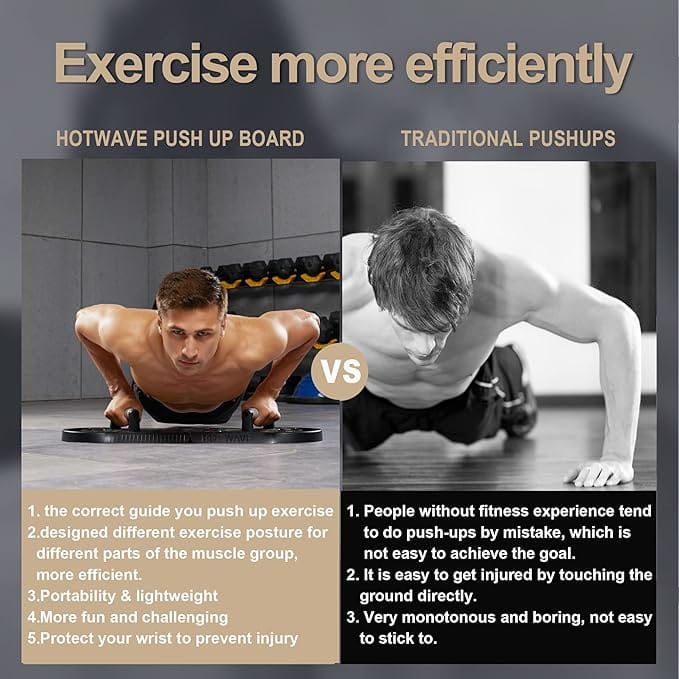
Floor push-ups require no equipment and can be highly effective. A board can provide repeatable hand placements and possibly a more comfortable grip, but it also adds a component that must remain stable. Choose the version that lets you train consistently with good technique.
Is the HOTWAVE Push Up Board Worth Buying?
It may be worthwhile for someone who enjoys structured push-up variations and prefers handles to palms-flat floor work. It is less compelling if the primary attraction is the claim of isolating many muscle groups. Confirm the exact board dimensions, load rating, handle fit, package contents, and price first.
Pros and Cons
Pros
- Multiple marked handle positions can add workout variety
- Handles may feel more comfortable for some wrists
- Foldable design may suit small spaces
- Useful for controlled bodyweight pressing routines
Cons
- Color coding does not isolate individual muscles
- Does not replace back or lower-body strength training
- Exact load capacity and accessory contents unverified
- Board and handles must remain secure under load
Frequently Asked Questions
Does the HOTWAVE Push Up Board really train 20 different muscles?
No. The “20-in-1” label describes marketed exercise or handle-position variety, not 20 isolated muscles. Push-ups primarily challenge the chest, triceps, shoulders, and trunk. Changing hand positions can alter the exercise’s emphasis, but it does not replace dedicated back and leg training. Focus on controlled progression instead of the number of colored slots.
Is the HOTWAVE Push Up Board good for beginners?
It may suit beginners who can perform controlled push-ups and verify that the board is stable. Start with manageable repetitions and a comfortable grip. If full push-ups are too difficult, use an appropriate elevated or modified version on stable equipment. Avoid improvised supports or positions that cause wrist or shoulder pain.
Can a push-up board reduce wrist pain?
Handles may let some users keep their wrists in a more neutral position, which can feel comfortable. However, this HOTWAVE model has not been independently tested for pain reduction. Raised handles may also increase movement range. Stop if symptoms worsen and consider individualized advice for persistent wrist pain.
Does the HOTWAVE Push Up Board work the back?
Push-ups are pressing exercises, so they do not replace rows, pull-ups, or other dedicated back movements. Back muscles help stabilize the shoulders, but colored “back” handle positions should not be interpreted as full back training. Include pulling exercises and lower-body work for a balanced strength program.
What is the weight limit of the HOTWAVE Push Up Board?
The existing PVL listing does not verify the maximum supported user weight for the selected HOTWAVE model. Check the manufacturer’s current specifications before purchase. Inspect the board, hinge, and handles before use. Avoid explosive push-ups or other high-impact movements unless the manufacturer explicitly approves them for this product.
Is the HOTWAVE Push Up Board better than regular push-ups?
Not necessarily. Regular floor push-ups can be highly effective for strength and muscular endurance. The board offers fixed handle placements and may improve grip comfort for some users, but it does not guarantee superior muscle growth. Choose the setup that stays stable, feels comfortable, and supports consistent progression.
Final Verdict
PVL Rating: 3.9/5 (provisional). The HOTWAVE Push Up Board can add convenience and variety to home pressing workouts, but its color-coded positions are not a shortcut to isolated muscle training. Verify the current model’s handle security, load rating, dimensions, and package contents before buying.
Reviews
There are no reviews yet.