
Sleep Debt Calculator
How Much Sleep Are You Missing?
Enter your age, choose a personal sleep target, and add your recent sleep. You’ll see your estimated accumulated shortfall, average sleep duration, nights below target, and recent sleep pattern. Longer nights are shown separately rather than automatically treated as hour-for-hour repayment.
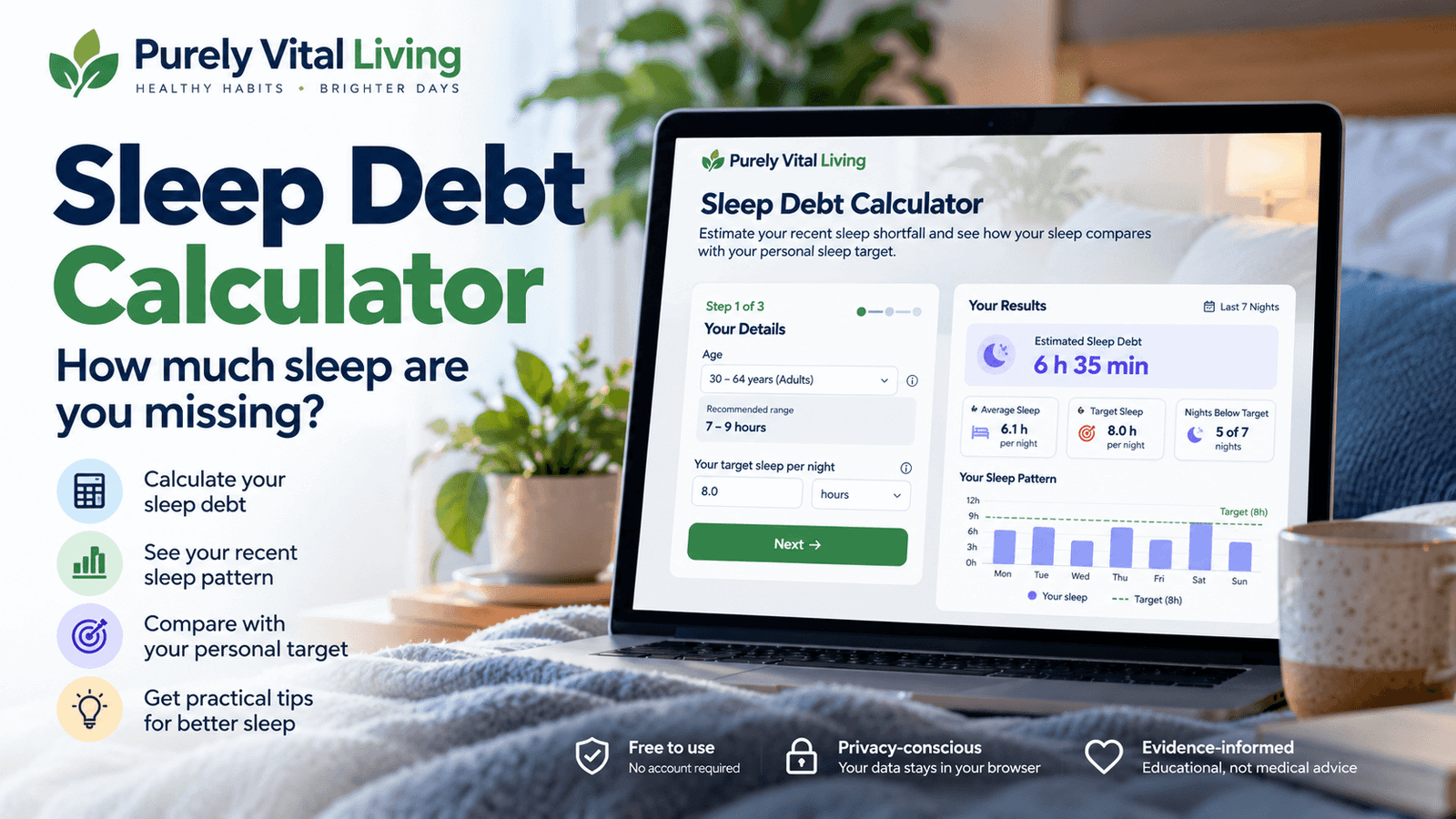
Set your sleep target
Choose your tracking period
Enter your recent sleep
Enter how long you slept each night. Leave a night blank if you don’t know it; at least 3 nights are required.
Educational estimate • No account required
Your recent sleep pattern
What your result means
Important: This is a duration estimate. It does not mean you need exactly the displayed number of extra hours to recover. Longer nights may support recovery, but this calculator does not assume they cancel earlier shortfalls hour-for-hour.
How Does the Sleep Debt Calculator Work?
The PVL Sleep Debt Calculator compares your selected sleep target with the amount you slept each night. When a night’s sleep falls below your target, the difference is added to your estimated accumulated sleep shortfall. Nights above your target are displayed separately rather than automatically cancelling previous shortfalls.
7 nights vs. 14 nights
Seven nights gives a quick picture of your most recent week. Fourteen nights provides a broader view of whether short sleep is recurring across more than one week. Both are estimates based on the information you enter.
Sleep Debt Formula
Total estimated shortfall = sum of nightly shortfalls
If your target is 8 hours and you sleep 6.5 hours, that night’s estimated shortfall is 1.5 hours. If you sleep 8.5 hours the next night, PVL records the longer night separately instead of assuming the extra 30 minutes erases the previous shortfall.
What Is Sleep Debt?
Sleep debt is the accumulated shortfall that develops when you repeatedly get less sleep than you need. The concept is useful for understanding repeated short sleep, but biological recovery is more complicated than simple arithmetic. Sleep duration is also only one part of sleep health; timing, quality, regularity, and sleep disorders can affect how rested you feel.
What Causes Sleep Debt?
Not allowing enough time for sleep
Work, caregiving, studying, commuting, entertainment, or a late bedtime can reduce sleep opportunity.
Difficulty falling or staying asleep
Time in bed is not always the same as time asleep. If getting to sleep is the problem, see How to Fall Asleep Faster Naturally.
Irregular schedules
Changing bedtimes, weekend shifts, travel, and shift work can create repeated short nights. Stress can also disrupt sleep; read Cortisol and Sleep.
Can You Catch Up on Lost Sleep?
Extra sleep can help with recovery after insufficient sleep, but sleep debt should not be treated as a balance that is necessarily repaid hour-for-hour. Recovery varies with the amount and duration of prior sleep loss and with the outcome being measured. That is why this calculator does not predict an exact recovery date.
Does weekend sleep erase sleep debt?
Not automatically. Longer sleep on days off may help after short sleep, but it does not prove that all effects of repeated sleep restriction have been reversed.
How long does recovery take?
There is no universally valid formula. Focus on restoring adequate sleep opportunity and a sustainable schedule rather than trying to repay an exact number of hours on a deadline.
Sleep Debt vs. Sleep Deprivation
| Concept | What it describes |
|---|---|
| Sleep debt | An accumulated duration shortfall relative to sleep need or target. |
| Sleep deprivation | Insufficient sleep, which may be acute or ongoing and is broader than this calculator can diagnose. |
How Much Sleep Do You Need?
Sleep needs vary by age and individual. General guidance provides useful context, but it cannot determine one exact personal requirement. The calculator therefore suggests age-appropriate context while allowing you to adjust your own target.
Practical Ways to Reduce Future Sleep Debt
Protect enough time for sleep, keep sleep and wake times reasonably consistent, and address barriers that repeatedly shorten your nights. For broader guidance, see How to Improve Sleep Quality Naturally, Best Sleeping Temperature, and When to Stop Eating Before Bed.
Want a broader view than sleep duration alone? Use the PVL Sleep Score Calculator to review your overall sleep habits.
Limitations of This Sleep Debt Calculator
Frequently Asked Questions
How do I calculate my sleep debt?
Choose a sleep target, subtract each night’s actual sleep when it falls below that target, and add those nightly shortfalls. This calculator performs that arithmetic for 7 or 14 nights.
How much sleep debt do I have?
Enter at least three recent nights above. The result estimates your accumulated duration shortfall relative to the personal target you selected.
Is sleep debt real?
Sleep debt is an established concept for accumulated insufficient sleep, but it should not be interpreted as a literal bank balance that predicts physiological recovery hour-for-hour.
Can you catch up on sleep?
Extra sleep can support recovery after insufficient sleep, but recovery is not reliably described by a simple one-for-one repayment equation.
Can I repay sleep debt in one night?
One longer night may help you feel better, but it does not establish that every effect of repeated sleep restriction has fully recovered.
Does weekend sleep cancel weekday sleep debt?
Not automatically. This calculator therefore shows time above target separately instead of subtracting it from earlier shortfalls.
Should I use 7 or 14 nights?
Use 7 nights for a quick weekly picture and 14 nights for a broader recent pattern.
Is sleep debt the same as sleep deprivation?
No. Sleep debt describes accumulated duration shortfall; sleep deprivation is a broader concept and cannot be diagnosed by this calculator.
References
Want a Broader View of Your Sleep?
Sleep debt looks specifically at whether your recent sleep duration fell below your selected target. For a broader look at your sleep habits and routine, use the Sleep Score Calculator.
Related PVL Sleep Resources