
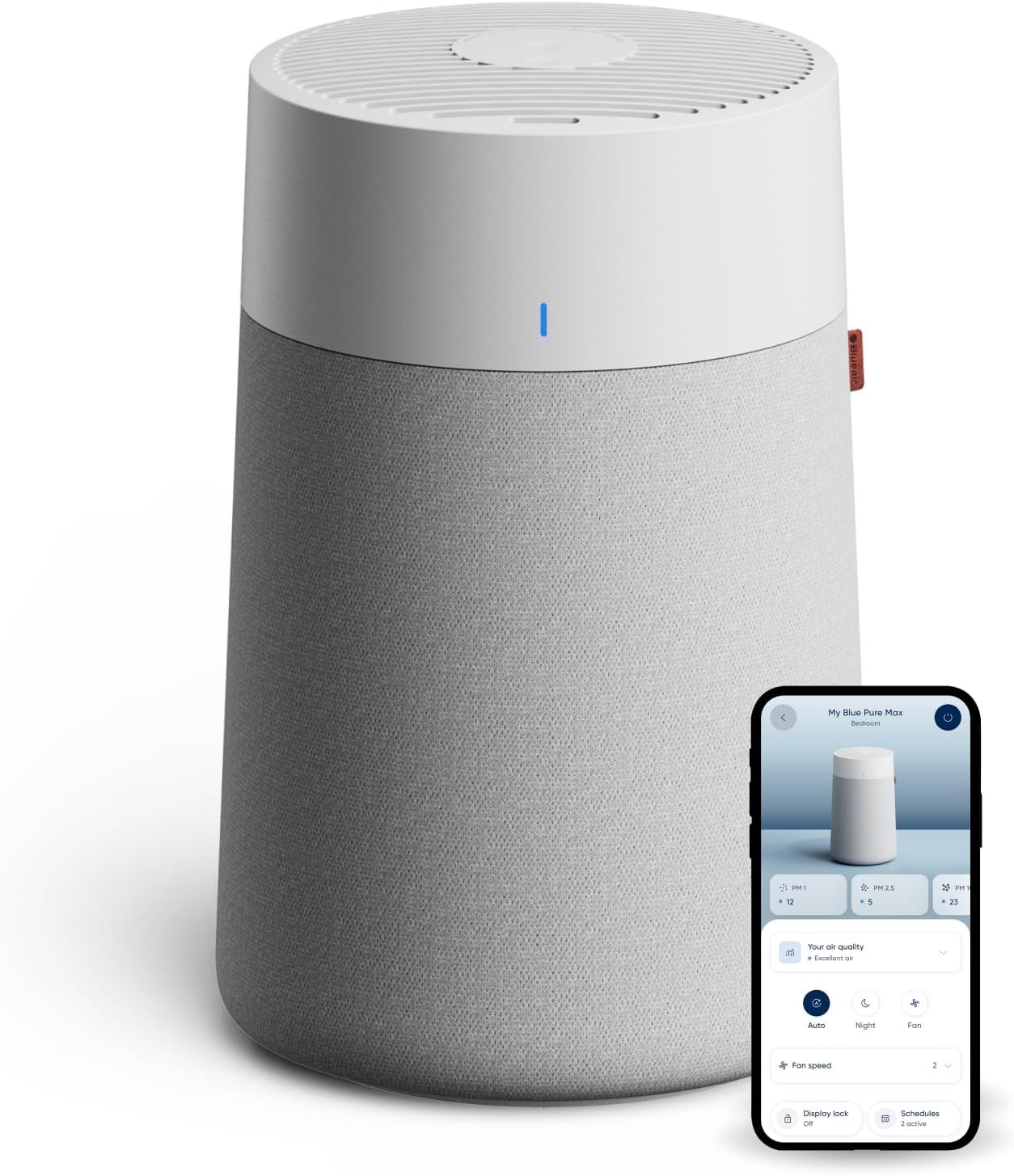
Direct answer: The BLUEAIR Blue Pure 511i Max is a compact smart air purifier best suited to bedrooms and small home offices. It offers useful particle-cleaning performance and quiet low-speed operation, but it is less suitable for heavy odors or large open spaces.
BLUEAIR 511i Max specifications at a glance
| Recommended room size | 237 sq ft (current Blueair product page) |
|---|---|
| Smoke / dust / pollen CADR | 153 / 159 / 174 CFM |
| Sound level | 19–48 dB (published specification) |
| Rated power | 17 W |
| Dimensions and weight | 14.5 × 9.3 × 9.3 in; 4.2 lb |
| Filter interval | Up to nine months, dependent on conditions |
| Connectivity | Wi-Fi, app control, Auto and Night modes |
Evidence: Values above are from Blueair’s product specifications; independent filtration discussion comes from RTINGS’ 511i Max review. Blueair’s older support tables may show a different room rating because published standards have changed.
PVL pick — compact smart air purifier. This is a research-based editorial review, not a hands-on PVL laboratory test.
Is the BLUEAIR Blue Pure 511i Max worth buying?
The BLUEAIR Blue Pure 511i Max is worth considering for a small bedroom or home office when you want compact, app-controlled particle filtration. Its strongest selling points are useful CADR for its size, automatic operation and quiet low-speed settings; the main compromises are replacement-filter costs and limited heavy-odor filtration.
Who is the BLUEAIR 511i Max best for?
This model makes the most sense in bedrooms and smaller workspaces where dust, pollen and airborne pet dander are the primary concerns. Its compact body suits apartments and dorms, and the app can help users who prefer remote scheduling. A small-room purifier also works best when doors and windows are managed consistently and the filter is replaced on schedule. Blueair’s current recommendation of 237 square feet is a more helpful starting point than its much larger one-hour coverage headline.
Who should avoid the BLUEAIR 511i Max?
Skip this model if you need frequent air changes in a large open-plan space, substantial control of cooking gases or VOCs, or a purifier based exclusively on conventional mechanical filtration. Buyers especially sensitive to noise should not assume that the advertised 19 dB minimum applies at high fan speeds. Those who dislike ongoing consumable costs should price the compatible replacement filter before purchase. A purifier is not a remedy for water damage, mold sources or inadequate ventilation.
What does HEPASilent filtration actually do?
Blueair’s HEPASilent system combines mechanical filtration with electrostatic assistance. The washable outer fabric captures larger debris, the primary filter targets particles, and the carbon layer provides limited odor treatment. This arrangement differs from a conventionally certified True HEPA cartridge. The product is not HEPA-certified according to RTINGS’ testing, so the clearest basis for comparison is CADR, independently measured particle removal, noise and long-term cost. The manufacturer’s 99.97% particle-capture language is a specified test claim, not a promise that every room will become 99.97% pollutant-free.
How much room can the 511i Max really clean?
Blueair lists 237 square feet as its current recommended room size, with approximately 4.8 air changes per hour under its rating assumptions. Its 1,138-square-foot figure describes cleaning a much larger area over one hour, not delivering that same frequent air-change rate. For a bedroom, check the ceiling height and target air changes rather than relying on the largest number printed in marketing. Blueair has revised some CADR and coverage values to align with newer DOE reporting standards; older packaging and support tables may therefore differ.
How strong is its CADR?
The current Blueair listing gives a smoke CADR of 153 CFM, dust CADR of 159 CFM and pollen CADR of 174 CFM. CADR estimates how quickly the unit delivers particle-cleaned air under standardized test conditions. Higher numbers generally help in larger spaces, but they do not measure gas or odor removal. For buyers with pollen concerns, the pollen CADR is relevant; for fine smoke particles, smoke CADR is the more useful comparison. No single CADR value predicts every real home because furniture, airflow, open doors and pollution sources differ.
Is the 511i Max quiet enough for sleeping?
Blueair publishes a sound range of 19–48 dB in its technical specifications. The lowest figure describes a low-speed condition, while the upper figure reflects a noisier setting. Night Mode and display-brightness controls may make the purifier easier to live with after dark, but sleepers who are sensitive to fan pitch or sudden speed changes should consider whether Auto Mode is desirable overnight. Lower fan speed is quieter but also generally moves less air, so the best setting balances sleep comfort with cleaning performance.
How do Wi-Fi and Auto Mode work?
The 511i Max includes an air-quality sensor, automatic fan adjustment and Wi-Fi app controls. Users can monitor conditions, adjust settings and create schedules without relying entirely on the physical controls. Auto Mode responds to what the built-in sensor detects, but that does not mean the sensor measures every indoor pollutant or gas. App features are convenient rather than essential to particle filtration. If you want a simple purifier without a connected interface, compare Blueair’s non-smart Blue Pure 511 instead.
Can it help with pet dander and pollen?
The purifier can reduce airborne particles that pass through its filter, including some pollen and pet dander. This may complement cleaning routines, but it cannot remove allergens already settled on upholstery, carpets and bedding. Large pet hairs tend to settle quickly and still require vacuuming or wiping. For an allergy-conscious household, consider the location of the unit, how often the pet uses the room, how frequently the outer pre-filter is cleaned and whether the chosen filter fits the exact 511i Max model.
Can it remove wildfire smoke, cooking odors or VOCs?
Particle filtration can help with the particulate component of smoke, and the smoke CADR provides a useful benchmark. However, gases and odors behave differently from particles. Independent analysis describes the included activated carbon as a sheet, which should not be confused with a deep bed of sorbent carbon designed for heavy gas loads. For persistent cooking fumes, smoke gases, solvents or other VOC sources, prioritize source removal, safe ventilation and appropriate specialized filtration. No portable air purifier makes an unsafe indoor pollution source harmless.
Does HEPASilent produce ozone?
HEPASilent uses electrostatic assistance, a feature that prompts reasonable questions about ozone. The presence of electrostatic technology does not by itself establish that a particular model emits unsafe ozone. Check the exact unit’s current certifications and model-specific emissions testing instead of assuming every Blueair model behaves identically. Buyers who want to avoid electrostatic particle charging entirely may prefer a purely mechanical purifier. Do not substitute unverified claims about ionizers for a model-specific safety assessment.
What are the maintenance and filter costs?
Blueair says its RealTrack filter monitoring estimates remaining filter life from usage and conditions, with a lifespan of up to nine months. The main filter must be replaced, while the fabric pre-filter can be cleaned according to the instructions. Blueair’s filter lookup identifies F5MAX-compatible replacements for the 511i Max, including variants targeted at smoke or allergens. Confirm the current price, cartridge type and regional availability before purchase. A low initial device price may be less attractive if recurring filter costs are high.
How much electricity does it use?
Blueair lists energy consumption of 17 W. At a hypothetical continuous 17 W draw, the unit would use about 0.408 kWh per day and 149 kWh over 365 days. Actual consumption varies with operating mode and speed, and the published figure should not be interpreted as a measured average for every household. To estimate electricity cost, multiply your actual kWh usage by your utility rate. Replacement filters may contribute more to annual ownership costs than the electricity bill, depending on local prices.
How does the 511i Max compare with other Blueair models?
The non-smart Blue Pure 511 is simpler and omits Wi-Fi and Auto Mode. The 511i Max adds connected controls and sensor-based automation for small rooms. The 311i Max is intended for medium-sized rooms, while the 211i Max is aimed at larger living areas. Compare each model’s current rated room area, CADR, footprint and compatible filter price before choosing. A larger model can clean a small room at lower speed, but it will take up more floor space and may cost more to purchase and maintain.
Pros and cons of the BLUEAIR 511i Max
Advantages include a small footprint, washable fabric pre-filter, app and scheduling features, automatic fan adjustment, a low advertised minimum noise level and useful particle CADR for a compact unit. Drawbacks include limited heavy-odor performance, a replaceable proprietary main filter, a potentially misleading maximum coverage headline, higher-speed noise and electrostatic technology that some shoppers prefer to avoid. These are product-design trade-offs rather than results from hands-on PVL laboratory testing.
PVL final verdict
For smaller bedrooms and home offices, the BLUEAIR Blue Pure 511i Max is a reasonable shortlist candidate if your main goal is reducing airborne particles while retaining smart controls. Its manufacturer-listed CADR and recommended room area are more useful buying criteria than its 1,138-square-foot one-hour claim. It is not the best match for major odor problems, large open rooms or shoppers who insist on mechanical-only filtration. This editorial assessment draws on published specifications and independent testing; PVL has not claimed to conduct a hands-on laboratory test of this unit.
BLUEAIR model comparison
| Model | Best fit | Connectivity |
|---|---|---|
| Blue Pure 511 | Simple small-room cleaning | No Wi-Fi |
| Blue Pure 511i Max | Smart small-room cleaning | Wi-Fi and Auto |
| Blue Pure 311i Max | Medium rooms | Wi-Fi and Auto |
| Blue Pure 211i Max | Larger rooms | Wi-Fi and Auto |
For additional product research, see PVL’s Blueair Blue Pure 211i Max listing and Best Wellness Products guide.
Frequently asked questions
Is the BLUEAIR 511i Max good for bedrooms?
Yes, it is designed for smaller rooms, and Blueair currently recommends approximately 237 square feet. The lowest advertised noise level is 19 dB, but higher fan speeds are louder. Match the purifier to your bedroom size and preferred sleep setting rather than relying on the maximum one-hour coverage claim.
Does the BLUEAIR 511i Max have a True HEPA filter?
The 511i Max uses Blueair’s HEPASilent system, which combines mechanical and electrostatic filtration. RTINGS reports that the model is not HEPA-certified. Shoppers comparing particle-removal performance should use independently reported CADR and test data instead of treating filtration labels as interchangeable.
Does the BLUEAIR 511i Max remove pet hair?
It can collect some loose airborne hair and pet dander reaching its intake, but it cannot remove hair that has settled on floors or furniture. Vacuuming, washing pet bedding and maintaining the purifier’s pre-filter remain important. Its value is primarily reducing airborne particles rather than replacing household cleaning.
How often should the BLUEAIR 511i Max filter be replaced?
Blueair states that its main filter can last up to nine months, depending on pollution and use. RealTrack monitors the estimated remaining life. The washable fabric pre-filter is separate from the replaceable main cartridge; verify that any replacement is compatible with the 511i Max before ordering.
Can the BLUEAIR 511i Max remove smoke and odors?
Its smoke CADR of 153 CFM describes particle-cleaning performance, not gas removal. The carbon sheet may help with light odors, but persistent smoke gases, cooking fumes and VOCs require attention to source control and ventilation. It is not a substitute for a dedicated heavy-carbon gas filtration system.
Is the BLUEAIR 511i Max energy efficient?
Blueair lists 17 W energy consumption. A theoretical 24-hour day at that draw would consume 0.408 kWh, although actual use varies by speed and operating mode. Consider both electricity and the cost of replacement filters when calculating the long-term cost of ownership.
Is 1,138 square feet the recommended room size?
No. Blueair’s current technical listing recommends 237 square feet for frequent air cleaning. The 1,138-square-foot figure refers to a much longer one-hour cleaning interval. For a typical bedroom, use the recommended room area and CADR rather than treating the largest marketing figure as equivalent performance.
Is the BLUEAIR 511i Max safe to run overnight?
It is designed for continuous household air-cleaning use when operated according to the manufacturer’s instructions. Check placement, ventilation clearances, maintenance and the specific model’s safety documentation. If you are concerned about electrostatic filtration or ozone, consult model-specific certifications rather than assuming that all ionizing technologies perform identically.
Related reads
- Levoit Core 300-P Air Purifier Review — compact alternative.
- Blueair Blue Pure 211i Max Review — larger-room alternative.
- Environmental Wellness Guide — indoor air quality advice.

Reviews
There are no reviews yet.