
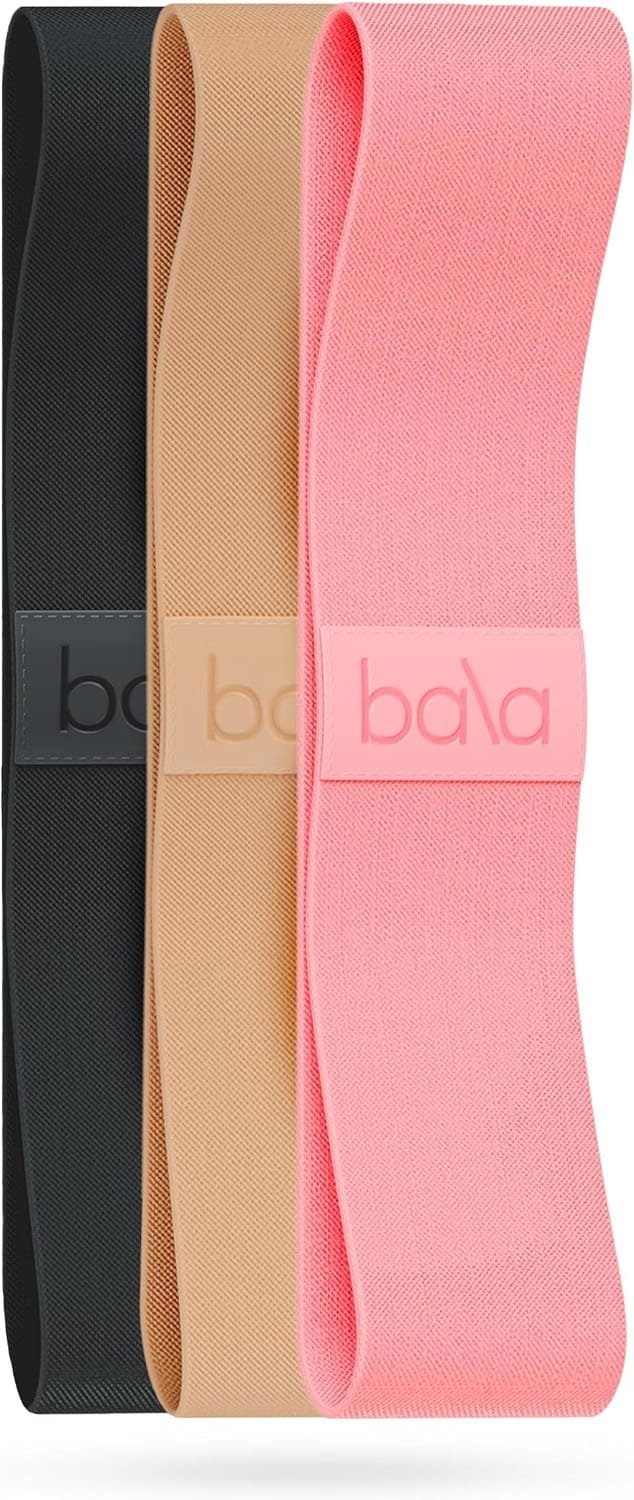
Quick verdict: Bala Bands are premium fabric mini-loop resistance bands that stay flatter and feel more comfortable than many thin latex loops. The three resistance levels work especially well for glute activation, Pilates, lateral walks, and controlled lower-body training. Their main weakness is value: $35 is expensive for a three-band set, and the short loop size limits full-body exercise variety.
PVL editorial rating: 4.3/5
A comfortable, durable-looking premium choice for lower-body and Pilates workouts, with excellent grip but a higher-than-average price.
Bala Bands at a glance
| Product | Bala Bands fabric resistance loops |
|---|---|
| Set | Three loop bands |
| Resistance levels | Light, medium, and heavy |
| Material | Woven elastic fabric with a grippy, non-slip interior |
| Best uses | Pilates, glute activation, lateral walks, squats, bridges, and lower-body accessory work |
| Current listed price | $35; prices and availability can change |
Pros and cons
Pros
- Fabric construction is less likely to roll or pinch than thin latex loops
- Three useful resistance levels
- Interior grip helps the bands stay in place
- Comfortable over leggings or bare skin
- Compact for travel and home workouts
Cons
- Costs more than many comparable fabric-band sets
- Short loop design favors lower-body exercises
- Fixed loop length cannot be adjusted
- Heavy band may be too demanding for beginners
- Not a replacement for progressive heavy resistance
Best for
- Pilates and barre users who want fabric loops that resist rolling
- Glute activation before squats, deadlifts, or running
- Home exercisers doing bridges, clamshells, kickbacks, and lateral walks
- Travelers who want three compact resistance levels
Who should choose something else?
These bands are less suitable for people who want a complete full-body cable replacement, long-band assisted pull-ups, or clearly measured resistance in pounds. People with acute hip, knee, ankle, or back pain, recent surgery, significant balance limitations, or a rehabilitation plan should use exercises and resistance prescribed for their situation.
Design and comfort
Bala Bands use wide woven fabric rather than a narrow sheet of latex. The wider surface distributes pressure across more skin and is less prone to curling into a thin edge. A grippy inner surface helps reduce sliding during repeated hip and leg movements.
The three colors correspond to light, medium, and heavy resistance. This makes progression simple: begin with the level that permits controlled range and move up only when repetitions remain steady without knees collapsing inward or the torso compensating.
How they perform across common exercises
Glute bridges and hip thrusts
Placing a loop above the knees creates outward tension during bridges and hip thrusts. The fabric design should stay flatter than a thin rubber loop, making it a practical use for the medium or heavy band.
Lateral walks and standing abduction
Lateral walks, monster walks, and controlled standing leg movements are strong use cases. Placement above the knees is generally easier; moving the band toward the ankles increases the lever arm and difficulty.
Squats
A band can cue outward knee pressure, but it does not automatically correct squat form. Use a resistance level that does not distort foot position, depth, or balance. The band adds lateral tension rather than replacing the main loading provided by body weight, dumbbells, or a barbell.
Upper-body training
Mini loops can support some shoulder activation and arm exercises, but the short circumference limits range. Long resistance bands, tubes with handles, or dumbbells provide more upper-body options.
Manufacturer claims vs. independent evidence
What Bala says
Bala markets the set as three non-slip fabric bands for strength, yoga, Pilates, and lower-body workouts. The light, medium, and heavy levels are intended to make the set usable across different exercises and abilities.
What independent evidence supports
Research supports elastic resistance as a legitimate strength-training tool. A systematic review and meta-analysis found that elastic resistance can produce strength gains similar to conventional resistance training when programs are appropriately designed. Broader reviews also report benefits for strength and physical function in several populations.
That evidence applies to elastic resistance training generally—not specifically to Bala Bands. Results depend on training effort, range of motion, exercise selection, progression, frequency, and consistency. No band can selectively “tone” one area or reduce fat from the hips or thighs.
Safety and proper use
- Inspect the fabric, seams, and inner grip before every session.
- Use enough space and a stable, non-slip surface.
- Choose a band that permits smooth, controlled movement.
- Keep knees tracking in line with the feet during squats and lateral work.
- Avoid stretching the band beyond its intended exercise range.
- Stop if you feel sharp pain, numbness, joint pain, or loss of control.
Beginners should master the movement without resistance first. If a band changes technique or reduces range substantially, use a lighter level. Elastic resistance is not risk-free: a damaged or overstretched band can fail, and excessive resistance can encourage compensatory movement.
Value and alternatives
At $35, Bala Bands sit in the premium part of the mini-band market. Their value rests on comfort, grip, finish, coordinated resistance levels, and a recognizable design—not unique training effects.
- Budget fabric loop sets: often supply similar light, medium, and heavy levels for less, though grip and stitching quality vary.
- Latex mini bands: cheaper and more compact, but more likely to roll, pinch, or pull hair.
- Long resistance bands: more versatile for rows, presses, assisted pull-ups, and mobility work.
- Adjustable tube systems: better for full-body home strength workouts and clearer progression.
Bottom line
Bala Bands are easy to recommend for someone who regularly performs Pilates, barre, glute activation, or lower-body accessory exercises and values a secure fabric loop. The set is comfortable, portable, and more polished than many inexpensive alternatives. Budget buyers can get similar resistance elsewhere, while people building a complete strength program will need heavier or more versatile equipment alongside them.
Check Bala Bands availability on Amazon
Frequently asked questions
What resistance levels come with Bala Bands?
Bala Bands include three short fabric loops with light, medium, and heavy resistance. The light band suits warm-ups and beginners, the medium band works well for controlled accessory exercises, and the heavy band adds more challenge to movements such as glute bridges, squats, and lateral walks.
Do Bala Bands roll up?
No, Bala Bands are less likely to roll into a narrow edge than thin latex loops because their wide woven fabric spreads tension across a larger surface. However, no resistance band is completely roll-proof. Correct sizing, placement, clothing, and controlled movement all affect how securely a band stays in position.
Are Bala Bands good for beginners?
Yes, Bala Bands can suit beginners when the light band is paired with movements they can already perform correctly. Start with a short range and controlled repetitions before increasing resistance. Move to the medium or heavy band only when technique remains stable and the band does not pull the knees or hips out of alignment.
Can Bala Bands build glutes?
Yes, Bala Bands can support glute training by adding lateral resistance to bridges, clamshells, squats, kickbacks, and lateral walks. That resistance can increase muscular effort, but meaningful growth still requires progressive overload, sufficient training volume, adequate protein and calories, and recovery. The bands are a useful tool rather than a complete program.
Can you use Bala Bands for upper-body exercises?
Yes, Bala Bands can be used for a limited selection of upper-body exercises, including shoulder activation, pull-aparts, and some arm movements. Their short loop length restricts range of motion, however. Long resistance bands or handled tubes are more versatile for rows, presses, pulldowns, and complete upper-body workouts.
Where should a resistance loop sit during leg exercises?
Place Bala Bands above the knees when learning bridges, squats, clamshells, and lateral walks because this position generally provides more control. Moving a loop toward the ankles or feet increases the lever arm and makes the exercise harder. Use the lower position only when you can maintain stable knees, feet, hips, and balance.
Are Bala Bands latex-free?
Bala Bands should not be assumed to be latex-free without confirmation from the manufacturer. The supplied product information describes woven fabric exercise bands, but it does not establish the complete composition of the elastic fibers or interior grip. Anyone with a latex allergy should ask Bala to confirm the current materials before purchasing or using them.
How should Bala Bands be cleaned?
Clean Bala Bands according to Bala’s current care instructions, using gentle methods that protect the woven fabric, seams, elastic fibers, and interior grip. Avoid harsh chemicals, machine drying, and high heat unless the manufacturer specifically permits them. Let each band dry completely before storage and replace it if you notice fraying, torn seams, or reduced elasticity.
Reliable references
- Bala — Bala Bands product information
- Lopes et al. — Elastic resistance versus conventional resistance training
- Li et al. — Elastic-band resistance training review
- NSCA — The value of resistance bands as a training modality
- Verywell Fit — Independent resistance-band testing
Related PVL guides
- Bala Bangles review
- PowerBlock adjustable kettlebell review
- Best ab rollers for home core training
- How to prevent muscle loss after 50
Editorial note: This review is based on product specifications, manufacturer information, independent product testing, and published resistance-training research. Purely Vital Living did not claim hands-on testing. Prices and availability can change.
Reviews
There are no reviews yet.