Quick answer: Prebiotics are substrates that beneficial microorganisms selectively use, probiotics are live microorganisms that provide a health benefit when taken in adequate amounts, and postbiotics are preparations of inanimate microorganisms and/or their components that confer a health benefit. They are not interchangeable—and not everyone needs a supplement.
Key Takeaways
- Prebiotics nourish selected gut microorganisms; certain fibers qualify, but not all dietary fiber is prebiotic.
- Probiotics must be live, identified microorganisms with evidence of a benefit at an appropriate amount.
- Postbiotics contain inanimate microorganisms and/or their components; ordinary fermentation byproducts alone are not necessarily postbiotics.
- For most people, a varied, fiber-rich diet is a sensible starting point. Supplements should be chosen for a specific purpose, not simply a high number on the label.
| Feature | Prebiotics | Probiotics | Postbiotics |
|---|---|---|---|
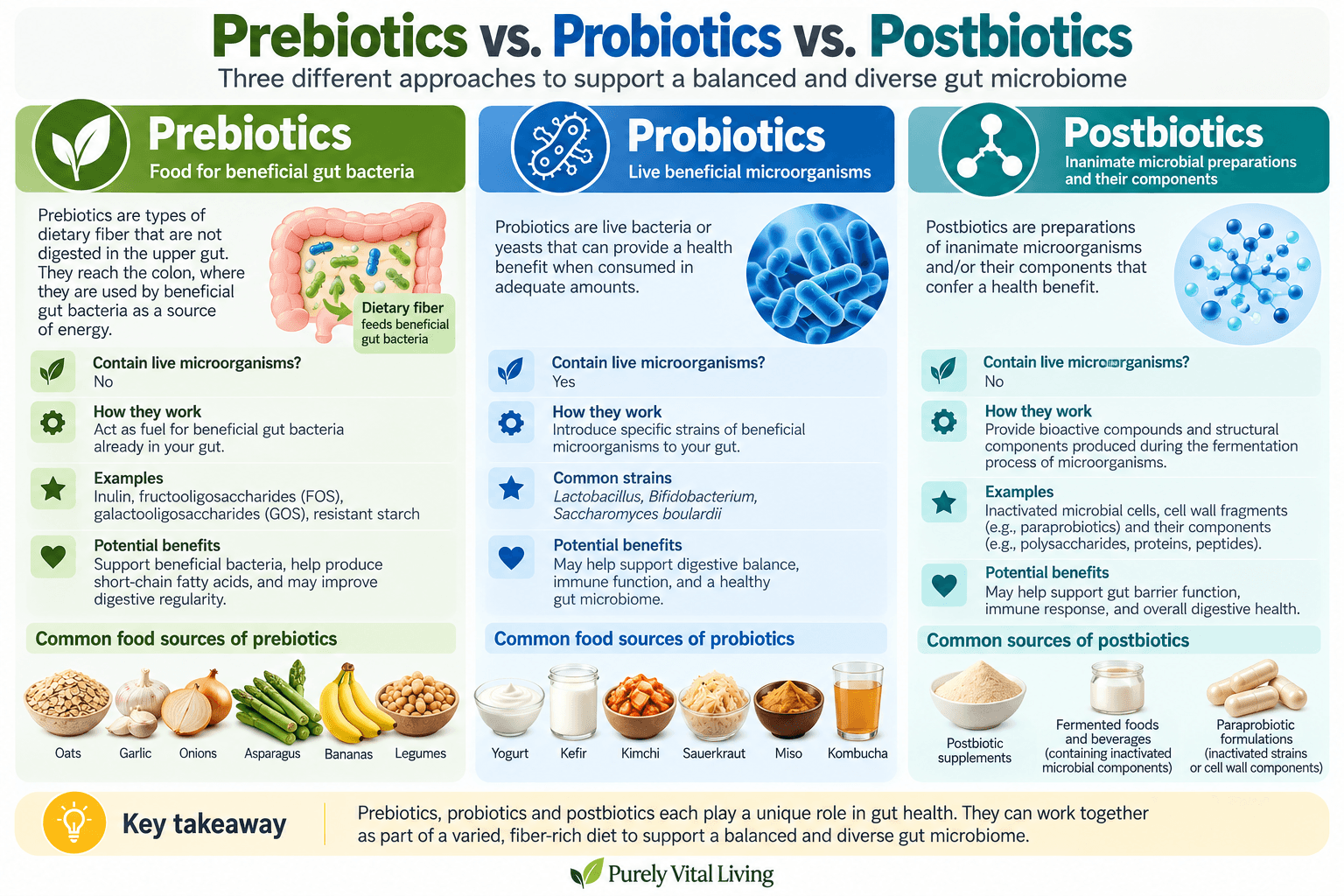
| What are they? | Substrates selectively used by host microorganisms that confer a health benefit | Live microorganisms that confer a health benefit in adequate amounts | Preparations of inanimate microorganisms and/or components that confer a health benefit |
| Are they alive? | No | Yes, when consumed | No |
| Main role | Support selected microbes already present | Deliver specific live microbes | Deliver studied nonliving microbial preparations |
| Examples | Inulin, fructooligosaccharides (FOS), galactooligosaccharides (GOS) | Evidence-backed strains in certain foods and supplements | Specific heat-treated microbial preparations studied for health outcomes |
| Important caveat | Not every fiber is a prebiotic | Not every fermented food contains proven probiotics | Not every dead microbe or microbial metabolite is a postbiotic |
What Are Prebiotics?
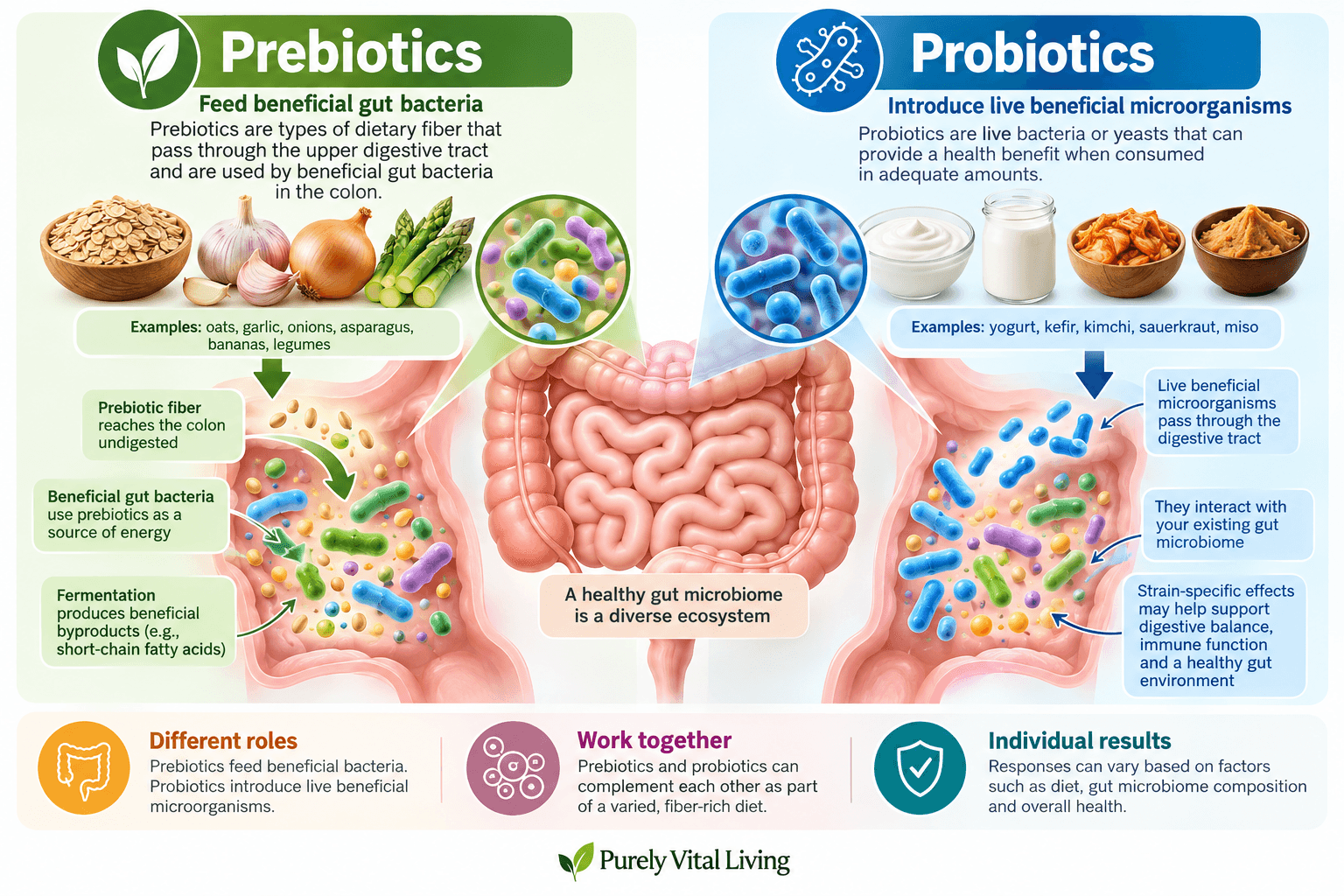
Prebiotics are substances selectively utilized by microorganisms in or on the body that confer a health benefit. Many well-studied prebiotics are fermentable carbohydrates, including inulin, FOS and GOS. The term is more precise than simply “fiber”: a fiber must meet the definition to qualify as a prebiotic.
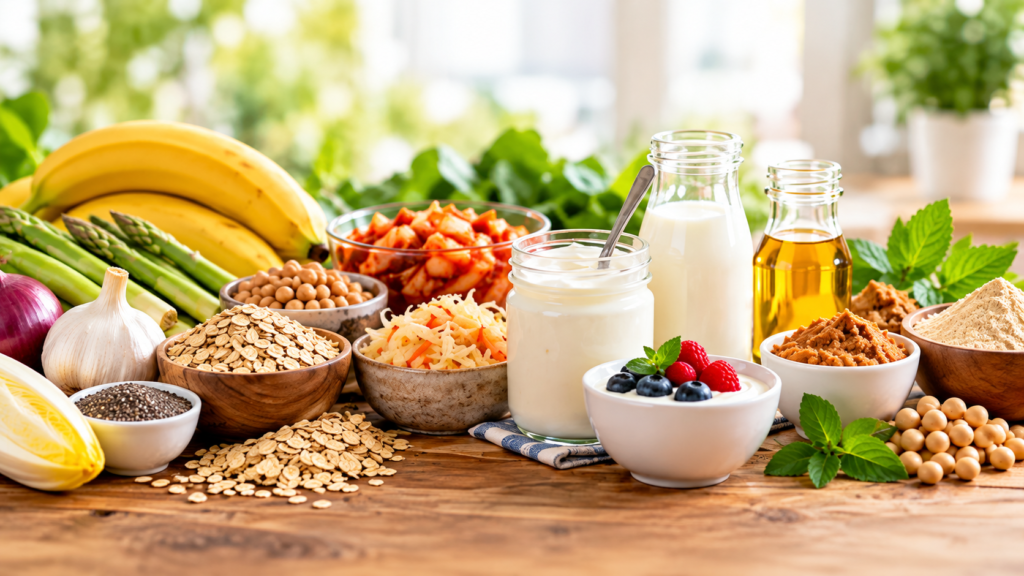
Foods that can contribute prebiotic compounds include onions, garlic, leeks, asparagus, chicory root, oats and certain legumes. The amount and type vary with the food and preparation. Eating a variety of plant foods also supplies other valuable fibers that may not formally qualify as prebiotics.
What Are Probiotics?
Why strain names matter: A label may identify a microorganism by genus, species and strain—for example, a strain code following the species name. Research on one strain should not be assumed to apply to every strain in that species. This matters because studies examine particular outcomes, such as specific digestive symptoms, rather than proving that all probiotics generally improve gut health. CFU stands for colony-forming units, a common way to express the quantity of viable microorganisms. A larger CFU number is not automatically better; the appropriate amount depends on the strain and the evidence for its intended use. Also check whether the labeled count is guaranteed through expiration rather than only at manufacture.
Some yogurts and fermented foods contain live cultures, but “fermented” does not automatically mean “probiotic.” To make a probiotic claim, the organisms and the relevant benefit need adequate evidence. When comparing supplements, look for the full strain designation, the studied amount, and the labeled viable count through the end of shelf life.
What Are Postbiotics?
Scientific basis: ISAPP postbiotics consensus (2021).
One way to understand the distinction is to compare a studied live microbial strain with a preparation made from microorganisms that have been intentionally inactivated. The latter does not need to remain viable, but it still needs evidence of a health benefit to qualify as a postbiotic. Researchers may examine effects of microbial cell structures or other components in the preparation. That does not mean all inactivated cultures are beneficial, or that a product advertised as “postbiotic” has proven benefits for digestion. Check whether research was performed in humans, used the same preparation and measured an outcome relevant to you.
Postbiotics are an emerging area of research. Claims should be tied to the exact preparation and outcome studied, rather than assuming that all postbiotics have the same effects.
How Do They Work Together? What Are Synbiotics?
Scientific basis: ISAPP synbiotics consensus (2020).
Scientists distinguish complementary synbiotics, which combine a probiotic and a prebiotic that each independently meet their respective definitions, from synergistic synbiotics, where a substrate is selectively used by the co-administered microorganism and the combination confers a health benefit. Simply mixing a bacterial culture with fiber does not establish that a product meets either definition. The formulation and supporting evidence matter.
A useful simplified picture is that prebiotics supply resources for selected microbes, while probiotics deliver live microbes. Some products combine both; these are called synbiotics when they meet the scientific definition. A synbiotic is not automatically superior to a probiotic or prebiotic alone. Whether it helps depends on the ingredients, amounts, and clinical evidence.
Microbial fermentation can also generate short-chain fatty acids such as acetate, propionate and butyrate. These compounds are important to gut biology, but they should not be casually equated with postbiotic products.
Food Sources: What Can You Eat?
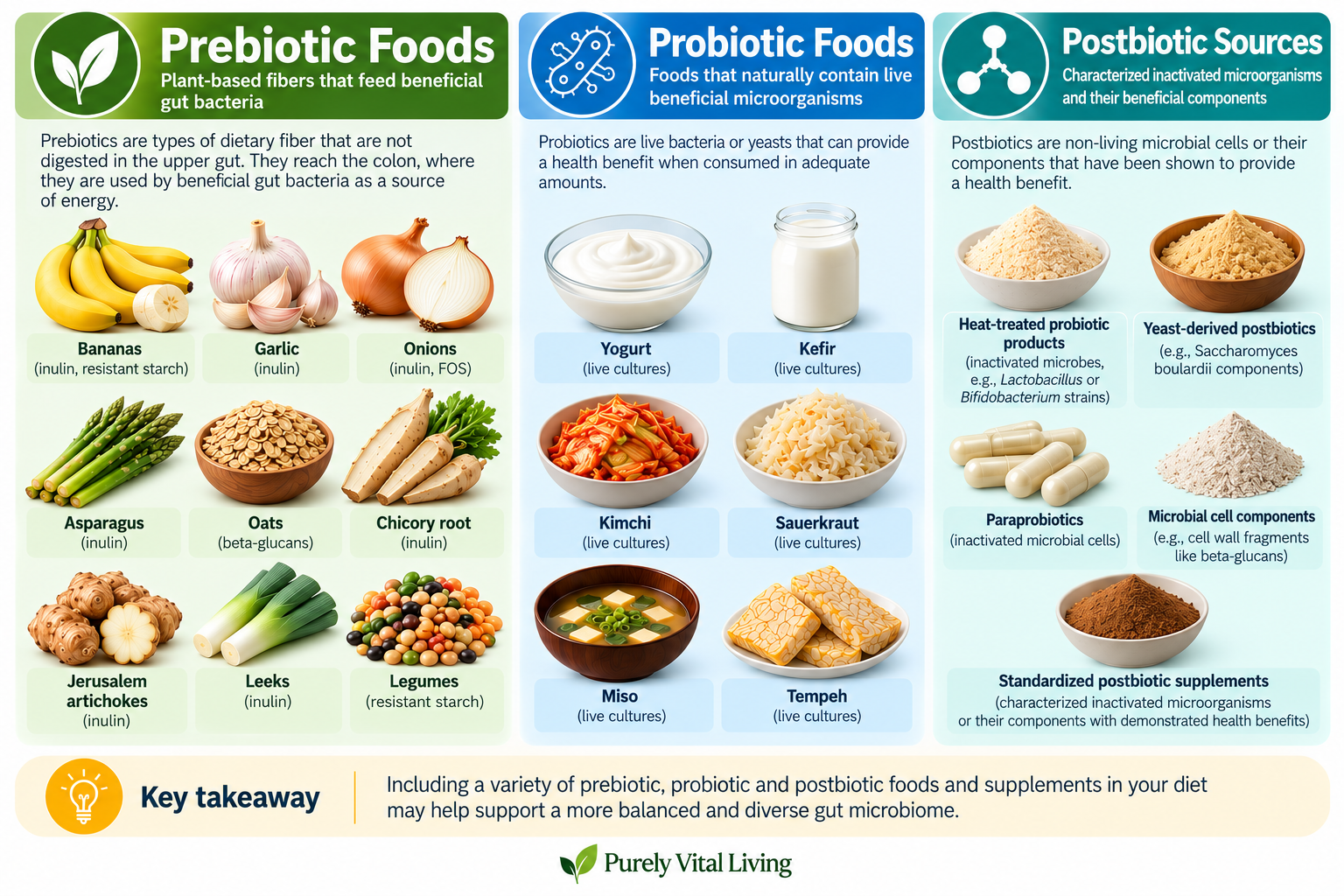
A food-first approach can be uncomplicated. Breakfast might include oats and fruit, lunch could include lentils or beans if tolerated, and a snack could be yogurt labeled with live cultures. Dinner can include a range of vegetables, with onion or garlic used according to personal tolerance.
| Food choice | What it may provide | Practical note |
|---|---|---|
| Onions, garlic, leeks, asparagus | Prebiotic-type fermentable carbohydrates | May aggravate symptoms in some people sensitive to FODMAPs |
| Oats, beans and lentils | Diverse dietary fibers; some fermentable substrates | Increase gradually if gas is an issue |
| Yogurt with live cultures, kefir | Live microorganisms | Check the label; not all cultures have proven probiotic effects |
| Kimchi and unpasteurized fermented vegetables | Potentially live fermentation microbes | Microbial content varies; not automatically a validated probiotic |
| Products labeled postbiotic | Specific inanimate microbial preparations | Assess evidence for the exact preparation, not just the marketing term |

Which Is Better for Gut Health?
Start with the problem you are trying to solve. A person eating very few plants may benefit from building a more varied diet; someone considering a probiotic for a specific condition should look for trials involving the exact strain and outcome. If a food regularly causes discomfort, increasing it merely because it is described as prebiotic is unlikely to be a helpful strategy.
| Your situation | Reasonable next step |
|---|---|
| Low intake of fiber-rich foods | Gradually diversify tolerated plant foods |
| Curious about fermented foods | Try suitable foods with live cultures, without assuming proven probiotic effects |
| IBS symptoms | Discuss dietary triggers and strain-specific evidence with a qualified clinician |
| Bloating after onions or garlic | Consider whether fermentable carbohydrates are contributing |
| Considering a postbiotic product | Look for human studies of the exact preparation and claimed outcome |
| Considering a synbiotic | Check the formulation and evidence rather than the combination claim alone |
There is no universal winner. If your diet lacks plant foods, improving fiber variety may be more useful than buying a supplement. A probiotic may be worth considering for a specific health goal when research supports the exact strain and dose. Postbiotics are less established for many everyday consumer uses, so product-specific evidence matters especially.
For persistent abdominal pain, diarrhea, constipation or unexplained weight loss, seek medical assessment rather than treating symptoms by trial and error. People with IBS or suspected SIBO may react poorly to certain highly fermentable prebiotic fibers. A personalized approach is more useful than assuming that more prebiotics always means better digestion.
Can You Take Prebiotics and Probiotics Together?
Many healthy adults can consume foods containing both. Combination supplements are not necessary for everyone, and combining ingredients does not guarantee added benefit. Introduce new high-fiber foods gradually and evaluate probiotics based on their specific evidence and your circumstances.
Possible Side Effects and Who Should Be Careful
Some prebiotic-rich foods contain fermentable carbohydrates often discussed under the term FODMAPs. In susceptible people, fermentation and movement of water into the intestine can contribute to bloating, gas or altered bowel habits. This does not make those foods unhealthy for everyone. For IBS, individualized dietary guidance can help distinguish foods that are generally nutritious from foods that trigger symptoms. Suspected SIBO requires clinical evaluation: neither prebiotic fiber nor an over-the-counter probiotic should be presented as a universal treatment. Seek prompt medical advice for concerning symptoms such as blood in the stool, unexplained weight loss or persistent severe pain.
Probiotics are not risk-free for everyone: people who are severely ill, immunocompromised or have complex medical conditions should ask a clinician before using live-microbe supplements. The safety of a postbiotic depends on the preparation and population studied.
Do not use supplements as a substitute for evaluation of persistent or worsening digestive symptoms.
PVL PRODUCT REVIEW · PROBIOTIC OPTION
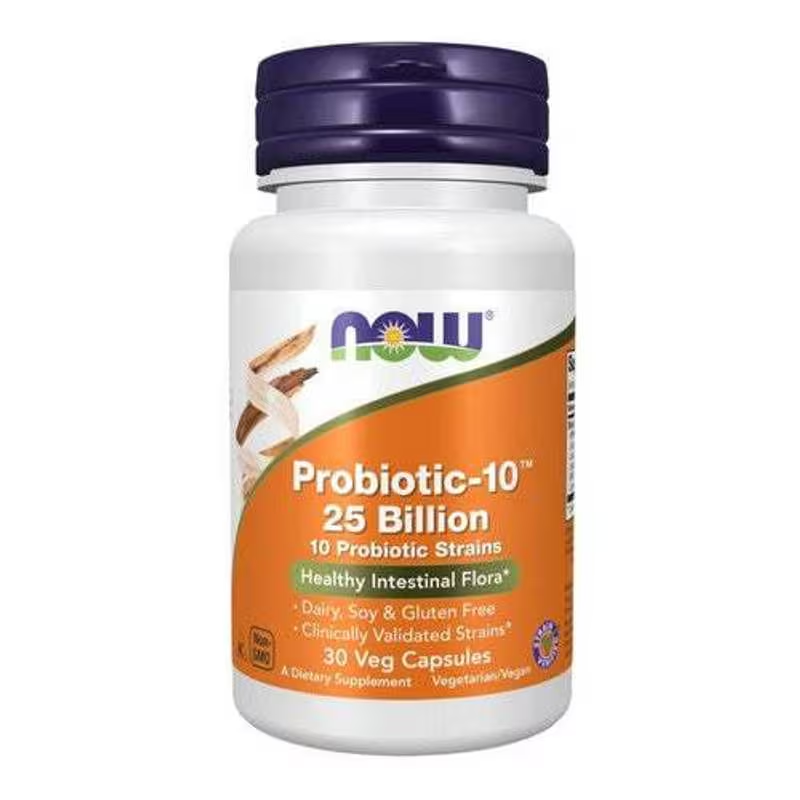
NOW Foods Probiotic-10 — 25 Billion CFU
PVL assessment: Ten labeled strains and a manufacturer-stated 25 billion CFU through the best-by date. Specific health benefits require strain- and outcome-specific evidence.
Availability: Check the current price, seller and product details on Amazon before ordering.
Buy on Amazon Read the Full Review
As an Amazon Associate, Purely Vital Living earns from qualifying purchases. Verify the exact product, seller, expiration date and storage conditions before ordering.
How to Choose a Supplement Without Falling for Hype
For example, compare two probiotic labels: one advertises “50 billion CFU” without clearly identifying strains, while another specifies its strains, amount through expiration and a relevant clinical study. The second label provides more information for an evidence-based decision, even if its CFU count is lower.
- Identify the specific goal or symptom you want to address.
- For probiotics, check the genus, species and strain, the dose used in studies, storage instructions and viable count through expiration.
- For prebiotics, identify the exact ingredient and serving size; start with a tolerable amount.
- For postbiotics, seek human evidence for the exact preparation and claimed benefit.
- Be cautious of blanket promises to “reset,” “detox” or permanently “rebalance” the microbiome.
For a closer look at strain-specific evidence and product selection, read PVL’s best probiotics for bloating guide. For symptom-specific context, see what research says about probiotics for IBS. If your stomach is sensitive, our guide to easily digested foods offers additional food ideas.
Frequently Asked Questions
Is it better to take prebiotics or probiotics?
Neither is universally better. Prebiotics provide substrates selectively used by certain microorganisms, while probiotics introduce specific live microorganisms with demonstrated health benefits. For general dietary support, varied fiber-rich foods can be a practical starting point. For a particular digestive concern, consider whether evidence supports the exact probiotic strain and intended outcome.
Are postbiotics the same as probiotics?
No. Probiotics are live microorganisms that confer a health benefit when administered in adequate amounts. Postbiotics are preparations of inanimate microorganisms and/or their components with demonstrated health benefits. Simply heat-treating a probiotic does not automatically produce a validated postbiotic, and isolated fermentation byproducts alone do not meet the scientific definition.
Do all fermented foods contain probiotics?
No. Fermented foods may contain live microorganisms, but they do not automatically provide an identified probiotic strain with demonstrated health benefits at the amount consumed. Some fermented foods are heated or pasteurized after fermentation, reducing or eliminating live microbes. Check the product and supporting evidence rather than assuming all fermented foods are probiotics.
Can prebiotics make bloating worse?
Yes. Some fermentable prebiotic ingredients, including inulin and fructooligosaccharides, can increase gas, bloating or discomfort, particularly in sensitive individuals or when introduced in large amounts. Effects depend on the ingredient, dose and personal tolerance. Introducing tolerable fiber-rich foods gradually may be more comfortable than immediately taking a concentrated supplement.
Do I need a synbiotic supplement?
Not necessarily. Synbiotics combine live microorganisms and substrates selectively used by microorganisms, but the precise combination and intended benefit matter. Many people can start with varied plant foods and fermented foods they tolerate. Consider a supplement when the specific formulation has relevant supporting evidence, rather than choosing one based on broad gut-health marketing claims.
How long does a probiotic take to work?
There is no universal timeline. The response depends on the exact probiotic strain, intended outcome, dose and individual circumstances. Clinical studies may assess outcomes over several weeks, but their timelines do not apply automatically to every product. Follow evidence for the specific strain and seek medical advice if symptoms persist or worsen.
The Bottom Line
Prebiotics, probiotics and postbiotics describe three distinct approaches to the microbiome. Start with diverse, tolerable plant foods; consider fermented foods if they suit you; and evaluate supplements by their exact ingredients and evidence. More is not necessarily better.
References and Further Reading
- ISAPP. Prebiotics: scientific definition and resources.
- Gibson GR, et al. Expert consensus document: The ISAPP consensus statement on the definition and scope of prebiotics. Nature Reviews Gastroenterology & Hepatology (2017).
- ISAPP. Probiotics: scientific definition and resources.
- Salminen S, et al. The ISAPP consensus statement on the definition and scope of postbiotics. Nature Reviews Gastroenterology & Hepatology (2021).
- Swanson KS, et al. ISAPP consensus statement on the definition and scope of synbiotics. Nature Reviews Gastroenterology & Hepatology (2020).
- NIH Office of Dietary Supplements. Probiotics: Fact Sheet for Health Professionals.
Medical disclaimer: This article is for general educational purposes and does not replace advice from a qualified healthcare professional. Seek personalized guidance for persistent symptoms or before using supplements if you have a complex medical condition.