For a long time, I thought my biggest problem was fatigue.
I could sleep through the night and still wake up feeling as though my body had never properly rested. Some days, the exhaustion followed me from the moment I woke up until the moment I went back to bed.
At first, I had plenty of explanations.
Maybe I was working too hard. Maybe stress was catching up with me. Maybe my chronic digestive problems were draining my energy. Maybe I needed to exercise differently, eat differently, or simply sleep longer.
What I didn’t fully understand was that the hours I spent asleep weren’t necessarily giving my body the restorative sleep it needed.
Snoring and daytime sleepiness eventually became pieces of a much larger puzzle. When sleep apnea entered that picture, I began looking at my fatigue—and my health—very differently.
Living with sleep apnea also became particularly significant for me because I was dealing with high blood pressure. Learning that the two conditions can be associated gave me another reason to stop treating sleep as an afterthought.
This is my experience of living with sleep apnea: what I noticed before I understood what was happening, how it affected my energy and everyday life, and what I wish I had taken more seriously earlier.
Quick Answer
Living with sleep apnea changed the way I understood fatigue. I learned that spending enough hours in bed doesn’t necessarily mean you’re getting restorative sleep. In my case, persistent exhaustion, daytime sleepiness and snoring became important clues that something more was happening during the night.
Sleep apnea eventually became one part of a larger health picture that also included chronic fatigue and high blood pressure. Understanding that didn’t instantly solve my health problems, but it changed how seriously I treated sleep and recovery.
This is my personal experience, not a diagnostic guide. Persistent daytime sleepiness, loud snoring, witnessed breathing interruptions or other concerning sleep symptoms deserve discussion with a qualified healthcare professional.
Key Takeaways
- I initially blamed my exhaustion on everything except sleep apnea. Work, stress, exercise and other health problems all seemed like reasonable explanations.
- Sleeping longer didn’t always make me feel better. I began to understand that sleep duration and sleep quality aren’t the same thing.
- Daytime sleepiness became difficult to ignore. This felt different from simply being tired after a long day.
- Snoring was a clue I didn’t initially appreciate. I later learned that snoring can occur with obstructive sleep apnea, although snoring alone doesn’t mean someone has the condition.
- Sleep apnea became one piece of my chronic-fatigue puzzle. It helped me understand why addressing energy wasn’t simply about trying harder or getting more hours in bed.
- High blood pressure made sleep health even more important to me. Because I was dealing with both conditions, learning about the relationship between sleep apnea and high blood pressure became personally significant.
Table of Contents
- My Sleep Apnea Journey at a Glance
- Before I Knew I Had Sleep Apnea
- The Daytime Sleepiness I Couldn’t Ignore
- Discovering Sleep Apnea
- Sleep Apnea and High Blood Pressure
- What Actually Helped Me Manage My Sleep and Energy
- What I Wish I Had Understood Earlier
- To Anyone Struggling With Persistent Daytime Sleepiness
- Living With Sleep Apnea Changed More Than My Sleep
- What Living With Sleep Apnea Looks Like for Me Today
- Questions I Wish I Had Asked Earlier
- My Perspective Today
- Related Reads
My Sleep Apnea Journey at a Glance
| Stage | What I Experienced |
|---|---|
| Early signs | Snoring, persistent tiredness and sleep that didn’t always feel restorative |
| Fatigue worsened | Waking tired despite spending what seemed like enough time in bed |
| Daytime symptoms | Increasing sleepiness and difficulty maintaining consistent energy |
| Looking for answers | I began paying much more attention to sleep quality rather than sleep duration alone |
| Sleep apnea | Sleep apnea became an important part of understanding my fatigue |
| High blood pressure | Having high blood pressure gave me another reason to take the relationship between sleep and overall health seriously |
| Today | I treat sleep and recovery as essential parts of managing my overall health and energy |
Before I Knew I Had Sleep Apnea
I Thought Exhaustion Was Just Part of My Life
Being tired wasn’t unusual for me.
I spent many years working in construction management, an industry where long days, demanding projects, deadlines, meetings and unexpected problems are simply part of the job.
There were periods of early mornings and late nights. There were stressful projects and times when work followed me mentally long after the working day had finished.
So when I became increasingly exhausted, work seemed like an obvious explanation.
I was also dealing with chronic digestive problems. IBS and slow motility had already taught me how much physical and mental energy a chronic condition can consume.
Then there was exercise.
I had experienced periods when going to the gym left me far more exhausted than I expected. Instead of feeling energized after recovering from a workout, there were times when I felt depleted.
With so many possible explanations, sleep apnea wasn’t the first thing on my mind.
I thought I needed more rest.
I thought I needed to manage stress better.
I thought I needed to improve my diet.
Sometimes I simply thought I needed to push through it.
Looking back, that is one of the reasons it took time for me to understand what was happening.
Fatigue rarely arrives carrying a label explaining its cause.
The Snoring I Didn’t Take Seriously Enough
Snoring was another piece of the puzzle.
Like many people, I didn’t initially think of snoring as something that might deserve serious attention.
Snoring can easily become a joke.
Someone tells you that you snore loudly. You laugh about it. Maybe you change your sleeping position. Then life continues.
That was much easier than imagining that something could be interfering with my breathing while I slept.
What I eventually learned is that snoring and sleep apnea aren’t the same thing. Many people snore without having obstructive sleep apnea.
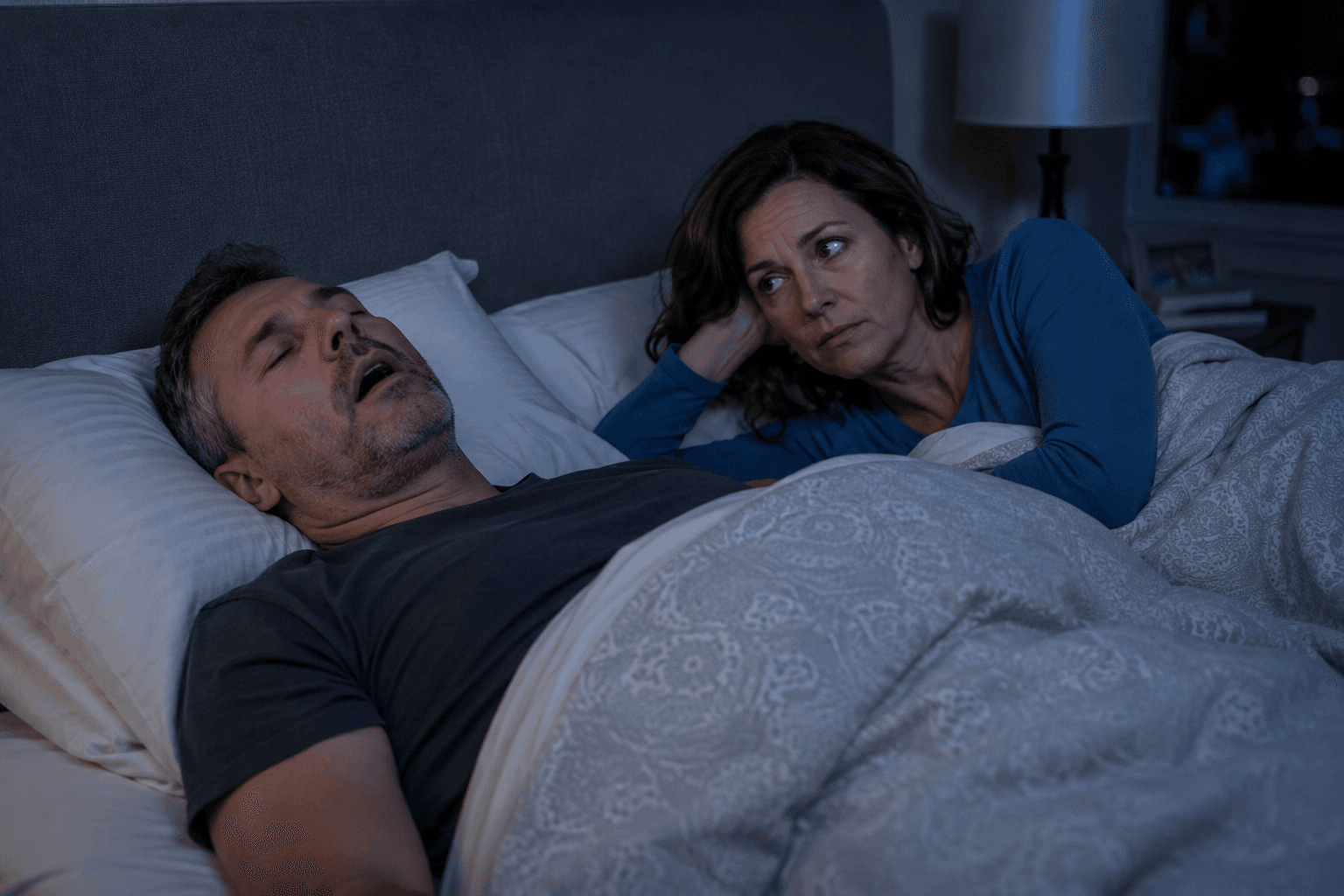
But snoring can also be one of the signs that prompts further investigation, particularly when it occurs alongside symptoms such as persistent daytime sleepiness or observed interruptions in breathing.
In my case, the snoring became more meaningful when I looked at it alongside everything else I was experiencing.
I wasn’t simply snoring.
I was exhausted.
I wasn’t always waking refreshed.
I was struggling with daytime sleepiness.
Separately, each problem had seemed easy to dismiss.
Together, they began telling a different story.
Waking Up Tired Even After Enough Sleep
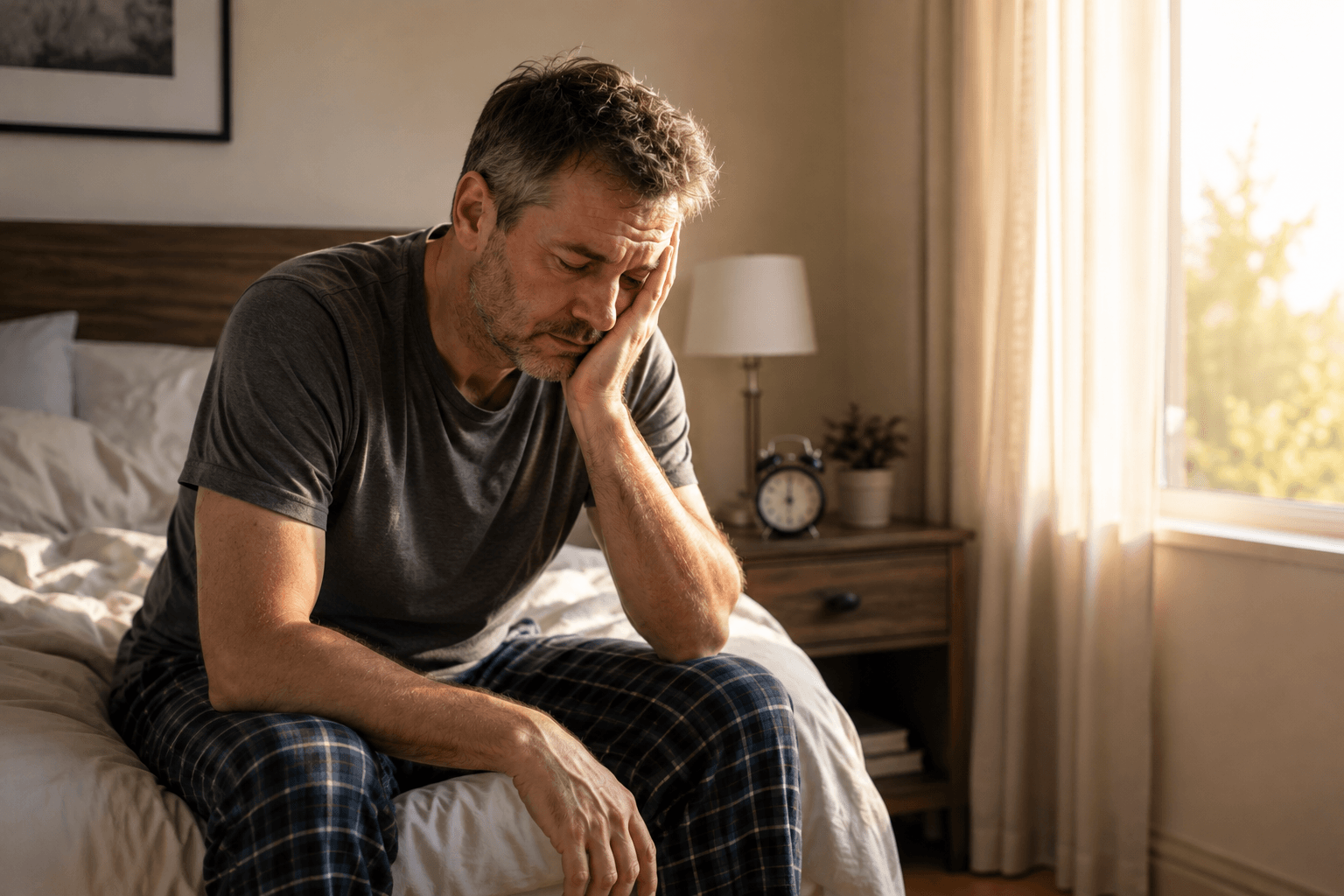
One of the most frustrating parts was waking up tired.
There is something psychologically difficult about going to bed expecting sleep to restore your energy and then opening your eyes the next morning feeling as though the restoration never happened.
Sometimes I had spent what seemed like enough time in bed.
On paper, I should have been rested.
My body didn’t always agree.
That experience eventually changed the way I thought about sleep.
Before this period of my life, I largely measured sleep by hours.
Six hours.
Seven hours.
Eight hours.
More hours should mean more recovery.
But sleep doesn’t work quite that simply.
My experience eventually taught me to think about sleep quality as well as sleep quantity.
It is one of the reasons I’ve since written separately about why someone can still feel tired after eight hours of sleep.
At the time, however, I wasn’t thinking about sleep architecture or breathing disturbances.
I was thinking:
Why am I still exhausted?
When Fatigue Followed Me Into the Day
Morning tiredness would have been difficult enough if it disappeared after breakfast and a cup of coffee.
Sometimes it didn’t.
The fatigue could follow me into the day.
That was when the problem became harder to dismiss.
There is an important difference between wanting an afternoon nap after a particularly difficult day and feeling as though your body is repeatedly demanding sleep when you’re supposed to be functioning normally.
I began experiencing daytime sleepiness that made me question whether ordinary tiredness could really explain what I was feeling.
I could still work.
I could still have conversations.
I could still fulfill responsibilities.
From the outside, there might not have been anything obviously wrong.
But maintaining that normal appearance could require much more effort than anyone around me realized.
That became one of the strangest parts of the experience.
You can look completely awake while internally fighting exhaustion.
The Daytime Sleepiness I Couldn’t Ignore
When Staying Awake Became Difficult
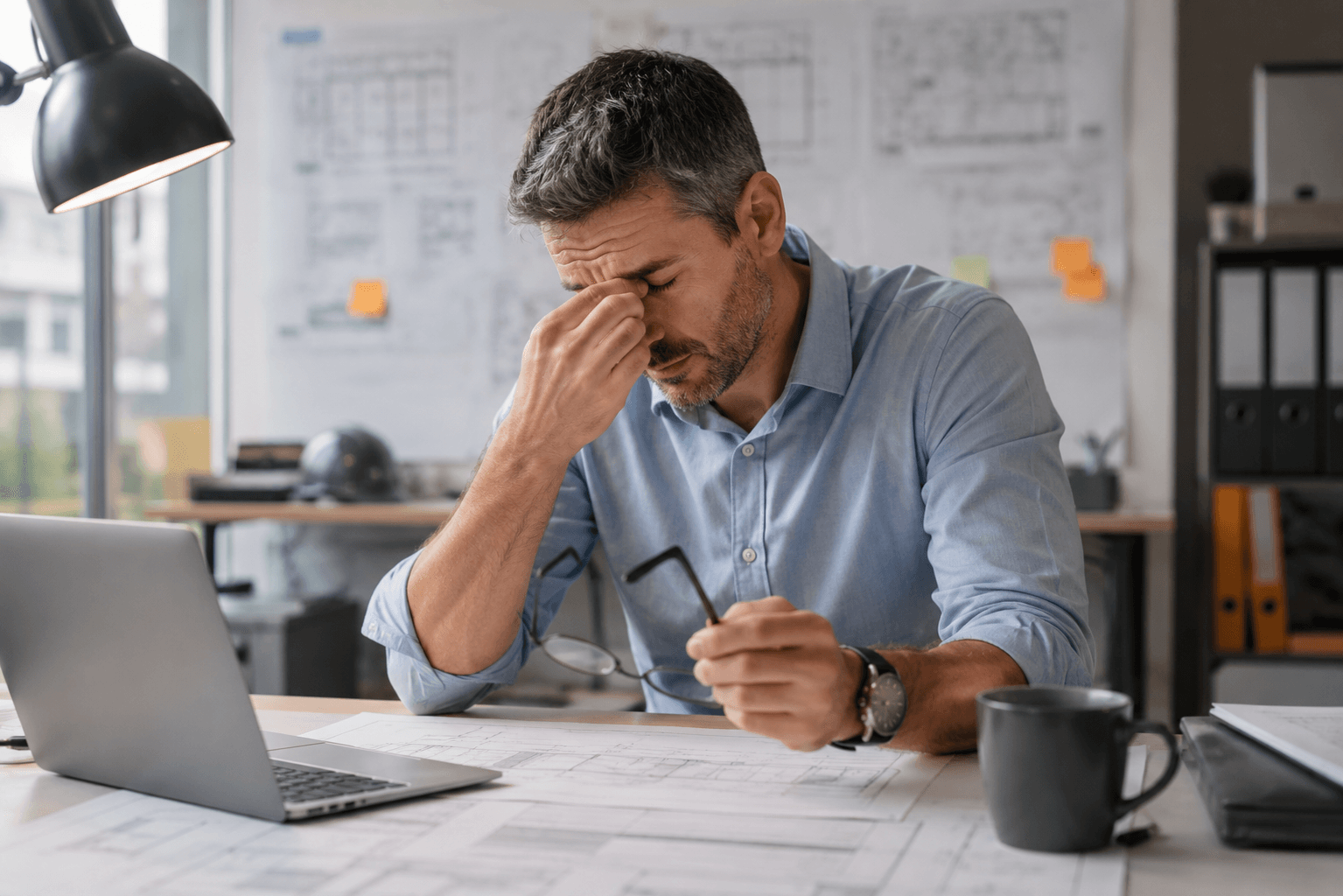
Eventually, daytime sleepiness stopped feeling like a minor inconvenience.
There were times when the urge to sleep became remarkably strong.
That frightened me more than ordinary fatigue.
Being tired is something most of us understand. You finish a difficult day, sit on the sofa and feel exhausted.
This was different.
There were moments when my body seemed to be demanding sleep regardless of what I wanted to do.
That loss of control changed the way I thought about the problem.
I could no longer simply tell myself:
You’re tired. Get on with it.
I had spent much of my professional life solving problems by working harder, planning better and pushing through difficult situations.
Fatigue didn’t respond particularly well to that approach.
Willpower could help me complete a task.
It couldn’t necessarily make my body feel rested.
That distinction took me a long time to accept.
Looking Fine While Feeling Completely Exhausted
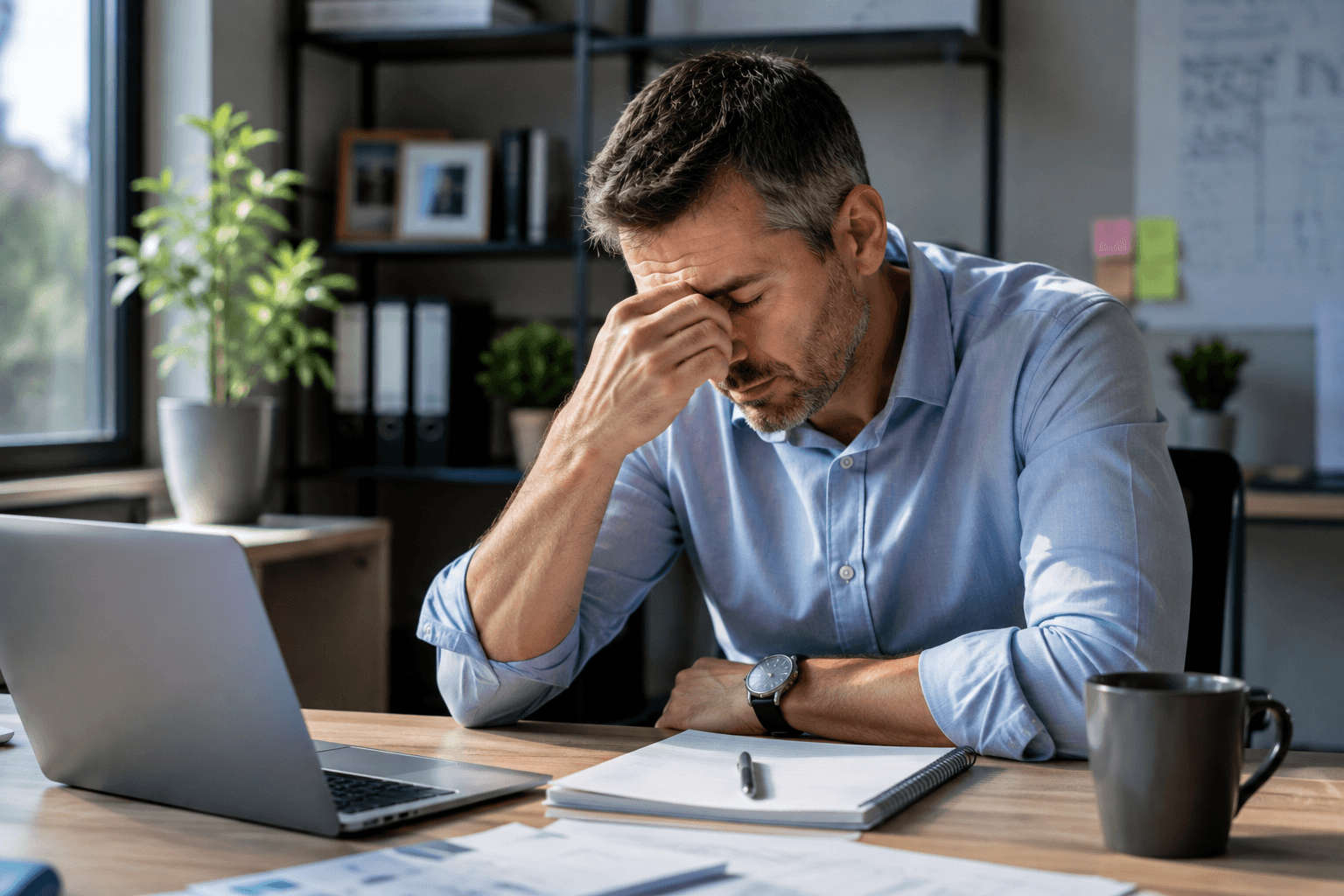
Sleep problems can be surprisingly invisible.
If someone has a broken leg, everyone understands why walking is difficult.
Fatigue doesn’t offer the same visible explanation.
Someone could look at me during a meeting and see a person sitting normally, talking about a project and making decisions.
They couldn’t necessarily see how much energy that required.
They couldn’t feel the heaviness behind my eyes.
They couldn’t know that I might have started the morning already tired.
And they certainly couldn’t see what had happened while I was sleeping the previous night.
This was something I had already encountered through my digestive problems.
People often judge health by appearance.
If you look healthy, they assume you feel healthy.
Living with chronic fatigue and sleep problems taught me repeatedly how unreliable that assumption can be.
Managing Fatigue During a Demanding Career
My work made the situation particularly challenging.
Construction management isn’t a profession where every day unfolds according to plan.
Problems happen.
Schedules change.
Decisions have consequences.
Different stakeholders want different things.
You have to communicate, solve problems and remain focused even when the day becomes stressful.
For years, I had relied on discipline to handle that environment.
If something needed to be done, I did it.
But persistent fatigue introduced a variable I couldn’t completely control.
My calendar might say I had eight productive hours available.
My body might disagree.
That forced me to begin thinking differently about energy.
I started recognizing that time and energy are two different resources.
Having time available doesn’t necessarily mean having the physical or mental energy to use it effectively.
That lesson later became central to the way I learned to manage chronic fatigue.
The Mental Cost of Unpredictable Energy
Unpredictability can be almost as frustrating as fatigue itself.
If I knew exactly how I would feel every morning, I could plan around it.
But energy didn’t always behave consistently.
There could be better days when I thought:
Maybe I’m finally improving.
Then a difficult day would arrive and make me question that progress.
This can create a strange relationship with your own body.
You begin monitoring yourself.
How tired am I this morning?
How much energy do I have?
Should I exercise today?
Will I still have enough energy this afternoon?
Should I rest now or keep going?
These calculations gradually become part of everyday life.
For someone accustomed to planning projects and solving problems, I naturally wanted to find a formula.
Do X and receive Y amount of energy.
My body refused to be that predictable.
Eventually, I had to become more flexible.
Fatigue Wasn’t Just About Feeling Sleepy
Another thing I came to understand was that fatigue could affect much more than my desire to sleep.
It influenced motivation.
Concentration.
Exercise.
Patience.
The amount of effort ordinary tasks seemed to require.
It could even change how I viewed the day ahead.
On a good-energy morning, a busy schedule looked manageable.
On a low-energy morning, exactly the same schedule could look overwhelming.
That experience is part of why I later wrote about how to get more energy naturally, but my personal journey taught me something important first:
There isn’t always one cause of fatigue.
For me, digestive health, stress, physical activity, sleep quality and eventually sleep apnea all became pieces of a much larger picture.
When I Realized I Needed to Look More Closely at Sleep
Eventually, I could no longer treat sleep as simply the number of hours between going to bed and waking up.
The combination was becoming too difficult to ignore:
Snoring.
Waking tired.
Persistent fatigue.
Daytime sleepiness.
Something was happening that required a closer look.
That realization marked an important turning point.
Until then, I had spent much of my energy trying to solve the exhaustion itself.
Now I began asking a different question:
What was happening while I was asleep?
That question would eventually lead me toward understanding sleep apnea—and give me an important new piece of a health puzzle I had been trying to solve for years.
Discovering Sleep Apnea
When I Finally Started Looking at My Sleep Differently
For a long time, I focused on the fatigue itself.
I wanted to know why I had so little energy, why exercise sometimes left me depleted, and why getting what seemed like enough sleep didn’t necessarily make me feel rested.
Eventually, though, I began looking at the problem from the opposite direction.
Instead of asking:
Why am I so tired during the day?
I started asking:
What is happening to me during the night?
That was an important change.
Snoring, persistent daytime sleepiness, and waking without feeling properly restored began to look less like unrelated problems and more like clues.
Until then, sleep had largely been something I measured by time.
If I went to bed at a reasonable hour and stayed there for seven or eight hours, I assumed I had slept.
But being unconscious for a certain number of hours and experiencing genuinely restorative sleep are not necessarily the same thing.
Sleep apnea helped me understand that distinction.
Discovering That Sleep Apnea Was Part of the Problem
Eventually, sleep apnea became part of my diagnosis and another piece of the health puzzle I had been trying to understand.
Receiving an explanation didn’t suddenly make the fatigue disappear.
But it changed the way I interpreted years of symptoms.
The snoring made more sense.
The daytime sleepiness made more sense.
Waking up without feeling properly refreshed made more sense.
For years, I had thought mostly about what I was doing while awake.
Was I exercising enough?
Was I eating correctly?
Was I stressed?
Was I drinking enough water?
Was I working too hard?
Now I had to consider something completely different:
My body might not have been getting the quality of sleep I assumed it was getting.
That realization was both concerning and strangely reassuring.
I didn’t want another health condition.
But after spending so much time wondering why my energy behaved unpredictably, having another piece of the puzzle mattered.
Finally Having an Explanation
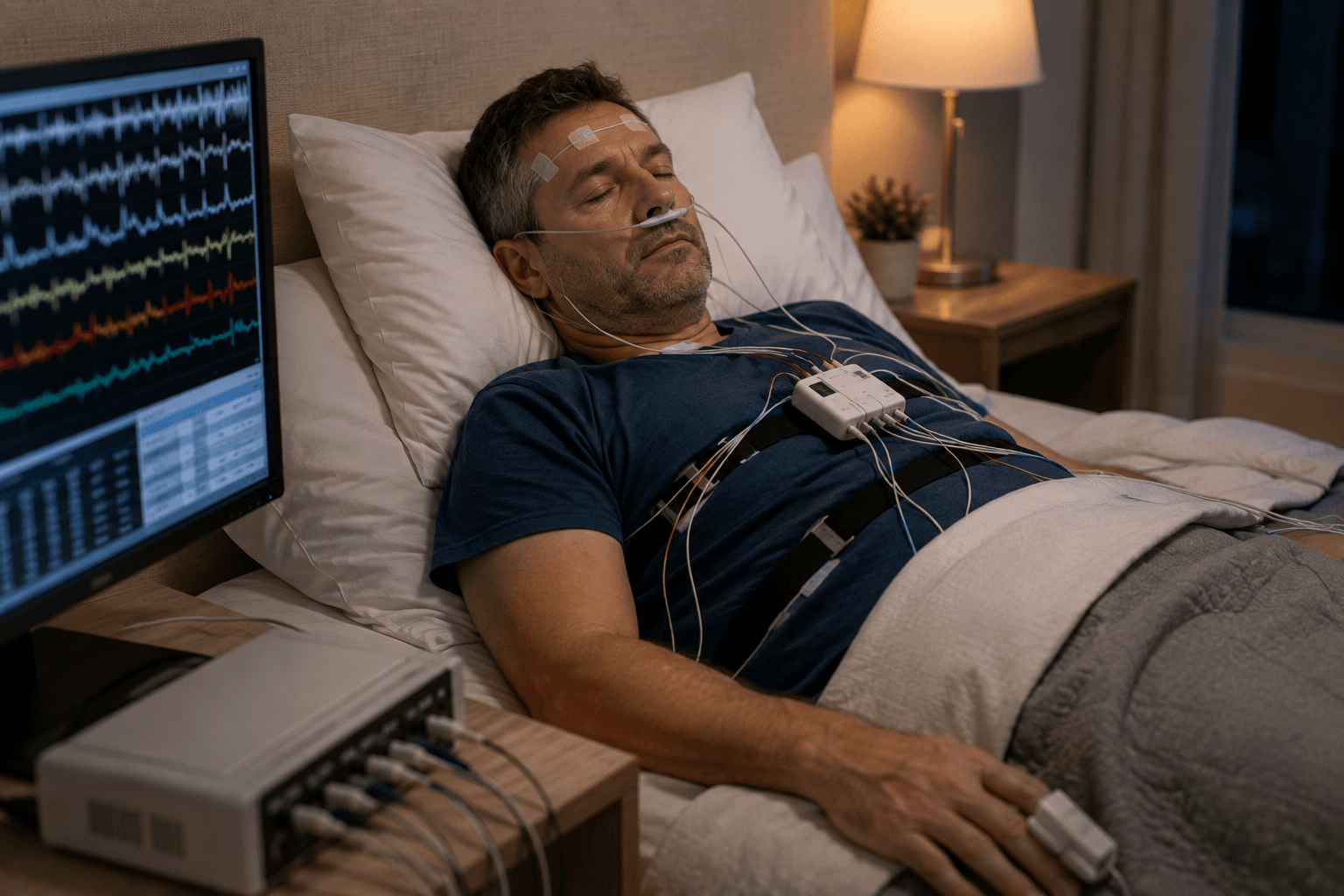
Anyone who has spent years dealing with unexplained symptoms may understand the strange mixture of emotions that can accompany a diagnosis.
There can be concern because you now know something is wrong.
But there can also be relief.
You finally have something concrete to investigate.
For me, sleep apnea didn’t explain every episode of fatigue I had ever experienced.
I was already dealing with other health challenges, and I had learned enough by then to be skeptical of simple explanations.
My chronic fatigue wasn’t a puzzle with only one piece.
Neither was my overall health.
But sleep apnea gave me something important that I hadn’t had before:
a reason to take the quality of my sleep as seriously as the quantity.
Looking Back at My Untreated Sleep Apnea
Looking back at the period before my sleep apnea was recognized, some of the signs seem more meaningful now than they did at the time.
The snoring.
The daytime sleepiness.
The persistent fatigue.
The feeling that sleep wasn’t always restoring my energy.
At the time, each symptom had other possible explanations.
That’s one of the difficulties with untreated sleep apnea: some of its effects can be easy to rationalize, particularly when you already have a busy life or other health problems.
The National Heart, Lung, and Blood Institute notes that untreated sleep apnea can interfere with quality sleep and contribute to problems with concentration, memory and decision-making. It is also associated with cardiovascular problems, including difficult-to-control high blood pressure.
That doesn’t mean every tired person has sleep apnea.
It also doesn’t mean snoring automatically means someone has it.
A proper diagnosis requires medical evaluation, and sleep studies are commonly used to determine whether sleep apnea is present and how severe it is.
For me, the important lesson was much simpler:
Persistent sleepiness deserved more attention than I had originally given it.
Sleep Duration Wasn’t the Same as Sleep Quality
This may have been the biggest change in how I thought about sleep.
Previously, I would look at the clock.
If I had spent eight hours in bed, I expected to feel rested.
If I didn’t, I assumed something else must be responsible.
Sleep apnea challenged that assumption.
Obstructive sleep apnea involves repeated partial or complete obstruction of the upper airway during sleep. These events can cause intermittent drops in oxygen and sleep fragmentation.
In practical terms, I began to understand something that now seems obvious:
You can give yourself enough opportunity to sleep and still not receive the restorative sleep you expected.
That helped explain why simply adding another hour in bed wasn’t necessarily solving my daytime exhaustion.
It also changed the way I approached my existing sleep habits.
Instead of asking only:
How many hours did I sleep?
I became much more interested in:
How well did I sleep?
That distinction eventually became central to the way I approach sleep throughout Purely Vital Living.
Sleep Apnea Became Part of a Bigger Health Picture
By this stage of my life, I had already learned that health problems rarely stay neatly inside separate boxes.
My digestive problems affected how I ate.
How I ate could affect how I felt.
Fatigue affected exercise.
Poor energy affected productivity.
Stress could influence both sleep and digestion.
And now sleep apnea was adding another dimension.
Instead of looking for one explanation for everything, I began thinking about health as an interconnected system.
That change in thinking eventually became much more important when I began learning about the relationship between sleep apnea and something else I was already dealing with:
high blood pressure.
Sleep Apnea and High Blood Pressure
Can Sleep Apnea Cause High Blood Pressure?
Yes. Obstructive sleep apnea is associated with an increased risk of high blood pressure, and medical organizations recognize sleep apnea as an important cardiovascular risk factor. The relationship is especially relevant in people whose hypertension is difficult to control.
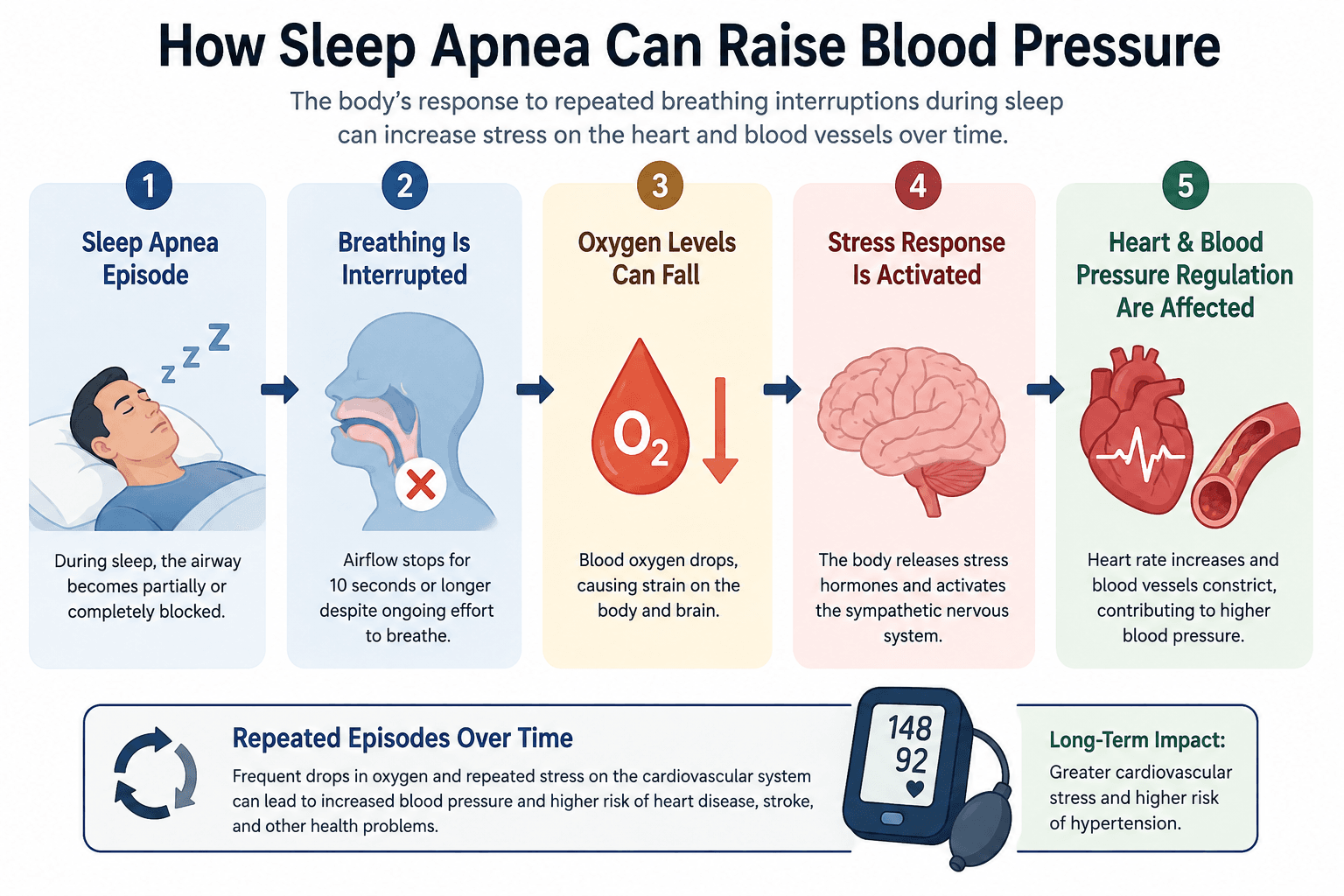
During obstructive sleep apnea, breathing repeatedly becomes reduced or stops because the upper airway is obstructed.
These episodes can cause oxygen levels to fall, disrupt sleep, and repeatedly activate the body’s stress responses. The American Heart Association describes these recurrent breathing disruptions as producing both acute and chronic physiological stress.
Over time, those repeated nighttime events are one reason researchers have connected obstructive sleep apnea with hypertension and other cardiovascular problems.
So when people ask “does sleep apnea cause high blood pressure?”, the relationship is well established enough that sleep apnea is specifically considered when clinicians evaluate some patients with resistant or poorly controlled hypertension.
But that doesn’t mean sleep apnea is responsible for every case of high blood pressure. Hypertension can have many contributing factors, and an individual’s cause or combination of causes needs to be assessed by their healthcare professional.
Why the Connection Became Personal for Me
Learning about the relationship between sleep apnea and high blood pressure wasn’t simply interesting medical information for me.
I was living with both.
That immediately made the subject more personal.
I want to make an important distinction here.
I cannot say that sleep apnea caused my high blood pressure.
My health history is more complicated than that, and hypertension can have multiple contributing factors.
But once I understood that obstructive sleep apnea and hypertension can be connected, I had another reason to take my sleep condition seriously.
The American Heart Association identifies obstructive sleep apnea as a condition that may increase the risk of developing high blood pressure, while the NHLBI similarly identifies high blood pressure among the health problems associated with sleep apnea.
For me, that information changed the context.
Sleep was no longer just about whether I felt tired the following morning.
It became part of how I thought about my wider health.
I Had Been Treating Sleep as an Energy Problem
Before understanding this relationship, most of my concern about sleep revolved around energy.
I wanted to sleep better because I wanted to wake up feeling better.
I wanted more energy for work.
I wanted enough energy to exercise.
I wanted to get through the afternoon without feeling as though my body wanted to shut down.
Those were perfectly understandable reasons to care about sleep.
But learning about the cardiovascular connection expanded my perspective.
Sleep quality wasn’t simply about whether I felt productive the next day.
What happened while I was sleeping could matter to other systems in my body as well.
That realization made sleep feel much less optional.
Why Sleep Apnea Can Affect Blood Pressure
The mechanism made more sense to me once I stopped thinking of sleep apnea as simply “bad sleep.”
During obstructive sleep apnea, breathing disruptions can repeatedly lower oxygen levels and activate the autonomic nervous system—the system involved in regulating functions such as heart rate and blood pressure.
Instead of the body remaining in a consistently restful state, those repeated episodes create physiological stress throughout the night.
The American Heart Association reports a particularly strong overlap between obstructive sleep apnea and cardiovascular conditions, including hypertension, and recommends screening for OSA in people with resistant or poorly controlled high blood pressure.
Understanding the mechanism helped me appreciate why doctors take the relationship seriously.
It also reinforced something my own health journey had been teaching me repeatedly:
Symptoms that seem unrelated can sometimes be connected.
High Blood Pressure Changed How Seriously I Viewed My Sleep
Fatigue is unpleasant.
Daytime sleepiness is frustrating.
Waking up exhausted can make an entire day harder.
But high blood pressure added a different dimension.
It made me think beyond how I felt.
That was important because many of the health decisions I had made earlier in life were driven by symptoms.
If something made me feel better, I paid attention to it.
If I didn’t feel an immediate difference, it was easy to assume it wasn’t important.
Sleep apnea taught me that health doesn’t always work that way.
Some things matter even when you can’t immediately feel what they’re doing.
That became another reason for me to stop judging sleep only by whether I felt energetic the following morning.
Sleep Became Part of My Overall Health Strategy
Once I began seeing sleep differently, I started treating it as one component of a much larger health strategy.
Not a cure.
Not a magic solution.
A foundation.
I became more deliberate about maintaining a consistent bedtime.
I paid more attention to recovery.
Morning sunlight became part of my routine.
Walking and stretching helped me stay active without always demanding intense exercise from an already tired body.
Swimming became another form of movement I could use when appropriate.
Hydration mattered.
Smaller meals often worked better for my digestive problems and could make the day easier to manage.
Stress management mattered too.
None of these habits replaces appropriate treatment for sleep apnea. Depending on the individual, medical treatment can include positive airway pressure such as CPAP, oral appliances, lifestyle changes or other approaches determined with a healthcare professional.
What changed for me was the mindset behind the habits.
I was no longer trying to squeeze as much productivity as possible out of a tired body.
I was trying to create conditions that gave my body a better opportunity to function.
What Living With Sleep Apnea Taught Me About Fatigue
Perhaps the biggest lesson was that fatigue deserves curiosity rather than judgment.
For years, my instinct was to fight it.
If I was tired, I needed to be more disciplined.
If I couldn’t exercise as hard as I wanted, I needed to push myself.
If I wasn’t productive enough, I needed to work harder.
Living with chronic fatigue had already begun challenging that mentality.
Sleep apnea reinforced it.
Sometimes exhaustion isn’t a character problem.
Sometimes your body is telling you that something deserves attention.
That doesn’t mean every period of tiredness requires extensive medical investigation.
But persistent or excessive daytime sleepiness—especially when accompanied by loud snoring, witnessed breathing pauses, gasping or other sleep concerns—is worth discussing with a healthcare professional. Sleep studies can be used to diagnose sleep apnea and assess its severity.
I wish I had understood that distinction much earlier.
The Bigger Lesson
My digestive-health journey taught me to pay attention to what happened after I ate.
Chronic fatigue taught me to pay attention to how I used my energy.
Sleep apnea taught me to pay attention to what happened during the hours when I thought I was simply resting.
Together, those experiences fundamentally changed the way I think about health.
I stopped looking for one perfect answer.
Instead, I began trying to understand how the different pieces fit together.
And that shift—from chasing individual symptoms to understanding the bigger picture—would eventually become one of the ideas behind Purely Vital Living.
What Actually Helped Me Manage My Sleep and Energy

I Stopped Treating Sleep as Something I Could Sacrifice
For much of my working life, sleep was flexible.
Work wasn’t.
Deadlines weren’t.
Responsibilities weren’t.
If something needed to be finished, sleep was often the easiest thing to sacrifice.
I could go to bed later.
I could wake up earlier.
I could tell myself I would catch up at the weekend.
Living with chronic fatigue and sleep apnea gradually changed that attitude.
Sleep stopped feeling like empty time between productive hours.
It became part of what allowed those productive hours to exist in the first place.
That sounds obvious to me now.
It wasn’t obvious when I was younger.
For years, I treated energy as though it were something I could create through determination.
If I was tired, I pushed harder.
If I had a busy day ahead, I expected my body to cooperate.
Eventually, I learned that constantly borrowing from sleep and recovery came with a cost.
Today, protecting my sleep is much more important to me than squeezing another hour out of the evening.
A Consistent Bedtime Became More Important
One of the simplest changes I made was becoming more consistent about when I went to bed.
It wasn’t dramatic.
There was no overnight transformation.
But consistency gave my days more structure.
Previously, bedtime could move depending on work, responsibilities or whatever else was happening.
Once fatigue became harder to manage, I began appreciating the value of giving my body a more predictable routine.
That didn’t mean every night became perfect.
Life doesn’t work that way.
There are still disruptions.
There are still nights when sleep isn’t as good as I would like.
But I stopped treating consistency as optional.
The goal became less about chasing one perfect night of sleep and more about creating a routine I could maintain over time. For a practical framework for rebuilding that timing, see how to fix your sleep cycle.
Morning Sunlight Became Part of My Routine
Another habit I came to appreciate was morning sunlight.
Whenever possible, I try to get outside in the morning rather than beginning the entire day indoors.
Sometimes that means walking.
Sometimes it simply means spending a little time outside.
What matters to me is the routine.
Morning light became one of the signals that helped separate the beginning of my day from the end of the previous night.
It also encouraged me to move rather than immediately sitting down and becoming absorbed in work.
I don’t think of morning sunlight as a treatment for sleep apnea.
It isn’t.
For me, it is simply one part of maintaining a healthier sleep-wake routine and managing my energy throughout the day.
That distinction is important.
Over the years, I spent enough time looking for miracle solutions.
I no longer expect one habit to solve everything.
I Learned That More Exercise Wasn’t Always Better
Exercise had always been something I associated with health and energy.
But chronic fatigue complicated that relationship.
There were times when intense exercise left me exhausted rather than energized.
That was difficult to accept.
My instinct was to believe that if I became fitter, I would automatically become more energetic.
Sometimes pushing harder produced the opposite result.
Eventually, I started paying more attention to how different forms of movement made me feel.
Walking became valuable because it allowed me to move without demanding too much from my body.
Stretching helped me maintain movement on days when my energy was lower.
Swimming became another activity I appreciated because it allowed me to exercise differently from the gym.
The biggest change wasn’t the activity itself.
It was my mindset.
I stopped asking:
How hard did I exercise today?
And started asking:
How did this activity leave me feeling?
That was a much better question for the body I was actually living in.
Hydration and Smaller Meals Helped Me Get Through the Day
My sleep problems didn’t exist separately from my digestive problems.
Living with IBS and slow motility meant that food could have a significant effect on how comfortable I felt throughout the day.
Large meals often weren’t ideal for me.
When my stomach was severely distended or I felt overly full, everything seemed harder—including maintaining energy.
Over time, smaller meals became part of the way I managed my digestive symptoms.
Hydration also became something I paid more attention to.
Again, neither smaller meals nor drinking enough water treats sleep apnea.
They are simply parts of the broader routine that I found made everyday life more manageable.
That distinction represents a major change in how I approach wellness.
I no longer ask one habit to solve an entire health condition.
I ask whether a collection of realistic habits can make my day a little better.
Often, that is enough reason to keep doing them.
I Started Paying More Attention to My Evenings
Morning routines get a lot of attention in wellness content.
My experience taught me that evenings matter just as much.
How late I worked.
How stimulated I was before bed.
Whether I gave myself time to mentally disconnect from the day.
Whether I maintained anything resembling a regular bedtime.
These things began to matter more once I stopped treating sleep as something that simply happened automatically.
After decades of working in demanding environments, switching off mentally wasn’t always easy.
You can leave work physically and still carry tomorrow’s problems around in your head.
I gradually learned that preparing for sleep wasn’t only about getting into bed.
It was also about giving my mind permission to stop solving problems for the day. These sleep hygiene tips explain how evening light, caffeine, bedroom conditions and a consistent wind-down routine can support that transition.
I Learned to Listen to My Energy Instead of Fighting It
This may have been the hardest adjustment.
I was accustomed to pushing through problems.
That mentality served me well professionally.
It didn’t always serve me well physically.
There were days when I had energy.
There were days when I didn’t.
Previously, I judged the low-energy days harshly.
I felt as though I should be able to overcome them through discipline.
Over time, I learned to work with my energy rather than constantly declaring war on it.
That didn’t mean abandoning responsibility.
It meant becoming more strategic.
If I had more energy in the morning, I could use that period for tasks requiring greater concentration.
If my energy was lower later in the day, I could adjust where possible.
If my body genuinely needed recovery, I became less likely to view that as laziness.
That shift helped me psychologically almost as much as any individual habit.
My Routine Supports Me—It Doesn’t Replace Treatment
This is something I want to make very clear.
A consistent bedtime, morning sunlight, walking, stretching, swimming, hydration and stress management are parts of my personal wellness routine.
They are not substitutes for diagnosing or treating sleep apnea.
Sleep apnea is a medical condition.
Appropriate treatment depends on the individual and can involve positive airway pressure therapy such as CPAP, oral appliances, lifestyle interventions, surgery or other approaches depending on the type and severity of sleep apnea and a person’s circumstances.
What my daily habits do is support the rest of my life.
I spent too many years hoping that the next lifestyle change would solve everything.
Today, I see things differently.
Medical treatment has its role.
Lifestyle has its role.
And learning how the two fit into your individual circumstances matters far more than searching for one perfect solution.
What I Wish I Had Understood Earlier
I Wish I Had Taken Snoring More Seriously
If I could go back and change one thing, I would pay more attention to the clues my body was giving me.
Snoring would be one of them.
I don’t mean that everyone who snores should assume they have sleep apnea.
Snoring is common, and it can occur without obstructive sleep apnea.
What I wish I had understood was that snoring combined with other symptoms deserved more attention.
In my case, it wasn’t happening in isolation.
There was persistent fatigue.
There was daytime sleepiness.
There was sleep that didn’t always feel restorative.
Looking at those symptoms together told a much more important story than looking at snoring alone.
I Wish I Had Known That Eight Hours Doesn’t Guarantee Good Sleep
For years, hours were my measurement.
If I slept eight hours and still felt tired, I assumed sleep couldn’t possibly be the problem.
That assumption was too simplistic.
Sleep apnea taught me that the quality and continuity of sleep matter.
You can spend enough time in bed and still wake up feeling exhausted.
That realization would have saved me a great deal of confusion.
It also changed the way I approached questions such as why I could still feel tired after eight hours of sleep.
Today, when I think about sleep, I don’t think only about duration.
I think about whether sleep is actually doing what it is supposed to do: helping the body and mind recover.
I Wish I Hadn’t Blamed Myself for Every Low-Energy Day
This lesson extends beyond sleep apnea.
For much of my life, productivity and discipline were closely connected in my mind.
If I wasn’t accomplishing enough, my first instinct was to question my effort.
Could I work harder?
Could I become more disciplined?
Could I exercise more?
Could I sleep less and use the extra time?
Persistent fatigue eventually forced me to reconsider those questions.
Sometimes pushing harder isn’t discipline.
Sometimes it’s ignoring information your body is giving you.
Learning that didn’t make me less ambitious.
It made me more realistic about the resources I actually had available.
I Wish I Had Understood That Fatigue Can Have More Than One Contributor
For years, I wanted one explanation.
If I could identify the cause of my exhaustion, I believed I could fix it.
But my health didn’t fit neatly into that model.
I was living with digestive problems.
I was experiencing chronic fatigue.
There was stress.
There were demanding periods at work.
Exercise sometimes left me depleted.
Then sleep apnea became another part of the picture.
Trying to decide which single problem was responsible for every tired day became less useful than recognizing that several things could influence how I felt.
That was a major turning point.
Instead of asking:
What is the one thing causing this?
I began asking:
What are the different factors affecting my health, and which ones can I address?
That question proved much more productive.
I Wish I Had Understood That Sleep Affects More Than Energy
Before sleep apnea, I mostly cared about sleep because I wanted energy.
If I slept well, I could work better.
Exercise better.
Think more clearly.
Feel better.
Then I learned about the association between sleep apnea and cardiovascular health, including high blood pressure.
That broadened my perspective.
Sleep was no longer simply an energy-management tool.
It was part of my overall health.
Because I was personally dealing with both sleep apnea and high blood pressure, that lesson became especially meaningful.
Again, I cannot say that sleep apnea caused my hypertension.
But knowing that the two conditions can be associated gave me another reason not to dismiss my sleep problems.
How Sleep Apnea Changed My Relationship With Productivity
One of the biggest changes wasn’t medical.
It was psychological.
For years, I measured productive days largely by output.
How much did I accomplish?
How many problems did I solve?
How many items disappeared from the list?
Living with chronic fatigue and sleep apnea forced me to add another question:
At what cost?
If I completed everything but left myself completely depleted, was that really sustainable productivity?
Sometimes the answer was no.
Today, I think much more about consistency.
I would rather build routines I can maintain than repeatedly exhaust myself trying to have perfect days.
That philosophy now influences how I approach work, exercise and wellness.
What I Would Tell My Younger Self
I would tell him that being exhausted doesn’t automatically mean he lacks discipline.
I would tell him to pay attention when sleep stops feeling restorative.
I would tell him not to dismiss persistent daytime sleepiness simply because life is busy.
I would tell him that snoring can sometimes be worth discussing rather than laughing about.
I would tell him that health problems don’t always arrive one at a time.
And I would tell him something that took me many years to understand:
You don’t have to wait until your body forces you to slow down before you start taking recovery seriously.
How Sleep Apnea Changed the Way I Think About Health
My experience with sleep apnea reinforced a lesson that had already begun with my digestive-health journey.
The body isn’t a collection of completely independent systems.
Sleep influences how I feel during the day.
Energy affects how willing I am to exercise.
Exercise influences how I feel physically and mentally.
Digestive symptoms can affect how comfortably I sleep.
Stress can influence almost everything.
High blood pressure added another dimension.
The more I experienced, the less interested I became in wellness advice built around one miracle habit.
My own life simply hadn’t worked that way.
What helped was building layers.
Better sleep habits.
Appropriate medical care.
Movement.
Nutrition.
Hydration.
Stress management.
Recovery.
Not perfection in any one area.
Consistency across several of them.
Why This Experience Shaped Purely Vital Living
Purely Vital Living wasn’t created because I discovered the secret to perfect health.
Quite the opposite.
It grew out of years of discovering how complicated health can actually be.
My experience with IBS and colonic inertia taught me that digestive problems could affect almost every part of daily life.
Chronic fatigue taught me that energy couldn’t always be forced through willpower.
Sleep apnea taught me that even the hours when I thought I was resting could influence how I functioned the following day.
Together, those experiences changed what I wanted from health information.
I didn’t want promises of perfection.
I wanted practical information grounded in evidence but realistic enough to use in everyday life.
That is what I have tried to build with Purely Vital Living.
To Anyone Struggling With Persistent Daytime Sleepiness
If you’re reading my story because you constantly feel tired, I understand how tempting it can be to search for one explanation.
But my experience isn’t a diagnostic checklist.
Fatigue and daytime sleepiness can have many causes.
Snoring doesn’t automatically mean sleep apnea.
And waking tired doesn’t prove that you have a sleep disorder.
What my experience taught me is simply not to ignore persistent symptoms indefinitely.
If you’re regularly struggling to stay awake during the day, snoring heavily, experiencing witnessed pauses in breathing, waking gasping or choking, or consistently waking without feeling restored, discuss those symptoms with a qualified healthcare professional.
And if sleepiness could affect your ability to drive or operate machinery safely, treat that seriously rather than trying to push through it.
I spent years believing determination could overcome almost anything.
Sometimes the more responsible decision is to investigate why your body is struggling in the first place.
Living With Sleep Apnea Changed More Than My Sleep
When this journey began, I thought I had an energy problem.
I wanted to know why I was tired.
Why exercise sometimes exhausted me.
Why sleeping didn’t always restore me.
Why my body seemed to have less energy available than I expected.
Sleep apnea didn’t answer every one of those questions.
But it gave me an important piece of the puzzle.
It taught me that spending enough hours in bed doesn’t necessarily mean your body is receiving the restorative sleep it needs.
It taught me that sleep can influence much more than how awake I feel the next morning.
And living with both sleep apnea and high blood pressure made that lesson particularly meaningful to me.
Today, I still don’t expect perfect sleep, perfect energy or perfect health.
My approach is much simpler.
I try to understand what my body needs.
I take sleep more seriously.
I respect recovery more than I once did.
And I no longer believe that pushing through exhaustion is always a sign of strength.
Sometimes strength means paying attention.
Sometimes it means asking for help.
And sometimes it means recognizing that the hours we spend asleep can shape far more of our waking lives than we realize.
What Living With Sleep Apnea Looks Like for Me Today
I No Longer Judge My Health by One Night of Sleep
One of the biggest changes in my thinking is that I no longer expect every night—or every morning—to tell me whether I’m doing well.
There are better nights.
There are worse nights.
There are mornings when I feel reasonably refreshed and others when my energy isn’t where I would like it to be.
Years ago, a difficult morning could make me question everything.
Was my routine failing?
Had I done something wrong?
Was another health problem getting worse?
Today, I try to look at patterns rather than individual days.
That approach has helped me in other areas of my health as well.
Living with IBS taught me that one difficult digestive day doesn’t erase weeks of progress.
Chronic fatigue taught me that one low-energy day doesn’t mean I’ve returned to the beginning.
Sleep apnea reinforced the same lesson.
Health rarely moves in a perfectly straight line.
My Morning Starts With an Energy Check
I don’t mean that I literally assign myself a score every morning.
It’s more of an awareness.
How rested do I feel?
How much energy seems available?
Does my body feel ready for activity?
Do I need a gentler start?
For years, my schedule dictated what my body was expected to do.
Today, where possible, I allow information from my body to influence the schedule too.
That doesn’t mean cancelling responsibilities every time I’m tired.
It means recognizing that energy is a resource.
If I have a demanding day ahead, I try not to waste that resource unnecessarily.
If my energy is good, I use it.
If it’s lower, I adjust where I reasonably can.
It sounds simple.
Learning to do it without feeling guilty took much longer.
I Think About Energy Differently Now
Before experiencing persistent fatigue, I thought of energy as almost unlimited.
You slept.
You ate.
You exercised.
Then you got on with life.
When my energy became less predictable, I began appreciating how valuable it actually was.
I also learned that energy isn’t only physical.
Mental concentration requires energy.
Making decisions requires energy.
Managing stress requires energy.
Even dealing with symptoms requires energy.
That became particularly obvious during periods when several health problems overlapped.
If my digestion was difficult, I was already spending mental energy managing food and discomfort.
If I had slept poorly, another portion of my energy was gone before the working day started.
Add professional responsibilities and exercise, and suddenly the margin became much smaller.
Understanding this made me more selective about where I spent my energy.
I No Longer Try to “Win” Against Fatigue
This was a difficult mindset to abandon.
I spent much of my career believing that persistence solves problems.
Often, it does.
If a project encounters an obstacle, you find another solution.
If something isn’t finished, you continue working.
If the first plan fails, you develop another.
Naturally, I brought that same mentality to my health.
I wanted to defeat fatigue.
I wanted to fix my digestion.
I wanted to perfect my sleep.
Eventually, I realized my body wasn’t another construction project.
There wasn’t always a schedule I could accelerate or a problem I could solve by applying more pressure.
Some things required patience.
Some required medical attention.
Some required lifestyle changes.
And some required acceptance.
That doesn’t mean giving up.
For me, acceptance means understanding where I am today and making the best decisions I can from there.
Sleep Is Now Part of the Plan, Not What Happens After the Plan
Earlier in my life, I planned everything else first.
Work.
Appointments.
Exercise.
Family responsibilities.
Tasks.
Then sleep received whatever time remained.
That hierarchy has changed.
I now see sleep as part of the infrastructure supporting everything else I want to do.
If my sleep suffers, maintaining energy becomes harder.
When energy falls, exercise can become harder.
Concentration can become harder.
Even maintaining healthy routines can require more effort.
Living with sleep apnea made those connections much more obvious to me.
Sleep stopped being the empty space between two productive days.
It became part of what makes those days possible.
I Still Have Difficult Days
I don’t want this story to create the impression that understanding sleep apnea suddenly produced perfect mornings and unlimited energy.
It didn’t.
I still experience fatigue.
I still have days when my energy is lower than I want it to be.
I still live with other health challenges that can influence how I feel.
That is precisely why I prefer talking about management rather than perfection.
My goal isn’t to wake up every morning feeling twenty years younger.
My goal is to understand my health better than I did yesterday and make choices that give me the best chance of having a good day.
Some days that works beautifully.
Some days it doesn’t.
Both are part of living with a chronic condition.
Questions I Wish I Had Asked Earlier
What Does Living With Sleep Apnea Feel Like?
There isn’t one experience that applies to everyone.
For me, living with sleep apnea was initially less about noticing something happening during sleep and more about experiencing the consequences while I was awake.
I noticed persistent fatigue.
I experienced significant daytime sleepiness.
I could spend enough time in bed and still not feel properly restored.
Snoring was another clue.
What made the condition difficult to recognize was that many of these experiences could easily be blamed on other things—work, stress, exercise or my other health problems.
My experience taught me that sometimes the most important clues to a sleep problem appear during the daytime.
Is Snoring Always Sleep Apnea?
No.
Snoring and sleep apnea aren’t synonymous.
A person can snore without having obstructive sleep apnea, which is one reason I wouldn’t tell someone to diagnose themselves based on snoring alone.
What became important in my own experience was the combination.
Snoring existed alongside persistent fatigue, unrefreshing sleep and daytime sleepiness.
Looking at the entire pattern was much more useful than looking at one symptom in isolation.
If snoring is accompanied by witnessed breathing pauses, gasping, choking or significant daytime sleepiness, that is worth discussing with a healthcare professional.
Can You Have Sleep Apnea and Still Sleep Eight Hours?
Yes.
This was one of the most important things for me to understand.
Time in bed and restorative sleep aren’t necessarily the same thing.
Sleep apnea can repeatedly disrupt breathing and fragment sleep, so someone may have what appears to be a full night’s sleep while still experiencing poor-quality rest.
That helped me understand why simply trying to spend longer in bed wasn’t necessarily answering the question:
Why do I still wake up tired?
It changed my focus from sleep quantity alone to sleep quality.
Can Sleep Apnea Make You Tired During the Day?
Yes, excessive daytime sleepiness can occur with sleep apnea.
In my experience, this became one of the hardest symptoms to dismiss.
Ordinary tiredness was familiar to me.
The feeling that my body strongly wanted to sleep during the day felt different.
That experience was one of the reasons I eventually stopped treating my fatigue simply as a consequence of being busy.
However, daytime fatigue and sleepiness can have many causes, so experiencing them doesn’t automatically mean someone has sleep apnea.
Can Sleep Apnea Cause High Blood Pressure?
Obstructive sleep apnea is associated with hypertension, and the repeated breathing disruptions, oxygen changes and nervous-system activation that occur during apnea episodes are among the mechanisms thought to contribute to increased cardiovascular stress.
This question became particularly important to me because I was living with both sleep apnea and high blood pressure.
I cannot say that sleep apnea caused my hypertension.
That would go beyond what I know about my individual case.
But learning about the relationship between the two conditions made me take my sleep health much more seriously.
What Happens If Sleep Apnea Is Left Untreated?
Untreated sleep apnea can affect more than whether someone feels tired the following morning.
Depending on the type and severity of the condition and an individual’s overall health, sleep apnea is associated with consequences including excessive daytime sleepiness and cardiovascular problems.
For me, the important lesson wasn’t to become frightened by a list of possible complications.
It was to stop dismissing persistent symptoms.
I spent enough time assuming fatigue was simply something I had to tolerate.
Knowing what I know now, I would have investigated my sleep sooner.
Does Everyone With Sleep Apnea Wake Up Gasping or Choking?
No.
This is particularly important because dramatic symptoms can create a misleading picture of what sleep apnea must look like.
Someone doesn’t necessarily have to remember waking up gasping or choking to have sleep apnea.
In fact, one of the difficulties is that you’re asleep while the breathing disturbances occur.
That is why symptoms reported by a partner—such as loud snoring or observed breathing pauses—and daytime symptoms can sometimes become important clues.
My own story should not be used as a checklist. Sleep apnea needs appropriate medical evaluation rather than self-diagnosis based on one symptom.
How Do You Know If You Have Sleep Apnea?
Symptoms can raise suspicion, but they cannot confirm the diagnosis on their own.
A healthcare professional can assess symptoms and risk factors and determine whether sleep testing is appropriate.
That distinction matters to me because wellness content can sometimes make diagnosis sound too simple.
I could describe every symptom I experienced.
Another person could experience several of the same things.
That still wouldn’t allow me to tell them they have sleep apnea.
My experience can help someone recognize that a symptom deserves attention.
Diagnosis belongs with qualified healthcare professionals.
What Has Been the Biggest Lesson From Living With Sleep Apnea?
For me, it has been learning not to judge health entirely by what I can see or how hard I can push myself.
I couldn’t see what was happening while I slept.
Other people couldn’t necessarily see how exhausted I felt during the day.
And determination couldn’t manufacture restorative sleep.
Living with sleep apnea taught me to pay attention to quieter signals.
Fatigue.
Recovery.
Sleep quality.
Energy.
The way seemingly separate health problems sometimes overlap.
That lesson now influences almost everything I write about wellness.

My Perspective Today
I began this journey wanting an explanation for why I was so tired.
What I eventually gained was a much broader understanding of my health.
Sleep apnea became another piece connecting experiences that had once seemed separate: fatigue, daytime sleepiness, recovery, exercise, stress and high blood pressure.
I still don’t have perfect health.
That isn’t the story I’m trying to tell.
The real change is that I understand my body better than I once did.
I know that sleeping longer isn’t always the same as sleeping better.
I know that persistent exhaustion isn’t something I should automatically blame on a lack of discipline.
I know that health problems can overlap in ways that aren’t immediately obvious.
And I know that taking care of myself sometimes means investigating a problem instead of simply pushing through it.
After years of trying to force my body to meet my expectations, I’ve learned something much simpler:
Pay attention to what your body is telling you—even when the message isn’t the one you wanted to hear.
Related Reads
- How Chronic Fatigue Changed My Life: Living With Muscle and Joint Pain With Fatigue
- Why Am I Still Tired After 8 Hours of Sleep?
- Why Do I Wake Up Tired?
- How to Improve Sleep Quality Naturally
- How to Get More Energy Naturally
- Stress and Sleep
- My 20-Year IBS Journey: What Worked and What Didn’t
- My Wellness Journey
Medical Disclaimer
This article describes my personal experience living with sleep apnea, persistent fatigue and high blood pressure. Individual experiences with sleep apnea vary, and the information here should not be used to diagnose or treat a medical condition. If you are concerned about snoring, breathing interruptions during sleep, excessive daytime sleepiness, high blood pressure or other symptoms, consult a qualified healthcare professional for individualized evaluation and treatment.