

Quick answer: To fix your sleep cycle, start by waking at the same time every day, get bright morning light, reduce bright light at night, avoid late caffeine and naps, and gradually move your bedtime by 15–30 minutes. Keep the new schedule consistent for at least one to two weeks.
Key Takeaways
- Anchor your wake time first. A consistent wake time gives your circadian rhythm a stable daily reference point.
- Use morning light and reduce evening light. Light exposure is one of the strongest signals for shifting circadian timing.
- Move bedtime gradually. Shifting by about 15–30 minutes at a time is usually more practical than forcing a several-hour change overnight.
- Protect sleep pressure. Late caffeine, long naps, alcohol, and inconsistent weekend sleep can make a reset harder.
- Know when to get help. Severe daytime sleepiness, long-standing timing problems, snoring or gasping, or failure to improve with a consistent plan deserve professional evaluation.
You know the pattern: you’re exhausted by 9 p.m., but the moment you lie down, your brain activates. Midnight comes and goes. You finally drift off around 1 or 2 a.m., then your alarm rips you out of sleep a few hours later. Or maybe you’re waking at 3 a.m. with your heart pounding, completely unable to fall back asleep. This isn’t a discipline problem. It’s a biological timing problem.
Sleep cycle repair is the process of bringing your internal clock back into alignment with your actual schedule, and no amount of willpower fixes a shifted circadian clock.
Sleep cycle repair is the framework Purely Vital Living uses across its sleep optimization content: grounded in circadian science, built around behavioral tools that actually move the needle. This guide walks you through exactly how your sleep stages work, how to recognize a genuine timing disruption, and how to follow a practical two-week reset plan using light exposure, low-dose melatonin, and targeted lifestyle shifts.
What Your Sleep Cycle Actually Does Each Night
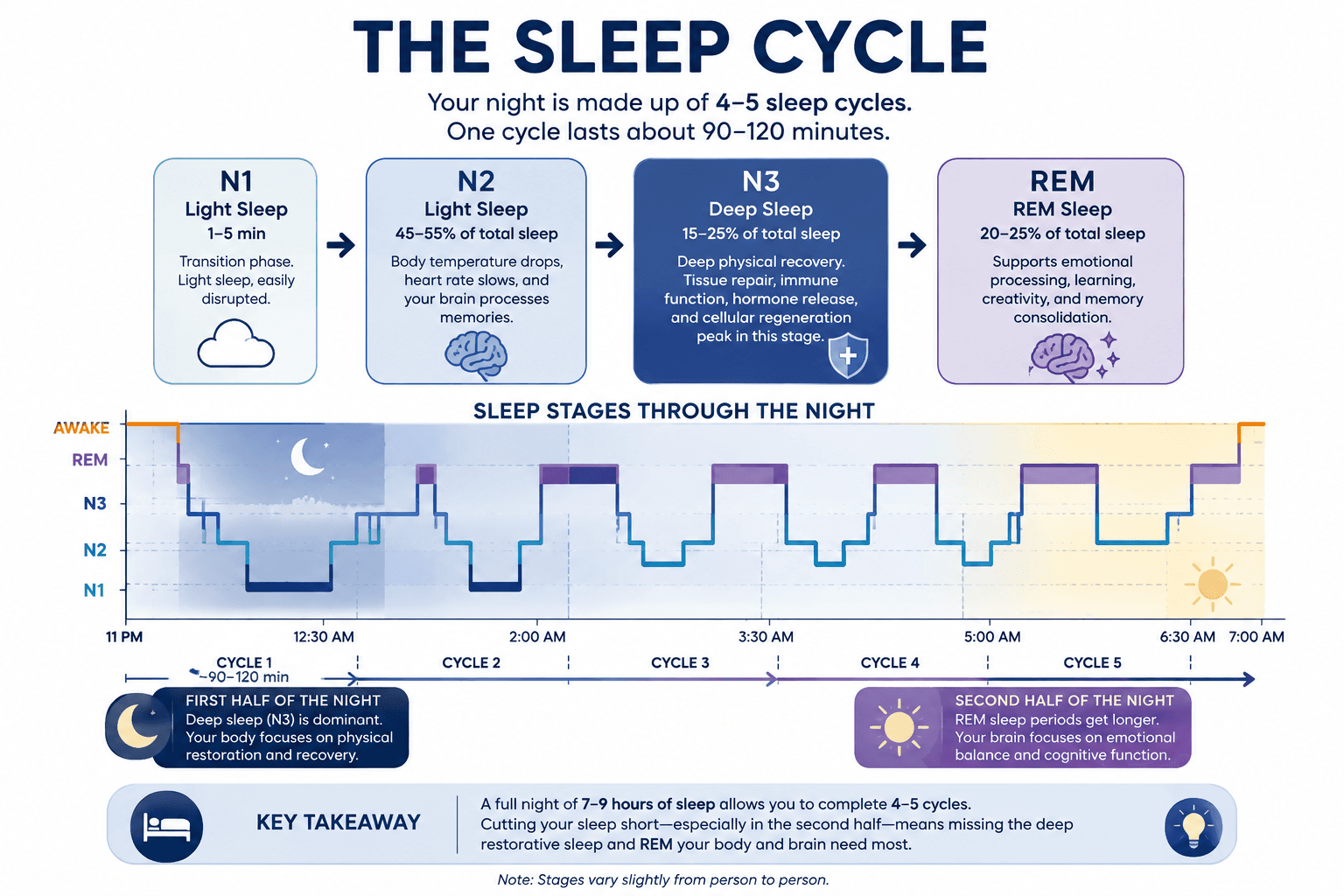
A full sleep cycle runs roughly 90 to 120 minutes, and a healthy night strings together about four to five of them. Each cycle moves through distinct stages, and each stage does something different for your body and brain. Knowing what each stage repairs helps you understand why a disrupted schedule creates such wide-ranging symptoms, from brain fog and immune suppression to emotional dysregulation.
Deep sleep is concentrated more heavily in the first half of the night, while REM periods generally become longer later. When your schedule is shortened or inconsistent, you may reduce your opportunity to move through the full pattern of sleep stages. For a closer look at each stage, see how to improve deep sleep, how to improve REM sleep, and what Core sleep means on trackers.
The Four Stages and What Each One Rebuilds
N1 is the shallow transition into sleep, lasting just one to five minutes. It’s easily disrupted and doesn’t provide meaningful restoration on its own. N2 follows and makes up the largest portion of your total sleep time, roughly 45 to 55 percent. During N2, your body temperature drops, your heart rate slows, and your brain processes memories from the day.
N3, or deep slow-wave sleep, is strongly associated with physical restoration, immune function, and growth-hormone release. It is concentrated more heavily in the earlier part of the night, although restorative processes continue across multiple sleep stages.
REM sleep tends to lengthen in later cycles and has important roles in learning, memory, and emotional processing. These functions overlap across sleep stages rather than belonging exclusively to one stage.
Why the Second Half of Your Night Matters More Than You Think
Because REM periods get longer as the night progresses, the final two cycles of an eight-hour night deliver a disproportionate share of your emotional regulation and cognitive repair. When an early alarm or inconsistent wake time cuts those cycles short, you lose exactly the sleep that keeps you steady, focused, and mentally resilient. Chronic REM deficits may contribute to irritability, poor decision-making, and emotional reactivity, symptoms most people attribute to stress rather than disrupted sleep architecture.
Signs Your Circadian Rhythm Is Out of Sync (Not Just “Bad Sleep”)
Not all sleep problems are the same. Ordinary insomnia involves difficulty initiating or maintaining sleep regardless of timing. A circadian timing problem is different: sleep itself may be fine in quality, but it’s happening at the wrong biological time relative to your schedule. The distinction matters because the fix is different.
Timing Signals That Point to a Shifted Internal Clock
The clearest signs of circadian misalignment are consistent, not random. You feel genuinely alert and mentally “on” between 10 p.m. and 1 a.m. You can’t fall asleep before midnight even when you’re physically tired. You struggle to wake before 8 or 9 a.m. regardless of how much sleep you’ve gotten. These are illustrative patterns, not diagnostic thresholds, but when this kind of delay has been stable for three months or longer, it fits the clinical profile of delayed sleep-wake phase disorder (DSWPD), a recognized circadian rhythm condition, not a personality trait or preference.
Other consistent signs include sleep that feels genuinely restorative when you’re allowed to follow your natural schedule, and significant difficulty functioning when work or social obligations force a different one.
Daytime Symptoms That Get Overlooked
Circadian misalignment can contribute to brain fog, difficulty concentrating, daytime sleepiness, and reliance on caffeine or naps, especially when sleep timing conflicts with work or social schedules. These symptoms are not specific to circadian problems, however, and can also reflect insufficient sleep, stress, medications, medical conditions, or other sleep disorders.
How to Fix Your Sleep Cycle: The 2-Week Behavioral Reset Plan
This two-week reset is a practical framework for building consistency, not a guaranteed treatment timeline. Week 1 establishes stable timing cues; Week 2 gradually shifts bedtime while keeping those cues in place. Circadian adjustment varies by person, and long-standing or severe timing problems may take longer or need professional guidance.
Week 1: Anchor the Wake Time and Remove Evening Disruptors
- Choose one wake time and keep it every day.
- Get bright outdoor light soon after waking.
- Avoid long or late naps while building sleep pressure.
- Move caffeine earlier in the day based on your sensitivity.
- Dim evening light and reduce stimulating screen use.
- Use a consistent wind-down routine before bed.

Set a fixed wake time and hold it every day, including weekends, regardless of when you fell asleep. This single step is the most evidence-backed behavioral lever for resetting a shifted sleep schedule. The circadian clock synchronizes more reliably to a consistent wake signal than to any other input.
Cut bright or blue-light exposure after 9 p.m. by dimming your environment and switching to warm, low-intensity lighting. Keep your bedroom cool and comfortable; many sleep researchers point to the 65–68°F range as a useful target, though individual preference matters too.

A premium acetate frame with anti-reflective lenses and clear or amber options. The amber version may be more practical for late-evening screen use, but evidence that blue-light glasses reliably improve sleep remains uncertain, so dimming lights and reducing stimulating screen use should remain the foundation.
As an Amazon Associate, Purely Vital Living may earn from qualifying purchases. Price shown was supplied at the time of writing and may change.
Avoid caffeine in the afternoon and evening. While the research supports restricting late-day caffeine as part of a reset protocol, the exact cutoff varies by individual metabolism; a general guideline is to stop by early-to-mid afternoon and adjust based on your own sensitivity.
Avoid naps during this week. Napping relieves sleep pressure temporarily, which makes it harder to build the biological drive needed to fall asleep at your target time. That said, avoiding naps is one component of a multicomponent behavioral program; the strongest evidence points to the combination of a fixed wake time, light management, and reduced sleep pressure working together.
Build a Consistent Wind-Down Routine
Give your brain a predictable transition from daytime activity to sleep. Start winding down at roughly the same time each evening, lower stimulation, dim the lights, and choose calm activities such as reading or gentle stretching. If worries or tomorrow’s tasks tend to follow you into bed, writing them down before your wind-down period can help move that mental work out of the sleep window.
Alcohol and nicotine can also interfere with sleep, so reducing or avoiding them close to bedtime is a sensible part of the reset. The goal is not to create a complicated nighttime ritual; it is to make the final part of the evening consistent enough that your body receives the same timing signals night after night. Our sleep hygiene tips provide a simpler habit-by-habit checklist for maintaining that routine.
Week 2: Gradual Phase Shifting, Sleep Cycle Repair in Action
- Keep the same wake time from Week 1.
- Shift bedtime gradually in 15–30 minute steps.
- Continue morning light and dimmer evenings.
- Keep meal and exercise timing reasonably consistent.
- Avoid compensating for a poor night with a major sleep-in.
- Once you reach the target schedule, hold it steady rather than continuing to shift.
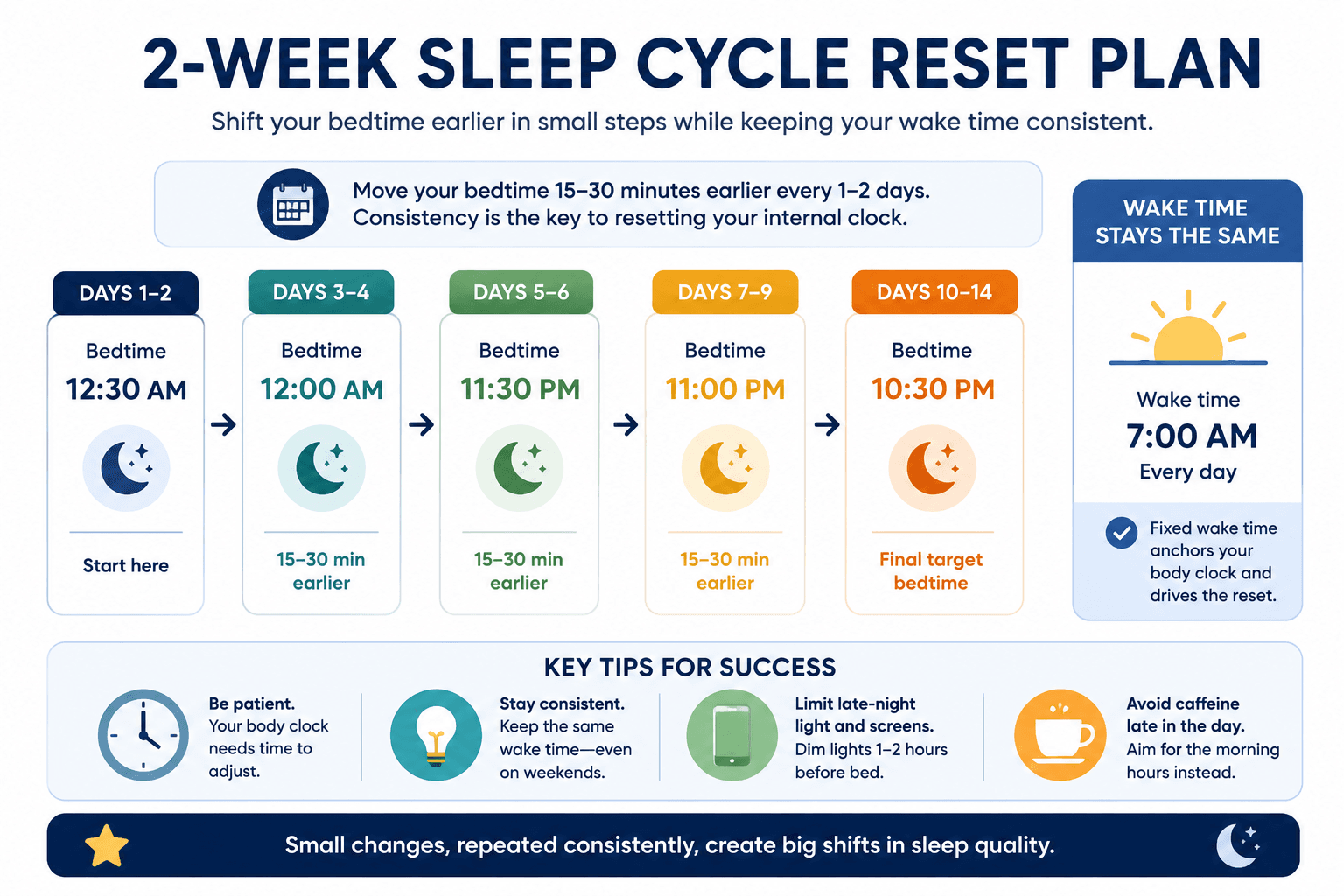
Once the wake time is anchored, start moving bedtime earlier in 15 to 30-minute steps every one to two nights. Clinical guidance supports this as a sustainable approach to advancing circadian phase; moving in smaller increments avoids the resistance that comes with abrupt schedule changes. The pace of shift will vary by individual, but moving consistently in one direction, rather than oscillating, is what produces lasting results. Once you reach your target sleep window, hold it stable for at least one week to consolidate the shift.
If your sleep timing is severely delayed by six or more hours, a different approach called chronotherapy may be more practical. Chronotherapy delays sleep progressively in large increments until the clock rotates all the way around to the desired window. This is a more intensive protocol and works best with professional guidance.
Where Exercise Fits Into the Reset Plan
Regular exercise can support sleep quality and circadian health, and some people find earlier-day workouts fit a phase-advance plan well. Evening exercise is not a problem for everyone, but if vigorous late workouts leave you alert or delay sleep onset, move intense sessions earlier and keep late activity lighter, such as walking or gentle stretching.
Sleep Cycle Repair Tools: Light Therapy and Melatonin Timing
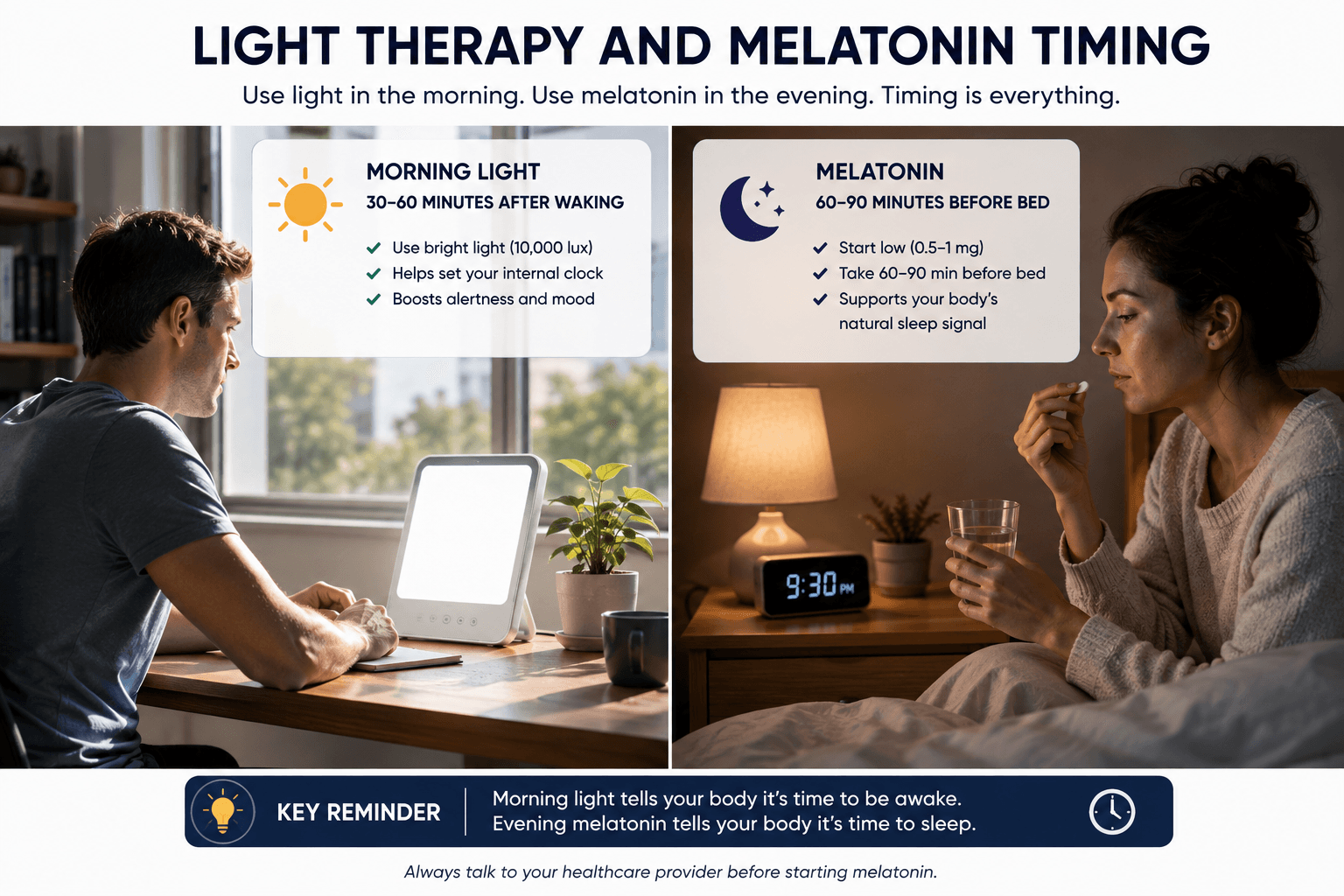
Behavioral changes establish the structure for sleep cycle repair. Light and melatonin accelerate it. Both tools work by directly signaling the suprachiasmatic nucleus, the master circadian clock in the brain, to shift its timing. The difference between using these tools effectively and wasting them comes down entirely to timing.
Bright Light Therapy for Sleep Timing: The Parameters That Actually Matter
For a phase advance, you need bright light exposure shortly after waking, once the body’s core temperature minimum has passed. The clinical standard is 2,500 to 10,000 lux for 30 minutes to two hours in the early morning. A 10,000-lux light box used for 30 minutes within 30 to 45 minutes of waking is the most common practical protocol. Natural outdoor light works too, provided the morning is bright and you’re actually outside, not sitting near a window.

A compact UV-free light therapy lamp that delivers up to 10,000 lux at the specified distance, with three brightness levels and a 15–60-minute timer. Its small panel makes positioning important, but it is a practical option for building consistent morning bright-light exposure into a sleep-reset routine.
As an Amazon Associate, Purely Vital Living may earn from qualifying purchases. Price shown was supplied at the time of writing and may change.
Evening light matters equally. Light exposure before bed delays the clock rather than advancing it, which is the opposite of what you’re trying to do. Dimming your lights in the hours before bedtime, using blue-light blocking glasses, and avoiding overhead fluorescent lighting are all direct circadian inputs, not just sleep hygiene suggestions.
Melatonin Timing and Dosing for Circadian Phase Advance
Melatonin can act as a circadian timing signal, but the timing used for phase shifting can differ from taking it simply at bedtime. The appropriate timing depends on the direction and degree of the shift, your usual sleep pattern, medications, age, and other health factors. For a diagnosed circadian rhythm disorder, timing is best individualized with a healthcare professional rather than estimated from a universal clock rule.
Higher doses are not necessarily more effective for circadian phase shifting and may increase side effects such as next-day drowsiness or vivid dreams. If you use melatonin, choose the dose and formulation carefully and avoid assuming that more is better.
Nutritional and Supplement Support for a Faster Recovery
Light exposure and behavioral consistency do the primary work of circadian reset. Nutritional support can complement those foundations by supporting pathways involved in sleep and recovery.
Foods That Support Melatonin Production and Deep Sleep
Tryptophan is the amino acid precursor to serotonin and melatonin. Foods with high tryptophan content include turkey, salmon, eggs, dairy, tofu, pumpkin seeds, and oats. Magnesium supports GABA activity, the neurotransmitter system that promotes slow-wave sleep. Good magnesium-rich food sources include pumpkin seeds, spinach, almonds, dark chocolate, avocados, and quinoa.
Consistent meal timing adds another circadian reinforcement layer. Your liver and gut have their own peripheral clocks that synchronize with the central brain clock partly through the timing of food intake. Eating at irregular hours or having large meals late at night sends conflicting signals to those peripheral clocks and can quietly undermine the sleep timing shifts you’re working to establish. If heavy or spicy meals make you uncomfortable at night, keeping them farther from bedtime may also make the reset easier to maintain.
Supplements Worth Considering (and What Purely Vital Living Has Vetted)

A straightforward 240 mg magnesium glycinate supplement with a generally well-tolerated form and a practical two-capsule serving. It can make sense for adults who need to improve magnesium intake, but it should not be treated as a proven insomnia remedy; sleep benefits remain mixed and may be more relevant when magnesium intake is low.
As an Amazon Associate, Purely Vital Living may earn from qualifying purchases. Price shown was supplied at the time of writing and may change.
Magnesium glycinate and magnesium threonate are two forms that have been studied for their bioavailability and potential CNS-relevant effects. Some research suggests these forms may support sleep quality, though the evidence is still developing and results vary by individual. Low-dose immediate-release melatonin, as covered earlier, has more established evidence for circadian phase shifting. The practical challenge with both is sourcing: potency, purity, and third-party testing vary widely across products on the market.
For sourcing, Purely Vital Living’s sleep category has already done the label-comparison work, bringing together options across low-dose melatonin and magnesium supplements so you can move directly from this plan to getting what you need, without spending hours comparing certifications and ingredient panels.
What Not to Do When Fixing Your Sleep Cycle
Trying to force a reset too aggressively can make consistency harder. Avoid repeatedly sleeping late after a poor night, compensating with long daytime naps, suddenly forcing bedtime several hours earlier, or exposing yourself to bright light late in the evening. These habits work against the wake-time, sleep-pressure, and light cues you’re trying to stabilize.
An all-nighter may make you sleepy earlier the following evening, but it does not create the consistent circadian signals that make a new schedule stick. A gradual reset built around a fixed wake time is usually the more sustainable approach.
When the Reset Plan Isn’t Enough
A two-week behavioral protocol can produce noticeable shifts for many people, but responses vary, and some individuals need longer treatment or specialist-directed care. Recognizing those signs early saves months of frustration. Knowing when to escalate is part of a smart reset plan, not a failure of it.
Red Flags That Point to a Clinical Circadian Disorder
If your sleep timing has been shifted for longer than three months and resists repeated self-directed efforts, that pattern warrants clinical evaluation. The same is true if you’re unable to maintain an early wake time despite genuine motivation and structure, or if daytime sleepiness is severe enough to affect your safety while driving or operating machinery. Loud snoring, gasping or witnessed breathing pauses point beyond a simple timing problem; for context, see my experience living with sleep apnea.
What a Sleep Specialist Can Offer That a Self-Guided Plan Can’t
A sleep medicine specialist has access to tools that go well beyond behavioral coaching. Actigraphy testing objectively measures your circadian activity patterns over two weeks. DLMO measurement pinpoints your exact circadian phase so that melatonin and light timing can be calibrated precisely rather than estimated. Supervised chronotherapy and tailored bright-light protocols can produce phase advances that self-guided efforts often can’t sustain. If the red flags above resonate with your experience, an evaluation is the logical next step.
Common Questions About Fixing Your Sleep Cycle
How long does it take to fix a disrupted sleep cycle?
Many people notice changes within one to two weeks of consistent timing cues, but there is no universal reset timeline. Mild schedule drift may improve faster than a long-standing circadian delay. If your sleep timing remains severely shifted despite consistent changes, professional evaluation may be more useful than repeatedly restarting the same plan.
Can I reset my sleep schedule without melatonin?
Yes. A fixed wake time, morning light, reduced evening light, and gradual schedule changes can be used without melatonin. Melatonin may help in some circadian situations, but timing matters and it is not required for every reset. Start with consistent behavioral cues before adding a supplement.
Is it possible to fix my sleep cycle permanently?
A behaviorally shifted sleep schedule can often remain stable when the habits that reset it are maintained. Consistent wake time, morning light, and controlled evening light usually need to continue after the reset. People with a circadian rhythm disorder may need ongoing management rather than a one-time permanent fix.
Can you fix your sleep cycle in one night?
Usually not in a lasting way. One early bedtime or an all-nighter may temporarily change when you feel sleepy, but stable circadian timing depends on repeating the same wake, light, and bedtime cues over several days. Consistency is more important than forcing one unusually early night.
Should you stay awake all night to reset your sleep schedule?
An all-nighter is generally not the best first strategy for resetting a sleep schedule. It creates acute sleep deprivation without reliably correcting circadian timing. A fixed wake time, morning light, dimmer evenings, and gradual bedtime shifts provide a more structured approach with less disruption.
What is the fastest safe way to reset your sleep schedule?
The safest practical approach is usually to anchor one wake time, get morning light, and shift bedtime gradually rather than forcing a large change overnight. Keep caffeine and naps from undermining sleep pressure, reduce bright evening light, and hold the new schedule consistently once you reach it.
What time should I wake up to fix my sleep cycle?
Choose a wake time that fits your required daily schedule and allows enough opportunity for sleep, then keep it consistent. The exact clock time is less important than repeating it every day. Morning light soon after waking can reinforce that timing signal and help stabilize the new routine.
When should I see a sleep specialist about a disrupted sleep cycle?
Seek professional evaluation when sleep timing remains severely shifted for months, repeated self-directed resets fail, or daytime sleepiness affects safety or daily functioning. Loud snoring, gasping, breathing pauses, persistent insomnia, or unusual sleep behaviors also deserve assessment because another sleep disorder may be involved.
Your Sleep Cycle Can Be Repaired, Here’s Where to Start
Sleep cycle repair is a biological project, and biology responds to consistent, targeted inputs. The stages of sleep tell you what you’re losing when the cycle breaks. The signs of circadian disruption tell you what kind of problem you’re dealing with. The two-week plan sequences the fix, starting with anchoring your wake time before you touch anything else.
Morning light exposure and appropriately timed low-dose melatonin are important biological levers in the plan. Tryptophan- and magnesium-rich meals eaten at consistent times can support the broader sleep routine. Many people who follow this plan consistently notice shifts in sleep onset, morning alertness, and daytime energy, though timelines vary and some may need longer or a specialist-directed protocol.
Ready to put this into practice? Purely Vital Living’s sleep section has guides, product reviews, and curated recommendations to support each step, from evaluating melatonin options to finding sleep-support tools. The goal isn’t just better sleep tonight; it’s a sleep cycle that works reliably, night after night, for the long term.
Related Reads
- How to Improve Sleep Quality Naturally: Complete Sleep Guide
- How to Fall Asleep Faster Naturally Tonight
- How to Improve REM Sleep Naturally: 10 Science-Backed Tips
- 7 Healthy Sleep Habits to Transform Your Nighttime Routine
- Sleep Hygiene Tips: 7 Bedtime Habits for Better Sleep
References
- National Heart, Lung, and Blood Institute — Circadian Rhythm Disorders
- National Heart, Lung, and Blood Institute — Circadian Rhythm Disorders: Treatment
- American Academy of Sleep Medicine — Clinical Practice Guideline for Intrinsic Circadian Rhythm Sleep-Wake Disorders
- Centers for Disease Control and Prevention — About Sleep
This article is for general educational purposes and is not a substitute for individualized medical advice, diagnosis, or treatment. Consult a qualified healthcare professional if sleep problems persist, cause severe daytime sleepiness, affect safety, or if you are considering melatonin or light therapy for a diagnosed circadian rhythm disorder.