

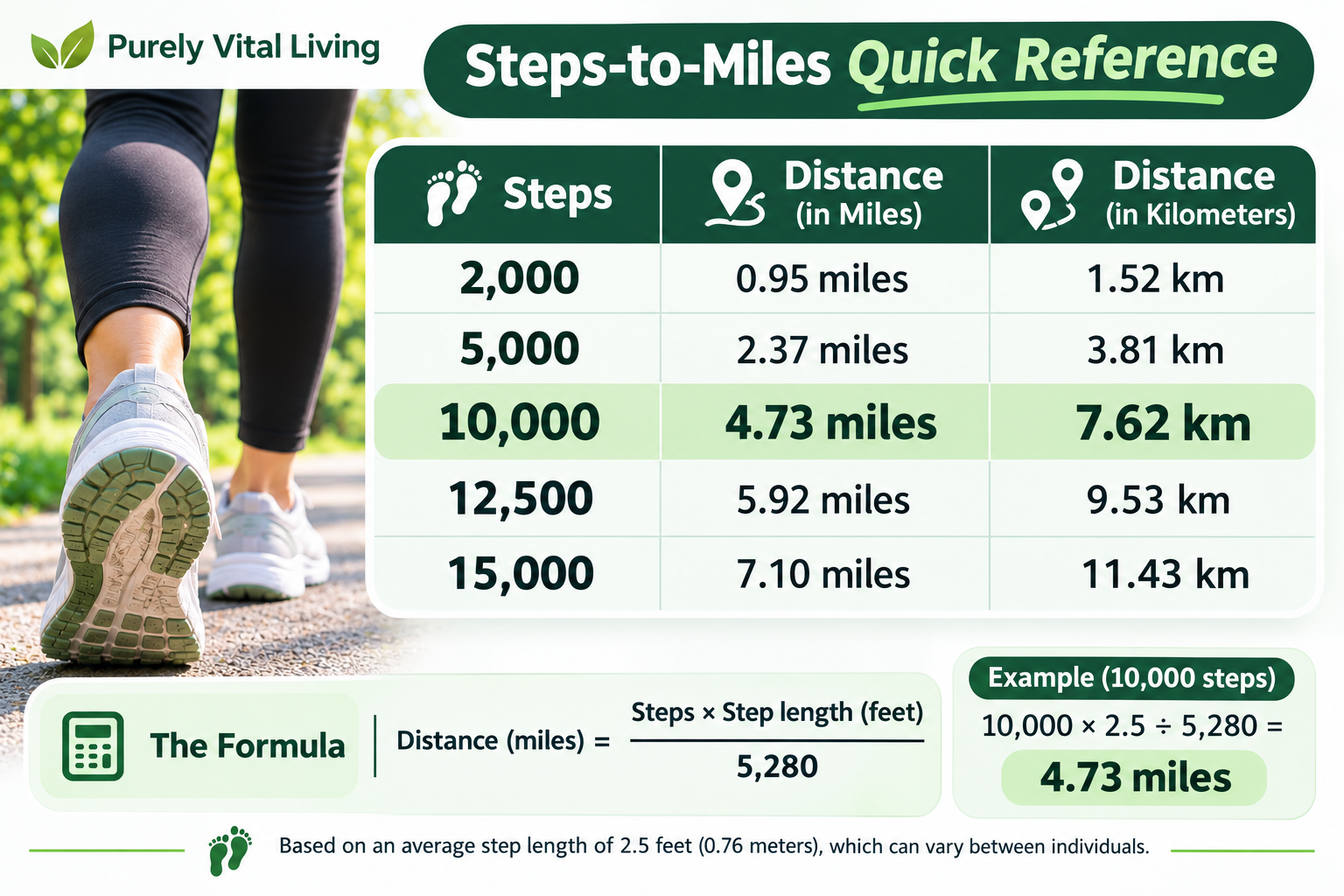
10,000 steps is about 4.17–5 miles if your average step length is 2.2–2.64 feet. This is an illustrative range, not a universal average: shorter or longer steps change the distance. At 2.5 feet per step, 10,000 steps equals approximately 4.73 miles (7.62 km). Use your measured step length for a more personal estimate.
To find your distance, multiply your step count by your average step length, then convert feet to miles. Below, you can compare examples and measure your own step length without relying on a fixed steps-per-mile rule.
Steps to Miles Calculator
To estimate your walking distance, enter your total steps and your measured average step length in feet into this formula:
Miles = (steps × step length in feet) ÷ 5,280. Kilometers = miles × 1.609344.
For example, 8,000 steps at 2.5 feet per step = 3.79 miles (6.10 km). This formula is a transparent manual calculator; an interactive input tool will be added separately after testing.
Steps to Miles and Kilometers Conversion Chart
All values below assume 2.5 feet per step, purely as an example. Your distance may differ.
For an additional example, 8,000 steps at 2.5 feet per step is approximately 3.79 miles (6.10 km). The illustrated chart below shows other common step totals.
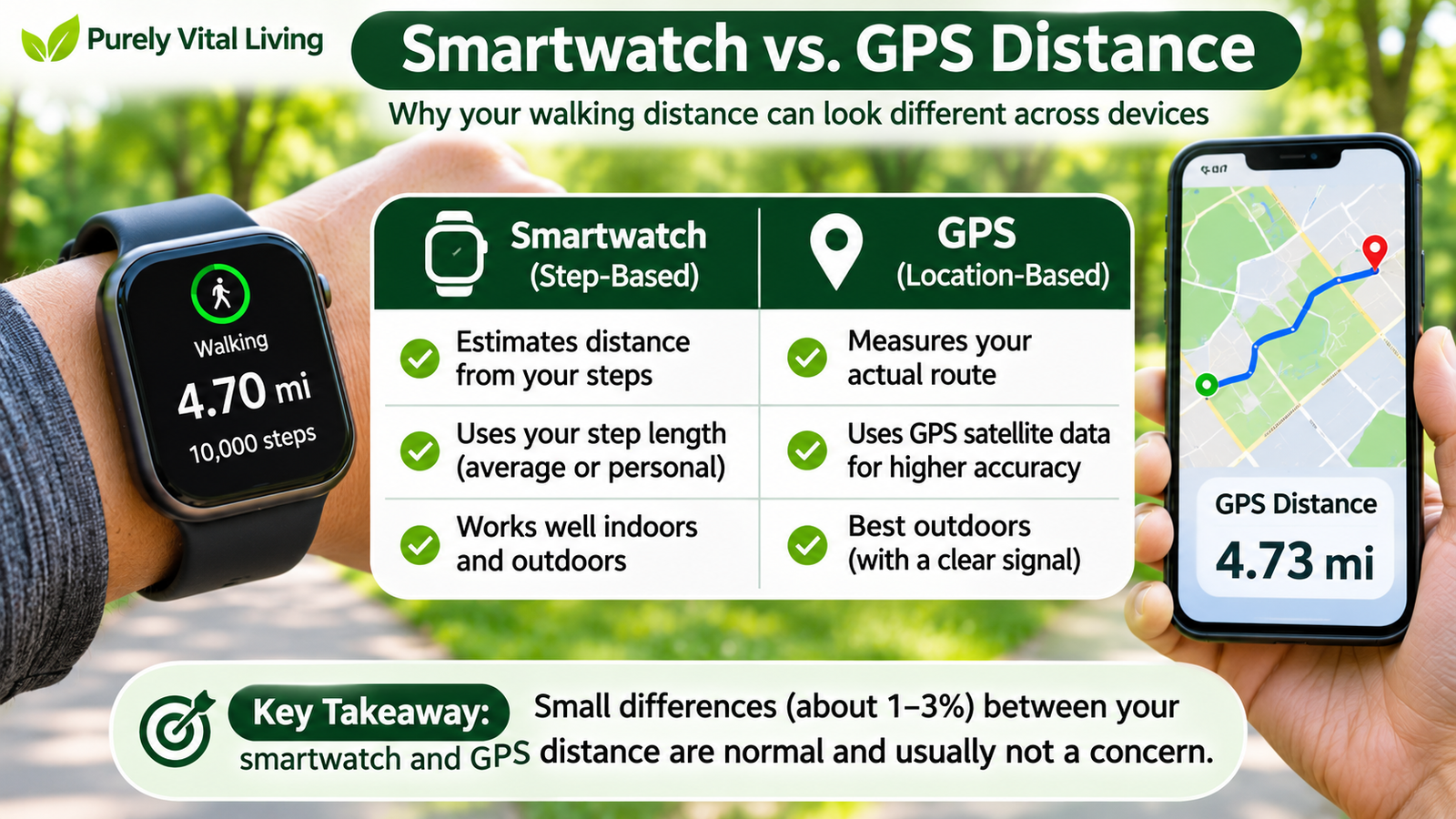
Step-based distance estimates rely on an assumed or calibrated step length. GPS-based distance instead estimates the route traveled from location readings. Differences can arise from changing walking speed, turns, indoor walking, GPS reception, or device calibration. Compare readings over a known route and follow your device manufacturer’s calibration instructions if available. Neither method is perfectly exact in every setting.
Does Walking or Running Change the Distance?
Yes. The same number of steps can cover different distances when step length changes. Running often involves a different step length than walking, and even your walking step length can vary with pace and terrain. Measure the movement type you intend to estimate rather than using one fixed conversion for every activity.
10,000 Steps in Miles: Conversion Table
This table uses selected step lengths to show how the calculation changes. The figures are rounded to two decimal places; they are not population averages or targets.
| Average step length | Distance for 10,000 steps |
|---|---|
| 2.0 feet | 3.79 miles |
| 2.2 feet | 4.17 miles |
| 2.4 feet | 4.55 miles |
| 2.5 feet | 4.73 miles |
| 2.64 feet | 5.00 miles |
| 2.8 feet | 5.30 miles |
How Do You Convert Steps to Miles?
Miles = steps × step length in feet ÷ 5,280.
There are 5,280 feet in one mile. If your measured step length is 2.4 feet, the calculation is:
10,000 × 2.4 ÷ 5,280 = 4.55 miles, rounded.
If you measure in centimeters, use: miles = steps × step length in centimeters ÷ 160,934.4. Use the length of one step, rather than the distance between two successive landings of the same foot.
How to Measure Your Step Length
To measure your average step length, walk a known distance at your normal pace, count each step, then divide the distance by the number of steps. The illustrated guide below shows how a step differs from a stride.
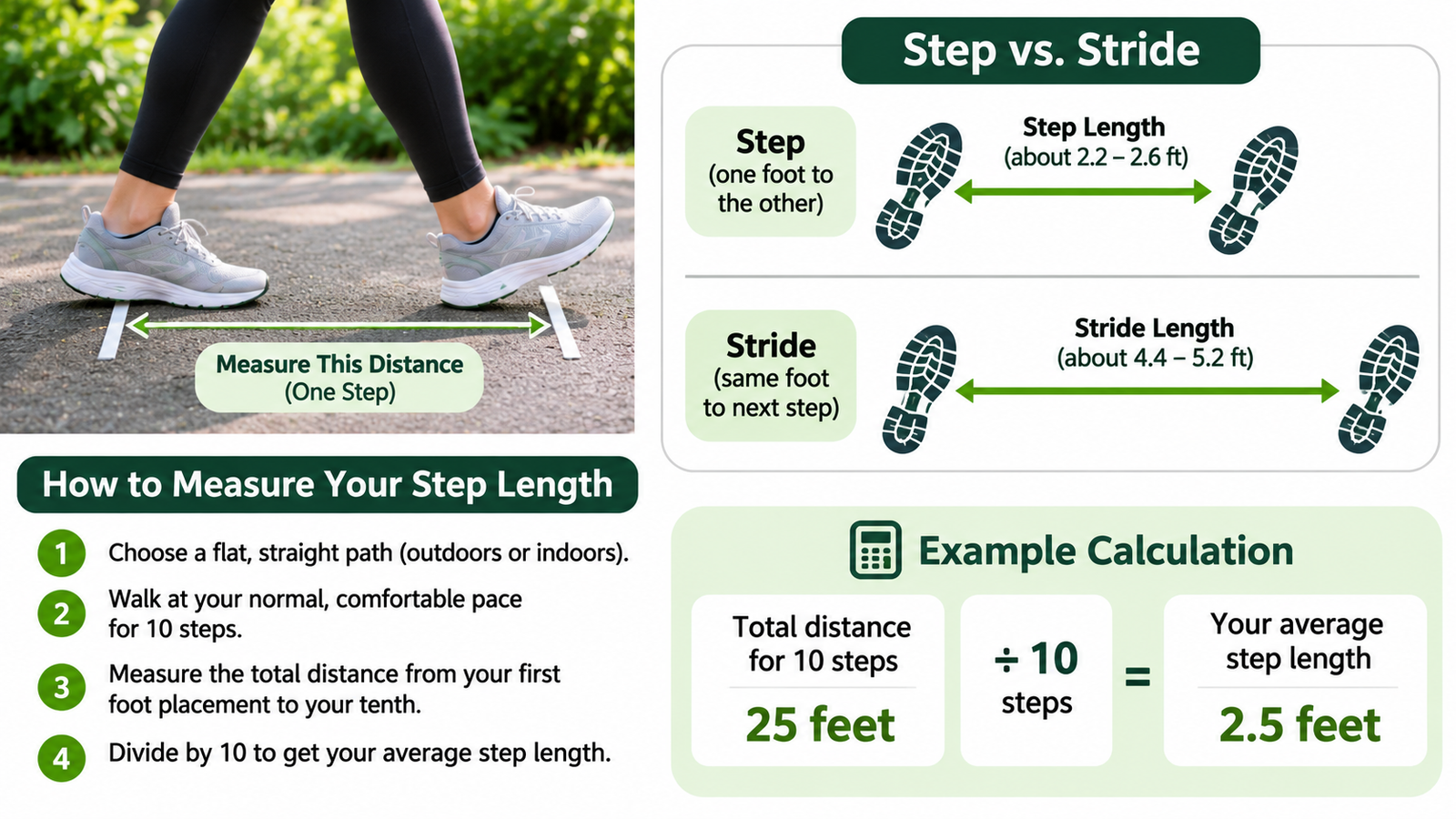
- Choose a level route with a known distance, such as a measured 100-foot section.
- Walk it at your usual comfortable pace, counting each footfall as one step.
- Divide the distance by your number of steps.
- Repeat the measurement a few times. For a combined estimate, divide the total distance across those walks by the total number of steps.
For example, covering 100 feet in 40 steps gives a step length of 2.5 feet. At that measured step length, 10,000 steps would cover about 4.73 miles.
Use a route and pace similar to the walking you want to estimate. A measurement is an estimate for those conditions, rather than a permanent conversion for every walk.
What Is the Difference Between a Step and a Stride?
A step runs from one foot landing to the opposite foot landing. A full stride runs from one foot landing to the next landing of that same foot and includes two steps. This article uses step length.
Some devices use the word “stride” differently in their settings. Check the device instructions before entering a measurement. Putting a two-step distance into a setting that expects one step would double the calculated distance.
How Many Steps Are in One Mile?
Steps per mile = 5,280 ÷ step length in feet. At 2.5 feet per step, one mile takes 2,112 steps. At 2.64 feet per step, it takes 2,000 steps. This explains why a fixed conversion can give a different result from your own measurement.

PVL pick — Everyday Step Tracking
Garmin vívosmart 5
A slim fitness band for everyday step counts and walking activity. Connected GPS requires a compatible paired phone.
How Long Does It Take to Walk 10,000 Steps?
The time depends on the distance those steps cover and your walking speed. If your 10,000 steps cover exactly 5 miles, walking continuously at 3 miles per hour would take 100 minutes. At 2.5 miles per hour, the same distance would take 120 minutes. These are arithmetic examples that exclude stops.
Steps collected throughout a day are different from one continuous walk. Your daily total can include short trips, household movement, and planned walks, so it does not tell you how long a single session lasted.
Using the Distance in Your Walking Routine
A personal conversion can help you estimate a route or understand a step total. It does not establish a required daily step goal or predict a weight-loss result. For the separate question of walking goals, read our guide to how many steps a day may support weight loss.

PVL pick — iPhone Walking Tracking
Apple Watch Series 11
A full-featured smartwatch with built-in GPS and walking workout tracking for iPhone users.
How to Get a More Reliable Personal Step-Length Estimate
A single short measurement can be affected by how you start, stop, or count. For a more useful estimate, choose a flat, measured route that is long enough for several dozen steps. Begin walking normally before the measured section so you are not estimating distance from an unusually short first step. Count each time either foot lands inside the section, and record the distance and number of steps.
Repeat the test on different walks at a comfortable pace. Rather than averaging the individual step-length results, you can add the distances and divide by the combined step counts. For example, three measured walks totaling 300 feet and 123 steps produce an average of about 2.44 feet per step. That converts 10,000 steps to about 4.62 miles. This result describes those walks; it is not a guarantee that every future 10,000-step day will cover exactly that distance.
Keep your measurements consistent. If your route is marked in meters, calculate meters per step first and convert to kilometers directly. Do not accidentally use a two-step stride measurement as one step. If you switch from leisurely walking to brisk walking or running, consider measuring again because the distance covered per footfall may change.
Worked Examples: How Step Length Changes Your Distance
Two walkers can record the same step count but travel different distances. Suppose one person’s measured step length is 2.2 feet and another’s is 2.8 feet. At 10,000 steps, the first estimate is 4.17 miles while the second is 5.30 miles. The difference is about 1.14 miles even though both devices show the same number of steps.
Now hold step length constant at 2.5 feet. A 4,000-step walk covers about 1.89 miles; an 8,000-step total covers about 3.79 miles; and a 12,000-step total covers about 5.68 miles. These are useful arithmetic comparisons for planning, not recommendations to reach a particular daily total.
If your measured step length is 75 centimeters, 10,000 steps gives 750,000 centimeters, or 7.5 kilometers. Divide by 1.609344 to obtain approximately 4.66 miles. Using centimeters directly can avoid unnecessary rounding when your measuring tape is metric.
How to Use Step Counts When Planning a Walking Route
If you already know the distance of a route, reverse the formula to estimate how many steps it might take: estimated steps = route distance in feet ÷ average step length in feet. A 2-mile route is 10,560 feet. At 2.5 feet per step, it would take approximately 4,224 steps. Your actual count may differ with turns, stops, and changes in pace.
For a loop around a park or neighborhood, first check the route length on a map or measure it with a GPS-capable device. Then compare that distance with your recorded steps. Over several outings, you may find a practical personal conversion for that route. Use the same distance units on both sides of the calculation and remember that a map route may not capture every small detour.
A daily step total is not the same as the length of one dedicated walk. Steps recorded while shopping, moving around at home, or taking short breaks add together. If you want to estimate the distance of a specific walk, look at the step count for that session rather than automatically converting the entire day’s total.
What Can Affect Your Steps-to-Miles Estimate?
Walking speed: Your step length may change as you move faster or slower, so a conversion measured during a leisurely walk may not match a brisk outing. Terrain: Hills, uneven ground, stairs, and sharp turns can change the relationship between footfalls and horizontal distance. Device placement: A wrist tracker, phone in a pocket, and other sensors may detect movement differently. Route measurement: GPS signal quality and map accuracy can influence the distance you compare against your steps.
When results disagree, first check whether you are comparing the same activity period. Next, confirm that your tracker is using the correct measurement units and any available calibration settings. Finally, repeat the comparison on a measured, relatively straight route. A small discrepancy does not automatically mean either number is defective: step-based and location-based methods estimate distance in different ways.
The illustration below compares a step-based smartwatch estimate with a GPS route reading. The values are examples, not a device accuracy benchmark.
Why Does Your Fitness Tracker Show a Different Distance?
PVL pick — GPS Walking Distance
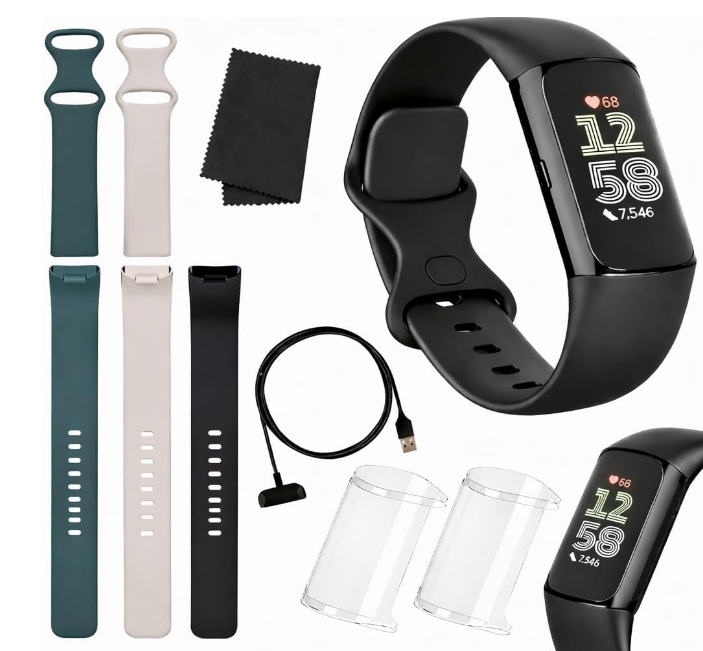
Fitbit Charge 6
A compact tracker with built-in GPS for outdoor walking routes. GPS accuracy can still vary with conditions and fit.
Frequently Asked Questions
How far is 10,000 steps in miles?
At a 2.5-foot average step length, 10,000 steps covers approximately 4.73 miles. Measure your own step length to refine the estimate.
Why does my smartwatch show fewer miles?
It may use a shorter estimated step length or a different distance method, such as GPS. Device settings, route conditions, and calibration can affect the result.
Is 10,000 steps exactly 5 miles?
Only when the average step length is 2.64 feet. With a different step length, the distance changes. Measure your steps over a known distance for a more personal conversion.
How many kilometers is 10,000 steps?
Multiply 10,000 by your step length in meters, then divide by 1,000. For example, a 0.75-meter step gives 7.5 kilometers. That is an illustrative calculation, rather than a standard distance for everyone.
Is 5,000 steps half the distance of 10,000 steps?
Yes, if the average step length stays the same. At 2.5 feet per step, 5,000 steps covers about 2.37 miles, compared with about 4.73 miles for 10,000 steps.
How many steps are in 3 miles?
At an assumed 2.5-foot step length, 3 miles is approximately 6,336 steps. Use your own measured step length for a personal estimate.
Should I use GPS distance or step-based distance?
Use the measure that fits your question. GPS can help estimate the length of an outdoor route when reception is suitable; a step-based formula is useful for a transparent estimate when you know your average step length. Both can have measurement error.
Can I calculate miles from height alone?
A height-based formula supplies an estimate, but it does not measure how far you actually move with each step. Walking a known distance and counting your steps gives you a measurement to use directly in the formula.
Calculation Methodology
Calculations use 5,280 feet per statute mile and 0.3048 meters per foot (the internationally defined conversion). Results are rounded to two decimal places. For background on the definition of the international foot, see the US National Institute of Standards and Technology. For device-specific calibration, consult the documentation for your tracker model.
Calculation note: All distance and time examples on this page are calculated from the stated inputs. They are not measured reader results, clinical findings, or prescribed walking targets.
References and Device Guidance
- National Institute of Standards and Technology (NIST). U.S. Survey Foot and International Foot. Reference for the international foot definition of 0.3048 meter.
- NIST. SI Units — Length. Reference for metric length units.
- For step counting and GPS calibration, consult your specific device manufacturer’s instructions; accuracy varies with the device and conditions.