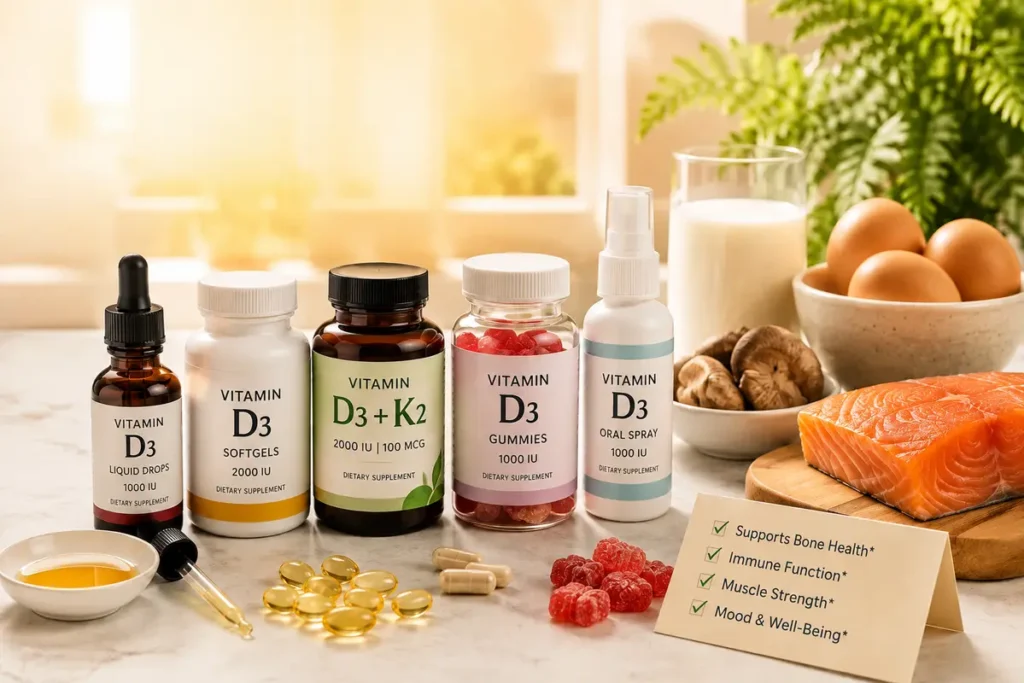
Quick Answer
Nature Made Vitamin D3 1,000 IU is PVL’s lower-strength softgel comparison pick for adults who need supplementation at that strength. Nature Made and NOW 2,000 IU offer higher-strength standalone options, while Pure Encapsulations Vitamin D3 Liquid provides 1,000 IU per drop for adults who prefer not to swallow capsules. This standard liquid is lanolin-derived and not vegan. Adults generally need 600 IU daily through age 70 and 800 IU thereafter from all sources; these amounts are not universal supplement doses. Products containing 4,000–5,000 IU should not be routine choices without professional guidance. Added K2 is not necessary for everyone and can interact with warfarin. Compare dose, ingredients, independent quality evidence and cost per serving. PVL’s recommendations are based on published documentation, not hands-on testing.
First establish the amount you need from diet and supplements together, then compare formats that make that intake practical. A drop, capsule and combined D3/K2 product may differ in serving instructions and additional ingredients. Check overlapping products and relevant medicines before assuming that a stronger formula offers greater value or a more useful effect.
Below, we compare D3 product features, explain dose labels and quality checks, and discuss when individual clinical advice is needed.
Introduction
For years, I treated supplements as if the main question was simply whether an ingredient was “good.” Over time, I learned that the more useful question is whether a product matches the person, the dose, and the reason for taking it.
Vitamin D is a good example. It supports calcium absorption and plays an established role in bone and muscle health, yet supplement labels range from modest daily doses to very high-strength formulas. Some include vitamin K2, some use vegan D3 from lichen, and others come as gummies, sprays, drops, or softgels.
This guide explains how to compare those options without assuming that the most expensive or highest-dose bottle is automatically the best. The aim is to help you understand what matters, what remains uncertain, and what realistic next step makes sense for you.
Key Takeaways
- Vitamin D3, or cholecalciferol, is generally more effective than vitamin D2 at raising and maintaining vitamin D status.
- Most healthy adults need 600 IU daily from all sources, rising to 800 IU after age 70; supplement needs depend on diet, sun exposure, health conditions, and clinician advice.
- Do not assume that a higher dose is better. The adult upper intake level is 4,000 IU daily unless a healthcare professional recommends a different amount.
- Vitamin D is fat-soluble, so taking it with a meal that contains some fat may improve absorption.
- Look for transparent labels and credible third-party verification such as USP, NSF, or another recognized testing program.
- People taking warfarin or another vitamin K–sensitive medication should not add a D3 plus K2 formula without medical guidance.
- Introduction
- Best Vitamin D3 Supplements at a Glance
- Vitamin D3 Supplement Comparison Table
- How We Selected Our Vitamin D3 Picks
- Individual Vitamin D3 Supplement Reviews
- High-Strength Vitamin D3 Products: Not Routine Picks
- Vitamin D3 Buying Checklist and Cost Worksheet
- Vitamin D3 Intake & Value Calculator
- Do You Need Vitamin D3 Before Choosing a Brand?
- Vitamin D3 Safety Before Product Comparisons
- What Is Vitamin D3 and Why Does It Matter?
- Is Vitamin D3 Better Than Vitamin D2?
- Should You Choose Vitamin D3 With K2?
- What Is the Best Vitamin D Supplement for Women?
- What Is the Best Vitamin D3 Supplement for Older Adults?
- How Much Vitamin D3 Should You Take Daily?
- When Is the Best Time to Take Vitamin D3?
- Which Form of Vitamin D3 Is Best?
- How Do You Read a Vitamin D3 Supplement Label?
- Who Is More Likely to Have Low Vitamin D?
- Can You Get Enough Vitamin D From Food and Sunlight?
- Can You Take Too Much Vitamin D3?
- Which Medications Can Interact With Vitamin D?
- Does Vitamin D3 Improve Energy?
- Frequently Asked Questions About Vitamin D3 Supplements
- Final Verdict: How Should You Choose a Vitamin D3 Supplement?
Best Vitamin D3 Supplements at a Glance
If supplementation is appropriate, compare lower-strength standalone products first. A 1,000 IU softgel is our lower-strength comparison pick, not a universal daily prescription. Choose a 2,000 IU product only when that strength fits your established needs. The reviewed Pure Encapsulations standard liquid is a pill-free alternative, but it contains lanolin-derived D3 and is not vegan.
Safety: The adult upper intake limit is 4,000 IU daily from food and supplements combined. Products at or above this amount are listed separately for comparison, not as routine wellness recommendations.
Vitamin D3 Supplement Comparison Table
| Product | D3 per serving | Format and ingredients | Quality evidence | Servings | Price / cost per serving | Best fit |
|---|---|---|---|---|---|---|
| Nature Made D3 1,000 IU | 25 mcg / 1,000 IU | Softgel; no K2; non-vegan | USP Verified mark on 300-count package | 300 | $8.89 / $0.030* | Lower-strength option; PVL 4.6/5 |
| Nature Made D3 2,000 IU | 50 mcg / 2,000 IU | Softgel; no K2; non-vegan | Check exact package for USP mark | 90 or 250 | Verify selected pack | Established 2,000 IU requirement |
| NOW D3 2,000 IU | 50 mcg / 2,000 IU | Softgel; no K2; non-vegan | Manufacturer GMP quality documentation; specific finished-product seal not confirmed | 240 | $8.49 / $0.035* | Value comparison; PVL 4.6/5 |
| Pure Encapsulations D3 Liquid (standard) | 25 mcg / 1,000 IU per drop | MCT liquid; no K2; non-vegan (lanolin) | Manufacturer documentation; product-specific independent certification not confirmed | Approx. 810 drops | $33 / $0.041* | Pill-free option; PVL 4.5/5 |
| Nature Made D3 + K2 | 5,000 IU (125 mcg) D3; 100 mcg MK-7 K2 | Softgel; non-vegan; gelatin and color ingredients | USP Verified mark on reviewed 30-count package | 30 | $14.19 / $0.473* | High strength; clinician-directed; PVL 4.2/5 |
| Nature Made D3 5,000 IU | 125 mcg / 5,000 IU | Softgel; no K2; non-vegan | USP Verified mark on reviewed bottle | 180 | $14.29 / $0.079* | Clinician-directed high strength; PVL 4.2/5 |
| Pure Encapsulations D3 & K2 | 4,000 IU (100 mcg) D3; 100 mcg MK-7 K2 | Cellulose capsule; lanolin-derived D3; non-vegan | Manufacturer GFCO gluten-free certification; USP verification not confirmed | 120 | $35.50 / $0.296* | High strength; clinician-guided; PVL 4.3/5 |
*Nature Made D3 1,000 IU price is from the 300-count Amazon listing supplied November 22, 2026. Other price examples in US dollars from listings accessed November 22, 2026: Target (Nature Made 180 softgels) and NOW Foods (120 softgels, listed sale price). These are snapshots, not live quotes; taxes and shipping are excluded. *Verify the exact Nature Made combination label before purchase; formulations can change. Unconfirmed information is intentionally not estimated.
How We Selected Our Vitamin D3 Picks
PVL uses published product labels, manufacturer documentation, available independent certification, ingredient suitability, serving convenience and cost per serving. We have not physically tested swallowing comfort, taste, dissolution, dropper accuracy or clinical outcomes. A quality seal does not establish clinical superiority. Some purchase links are affiliate links; commissions are not a selection criterion. No product is ranked by commission.
Individual Vitamin D3 Supplement Reviews
1. Nature Made Vitamin D3 1,000 IU — Lower-strength softgel
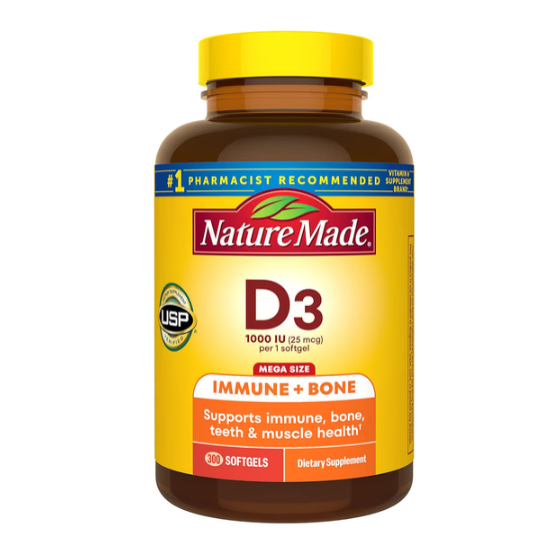
PVL pick — lower-strength vitamin D3. This 300-softgel package provides 25 mcg (1,000 IU) of cholecalciferol per serving with soybean oil, gelatin and glycerin. Its label displays USP verification. We selected this formula for its simple composition, quality-verification mark and value relative to higher-strength alternatives. It is not vegan, and the fixed softgel cannot be accurately divided. The 300-count Amazon listing shown on November 22, 2026 was $8.89 (about $0.03 per serving); this is a historical price rather than a live quote. Choose a supplemental dose based on your total intake and individual needs.
PVL editorial rating: 4.6/5. See the full review for the rating methodology, ingredients, safety and value assessment.
2. Nature Made Vitamin D3 2,000 IU — Standalone higher-strength option
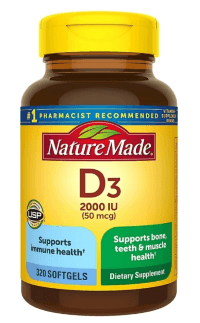
One softgel supplies 50 mcg of D3 without added K2. The manufacturer lists 90- and 250-count options. This is useful for someone comparing an established 2,000 IU requirement, but it delivers twice the D3 of the 1,000 IU option. Confirm the package ingredients, certification and selected bottle count before buying. Compare price against NOW at the same strength rather than comparing bottle prices alone.
3. NOW Vitamin D3 2,000 IU — Value comparison

PVL pick — value comparison. NOW Vitamin D3 delivers 2,000 IU (50 mcg) of cholecalciferol per softgel in an oil-based formula. The 240-count bottle appeared at $8.49, or approximately $0.035 per serving, in an Amazon listing captured November 22, 2026; this is a historical price, not a live quote. Its main strengths are convenient fixed servings, clear labeling and documented manufacturing quality practices. This lanolin-derived D3 formula includes a gelatin softgel and is not vegan. Taking more vitamin D does not necessarily offer greater benefits, so compare this strength only if it fits your established needs.
PVL editorial rating: 4.6/5. Our research-based rating covers the formula, quality documentation, dose practicality, value and dietary limitations; it is not a hands-on performance test.
4. Pure Encapsulations Vitamin D3 Liquid — Pill-free option
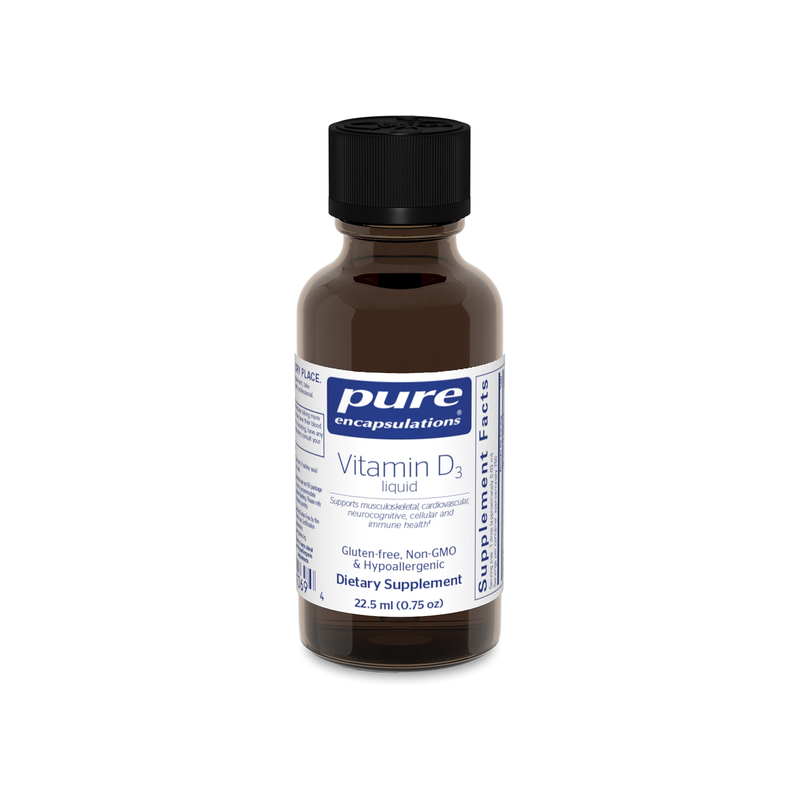
PVL pick — liquid vitamin D3. The standard Pure Encapsulations Vitamin D3 Liquid provides 1,000 IU (25 mcg) per drop in an MCT oil base. Its 22.5 mL (0.75 fl oz) bottle is designed for adults who prefer a pill-free format. This formula uses lanolin-derived vitamin D3, so it is not vegan. Do not confuse it with the separate lichen-derived Vegan Liquid, which provides 1,000 IU per five drops. The reviewed Amazon listing showed $33 on November 22, 2026, approximately $0.041 per drop at roughly 810 labeled servings. That price is a historical snapshot, not a current quote. The product is not intended for infants, and accurate drop measurement is essential.
PVL editorial rating: 4.5/5. The full review covers ingredient sourcing, absorption evidence, dosage precautions, comparison with vegan liquids and the limitations of manufacturer quality claims.
High-Strength Vitamin D3 Products: Not Routine Picks
The following products are included to help shoppers recognize higher-dose labels. Do not use these as default daily supplements without professional guidance.
5. Nature Made Vitamin D3 + K2 — High-strength combination
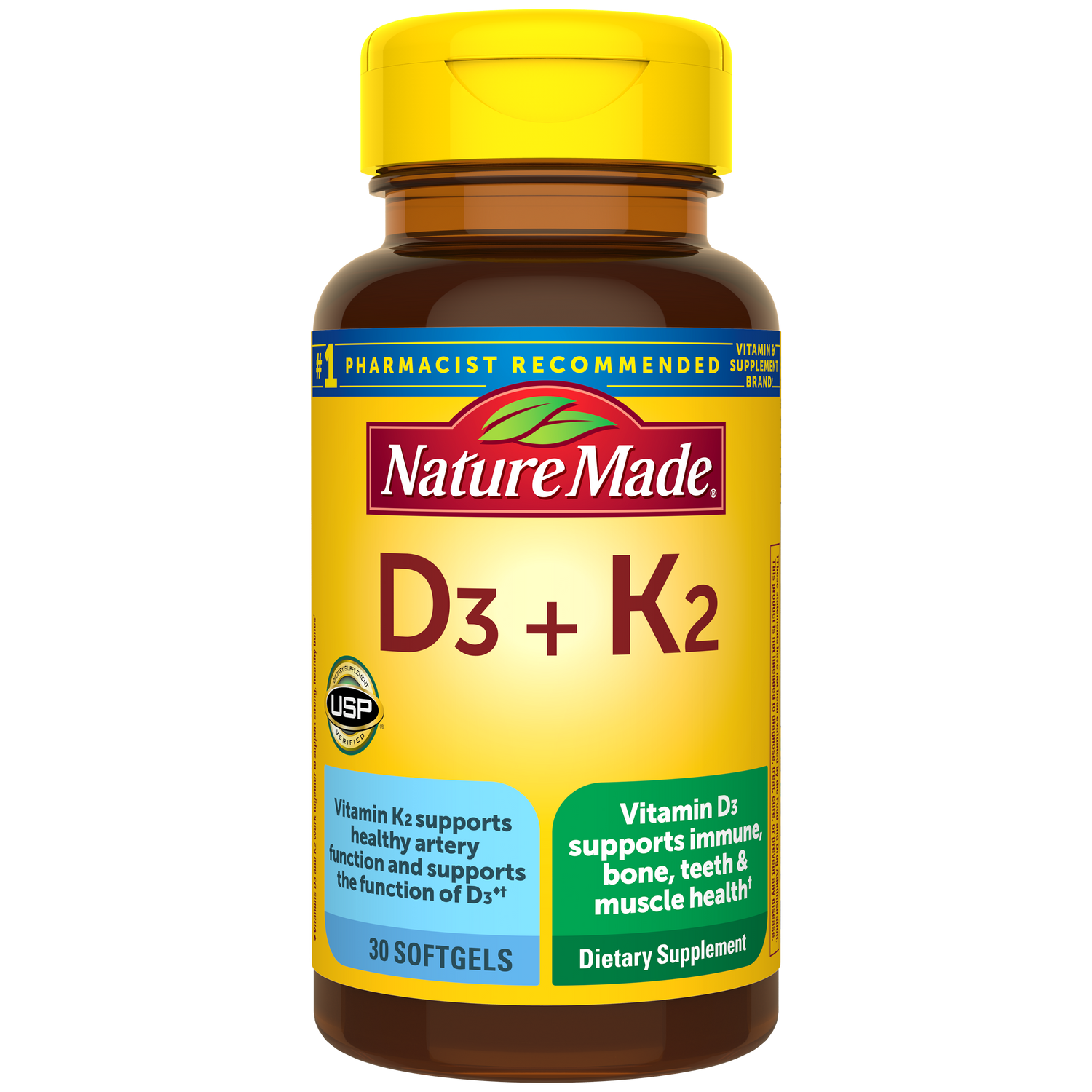
PVL high-strength comparison — clinician-directed use. Each Nature Made D3 + K2 softgel provides 5,000 IU (125 mcg) vitamin D3 and 100 mcg vitamin K2 as MK-7. The 30-count package carries the USP Verified mark. Its convenience is a combined formula, but the fixed D3/K2 ratio limits independent adjustment, and its 5,000 IU D3 dose exceeds the usual adult upper intake limit of 4,000 IU per day from all sources. Added K2 does not offset excessive vitamin D. People using warfarin should not alter vitamin K intake without prescriber guidance. The 30-count Amazon listing showed $14.19 on November 22, 2026, or about $0.47 per softgel; this is a historical price, not a live quote.
PVL editorial rating: 4.2/5. The full review evaluates USP verification, ingredient transparency, MK-7 versus MK-4, dose safety, costs and product limitations. This high-strength product is not a routine daily wellness pick.
6. Nature Made Vitamin D3 5,000 IU — Clinician-directed high-strength option
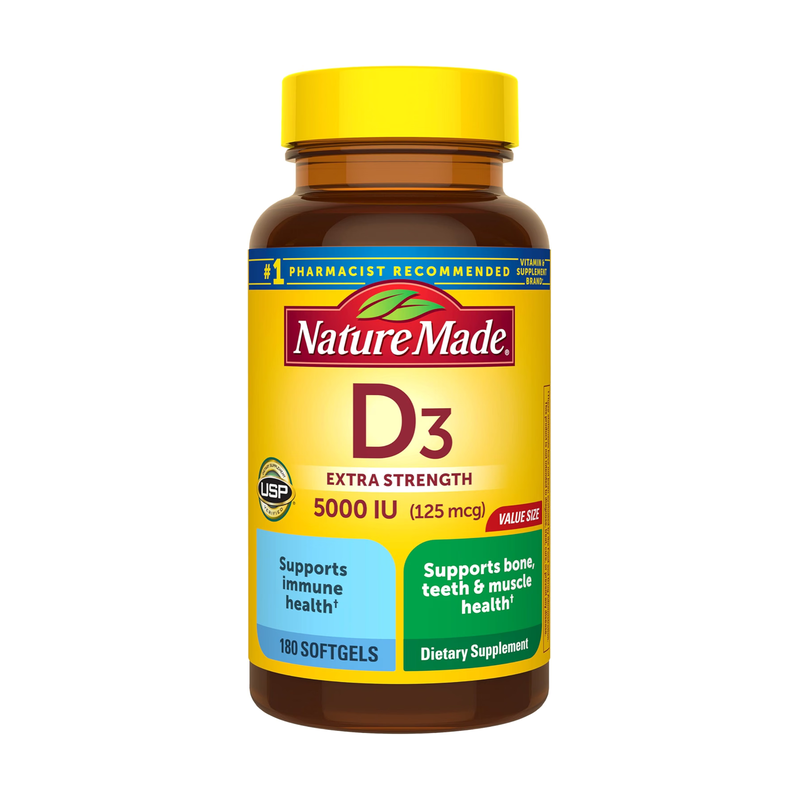
PVL high-strength comparison — clinician-directed use. Each softgel contains 5,000 IU (125 mcg) vitamin D3, and the reviewed 180-count package displays the USP Verified quality seal. The Amazon listing shown on November 22, 2026 was $14.29, approximately $0.079 per serving; this is a historical price, not a live quote. Although the product has clear labeling and a low cost per softgel, 5,000 IU exceeds the usual adult upper intake limit of 4,000 IU daily from all sources. Do not treat a larger strength or a 180-count bottle as a reason for routine daily use. A clinician should determine whether this strength is appropriate, considering existing supplements and medical history.
PVL editorial rating: 4.2/5. This research-based score reflects documented product quality, ingredients, value and limitations—not clinical effectiveness or hands-on product testing. The formula is not vegan and contains gelatin and soybean oil.
7. Pure Encapsulations Vitamin D3 & K2 — High-strength combination
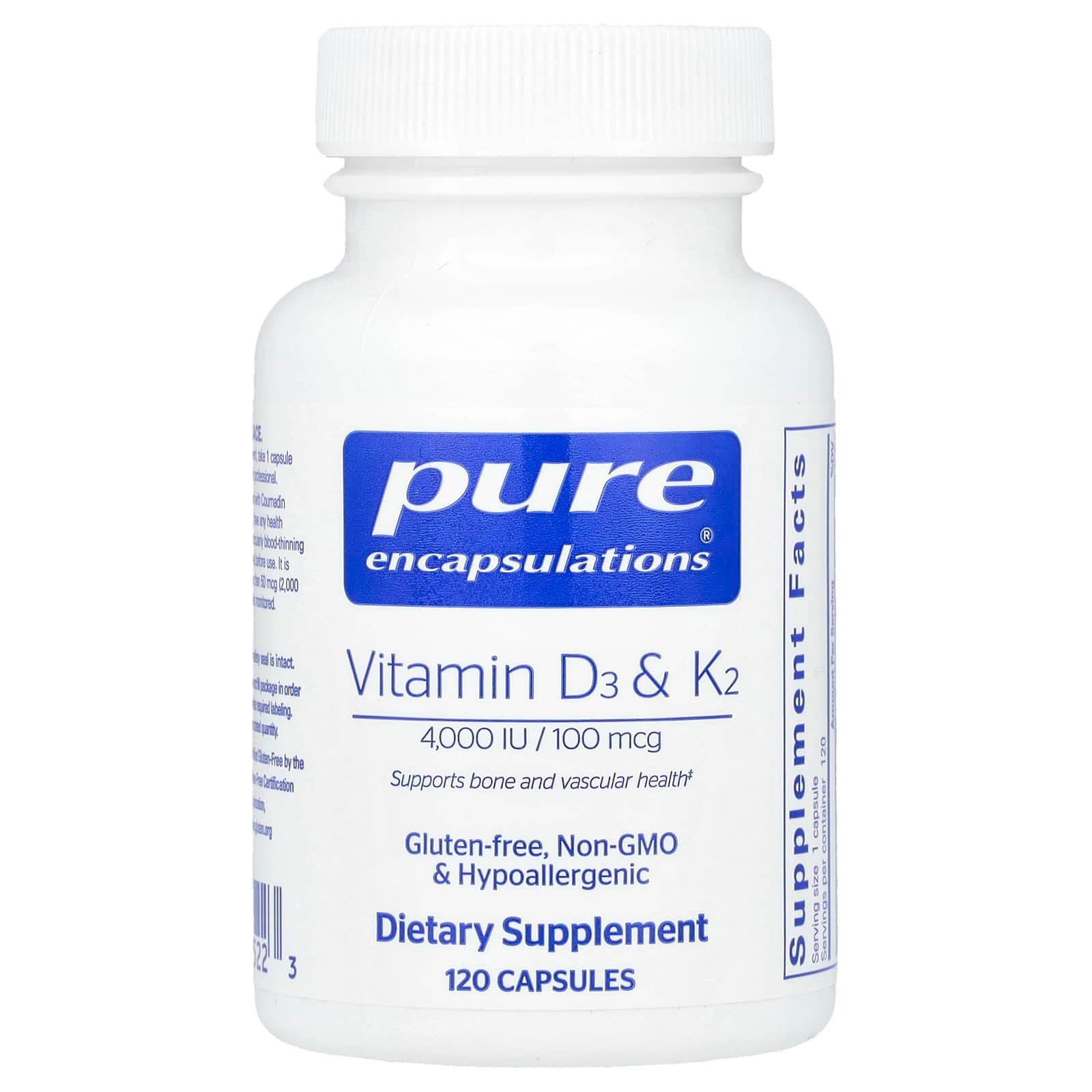
PVL high-strength comparison — clinician-guided use. Each Pure Encapsulations D3 & K2 capsule provides 4,000 IU (100 mcg) vitamin D3 and 100 mcg MK-7 vitamin K2. The 120-capsule Amazon listing showed $35.50 on November 22, 2026, approximately $0.296 per capsule; this is a historical price, not a live quote. The minimalist cellulose capsule contains no gelatin, but the D3 is sourced from lanolin and the finished formula is not vegan. One capsule reaches the usual adult daily vitamin D upper intake limit of 4,000 IU before counting food or other supplements. Vitamin K2 may interact with warfarin and does not eliminate risks from excess vitamin D.
PVL editorial rating: 4.3/5. Read the full research-based review for ingredient sourcing, K2 form, safety, quality documentation and price comparison. This is a high-strength comparison product, not a routine daily wellness recommendation.
Vitamin D3 Buying Checklist and Cost Worksheet
Step 1: Check whether a supplement is needed before selecting a product. Step 2: Record vitamin D from your multivitamin, other supplements and estimated food intake. Step 3: Confirm the vitamin D amount per serving in IU and mcg (1 mcg = 40 IU). Step 4: Check K2, allergies, capsule ingredients and product-specific quality verification. Step 5: Divide the bottle price by the number of labeled servings to compare value at the same strength.
Example: a $10 bottle with 100 servings costs $0.10 per serving. If the selected product contains 1,000 IU and a multivitamin contains 400 IU, those two supplements contribute 1,400 IU before food intake. This calculation is not a dose recommendation, and being below the upper limit does not establish that supplementation is appropriate.
Vitamin D3 Intake & Value Calculator
Compare the vitamin D amounts printed on your supplement labels and work out the price per serving. This tool is for adult label arithmetic, not for diagnosing deficiency, calculating vitamin D from sunlight or choosing a treatment dose.
Enter the D3 or D2 amount on the exact label; 1 mcg = 40 IU.
0 means no dietary amount was entered, not necessarily zero vitamin D from food.
Your entered intake is below the adult upper limit, but that does not establish a need to supplement.
Important: Assumes one labeled serving of the selected supplement per day plus the amounts entered. This arithmetic does not assess age-specific requirements, sunlight, absorption, blood levels, medication interactions or clinical treatment. Some people should not take vitamin D supplements without clinician guidance. The adult 4,000 IU upper limit from all sources is not a dose target. Do not use this calculator for children or infants.
Do You Need Vitamin D3 Before Choosing a Brand?
Vitamin D supports calcium absorption and bone health. Supplementation can fill an intake gap or form part of clinician-directed deficiency treatment; higher doses do not automatically improve energy or immunity. See the NIH vitamin D fact sheet.
The Endocrine Society’s 2024 guideline advises against routine vitamin D testing in generally healthy adults without an established indication. Its prevention guidance does not replace individual care for diagnosed deficiency. Do not chase a universal “optimal” blood level or choose a dose from symptoms alone.
Vitamin D3 Safety Before Product Comparisons
The adult upper limit is 4,000 IU (100 mcg) daily from food and supplements combined—a ceiling, not a target. A daily 5,000 IU supplement exceeds it. Higher-dose treatment requires medical supervision. Count overlapping multivitamins and other supplements.
Excess vitamin D can raise blood calcium and harm the kidneys. Seek prompt medical advice for vomiting, confusion, weakness, unusual thirst or frequent urination while taking high doses. Discuss kidney disease, kidney stones, high calcium and medicines such as thiazide diuretics with a clinician before supplementing.
K2 does not make excessive D3 safe and is not automatically necessary. Vitamin K can interact with warfarin: keep intake consistent and consult your prescriber before changing it. See NIH vitamin K guidance.
What Is Vitamin D3 and Why Does It Matter?

Vitamin D3 is cholecalciferol, the form of vitamin D your skin produces after exposure to ultraviolet B light. It is also found in some animal-derived foods and dietary supplements. Vegan D3 is commonly sourced from lichen.
Vitamin D helps your body absorb calcium and maintain normal calcium and phosphate levels. That supports bone mineralization, muscle function, and the prevention of rickets in children and osteomalacia in adults. It also participates in immune and neuromuscular processes, but evidence for preventing many chronic diseases remains uncertain.
That distinction matters. A nutrient can be essential without every high-dose supplement claim being proven.
Is Vitamin D3 Better Than Vitamin D2?
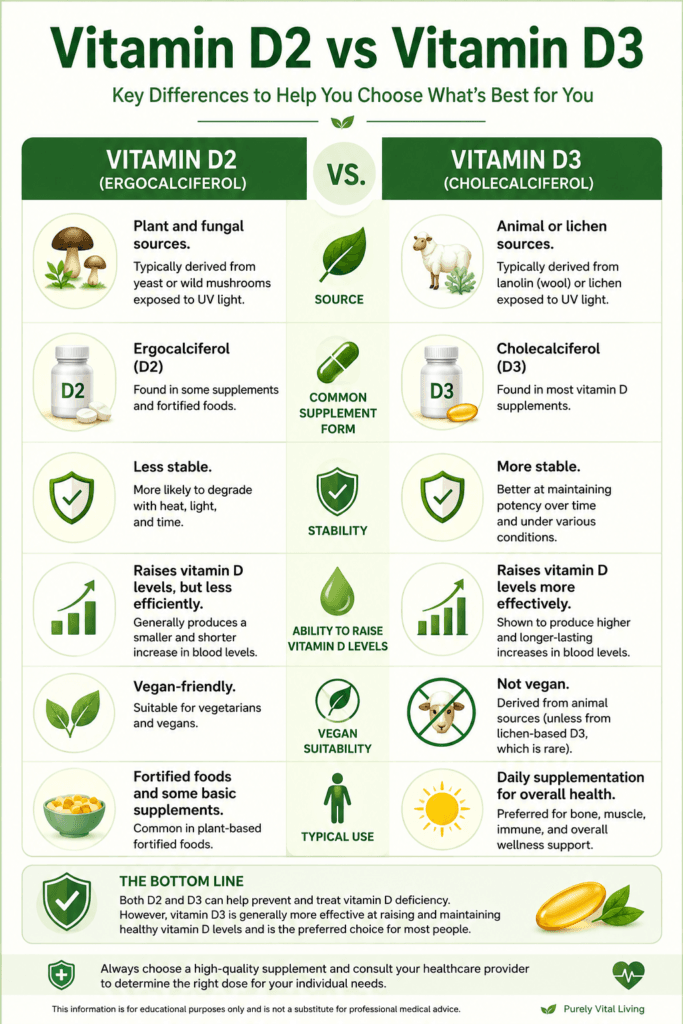
Both vitamin D2 and D3 are absorbed in the small intestine and can improve vitamin D status. However, research generally finds that D3 raises and maintains circulating 25-hydroxyvitamin D more effectively than D2. This is why D3 is commonly preferred for routine supplementation.
| Feature | Vitamin D3 | Vitamin D2 |
|---|---|---|
| Scientific name | Cholecalciferol | Ergocalciferol |
| Common source | Lanolin or lichen | Yeast or mushrooms |
| Raises vitamin D status | Generally more effective over time | Effective, but often less sustained |
| Vegan availability | Yes, when lichen-derived | Usually vegan |
Should You Choose Vitamin D3 With K2?
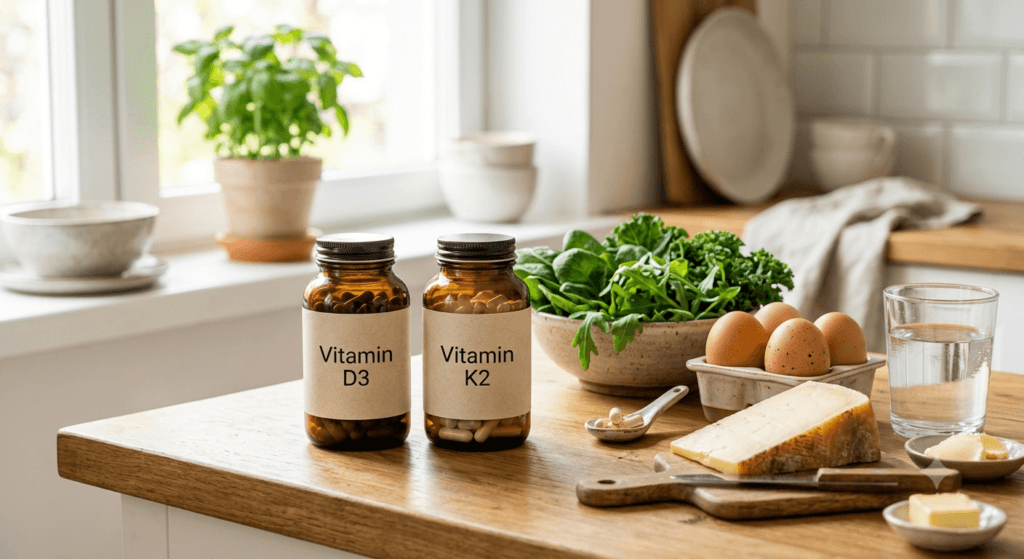
Vitamin K supports proteins involved in normal blood clotting and bone metabolism. This has led to growing interest in D3 plus K2 combinations, particularly for bone health.
However, a combined product is not automatically necessary for every adult taking vitamin D. Evidence for the clinical advantages of routine D3 plus K2 supplementation is still developing, and individual needs vary. A simple D3 product may be sufficient when diet provides adequate vitamin K.
Vitamin K can interfere with warfarin and related anticoagulant management. Anyone taking these medicines should speak with the prescribing clinician before changing vitamin K intake.
What Is the Best Vitamin D Supplement for Women?

The best vitamin D supplement for women is not a special gendered formula. It is a suitable dose of D3 that reflects age, pregnancy status, diet, sun exposure, bone-health risk, medications, and any confirmed deficiency.
Women after menopause may pay closer attention to bone health, but vitamin D should be considered alongside adequate calcium intake, resistance exercise, protein, and medical risk assessment. Pregnant or breastfeeding women should follow prenatal and clinician guidance rather than adding high-dose vitamin D independently.
What Is the Best Vitamin D3 Supplement for Older Adults?
Adults over 70 have a recommended intake of 800 IU per day from all sources. A clearly labeled daily D3 softgel or liquid may be easier to use consistently than a complex formula. The best choice should also consider swallowing ability, medication interactions, kidney health, osteoporosis risk, and whether a clinician has recommended testing.
Consistency matters more than collecting many supplements. This is also why a broader balanced lifestyle for healthy aging remains the foundation.
How Much Vitamin D3 Should You Take Daily?
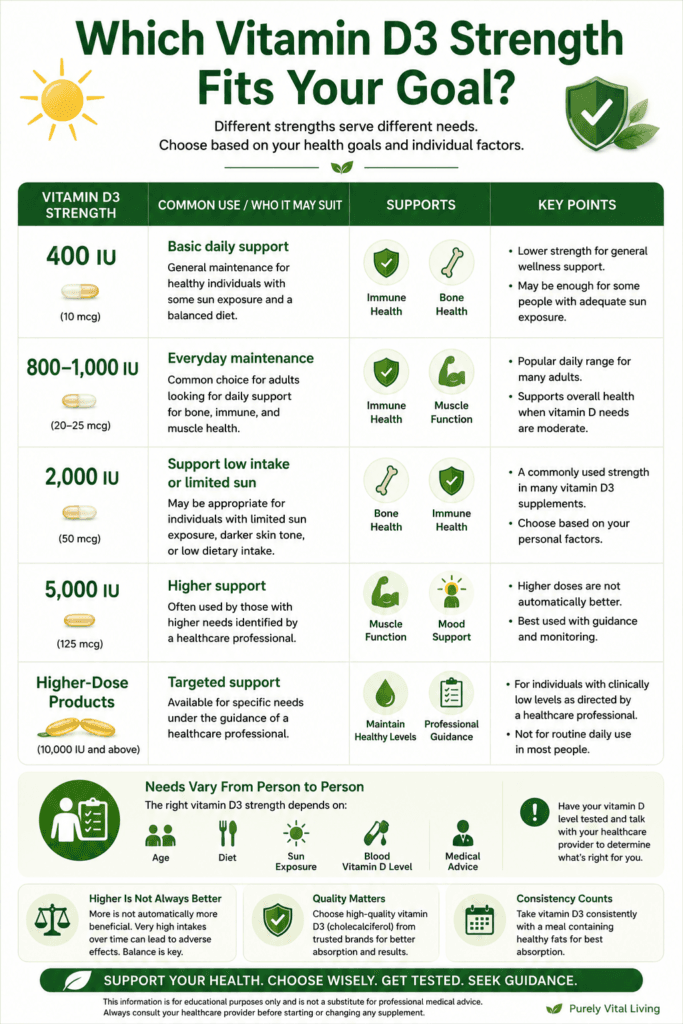
The U.S. recommended dietary allowance is 600 IU, or 15 micrograms, daily for adults through age 70 and 800 IU, or 20 micrograms, for adults over 70. These figures include vitamin D from food, fortified products, and supplements.
| Daily amount | How to interpret it |
|---|---|
| 600 IU | Recommended daily intake for most adults ages 19–70 from all sources |
| 800 IU | Recommended daily intake for adults over 70 from all sources |
| 1,000–2,000 IU | Common supplement range, but not automatically necessary for everyone |
| 4,000 IU | Adult tolerable upper intake level for routine unsupervised intake |
| 5,000 IU or more | Should not be treated as a default daily wellness dose; use professional guidance |
A blood test for 25-hydroxyvitamin D can help in selected clinical situations, but the Endocrine Society does not recommend routine screening for every healthy adult. Testing makes more sense when a clinician identifies a specific indication.
More vitamin D is not always better. For adults, 4,000 IU per day from all sources is the tolerable upper intake level for routine unsupervised use. A 5,000 IU supplement exceeds that level and should not be treated as a default daily wellness dose; it may be appropriate in specific circumstances when a qualified healthcare professional recommends and monitors the higher intake.
When Is the Best Time to Take Vitamin D3?

There is no strong evidence that morning is universally better than evening. The best time is the time you can remember consistently.
Because vitamin D is fat-soluble, taking it with a meal containing some dietary fat may improve absorption. Breakfast, lunch, or dinner can all work. If taking it late seems to affect your sleep, move it earlier, but this response is individual rather than a universal rule.
Which Form of Vitamin D3 Is Best?
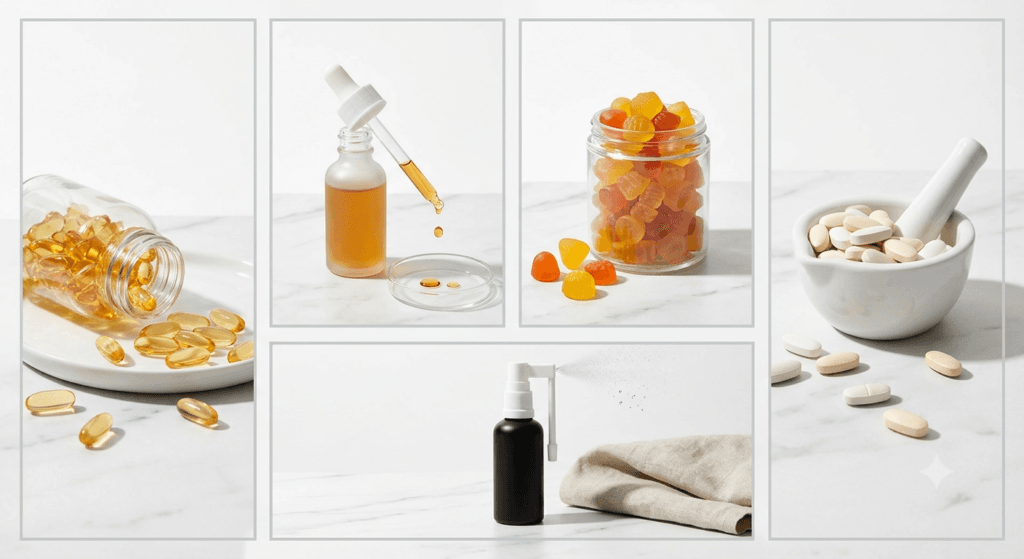
Softgels
Softgels are convenient, stable, and easy to compare by dose. Many use oil as a carrier, which suits a fat-soluble nutrient.
Liquid Drops
Liquid D3 can be useful for people who dislike pills or need flexible dosing. The main limitation is measurement accuracy, so the dose per drop must be clearly stated.
Gummies
Gummies may improve consistency for people who avoid capsules. Check added sugar, serving size, and whether the appealing format encourages accidental overuse.
Sprays
Oral sprays are convenient and may suit people with swallowing difficulties. They are not automatically superior to capsules, so judge them by dose accuracy, ingredients, and quality rather than marketing claims.
How Do You Read a Vitamin D3 Supplement Label?

- Confirm the form. Look for vitamin D3 or cholecalciferol.
- Check both units. One microgram of vitamin D equals 40 IU.
- Read the serving size. A label may list the dose per two gummies rather than per gummy.
- Review inactive ingredients. Check oils, gelatin, sweeteners, colors, and allergens.
- Look for credible verification. USP, NSF, or other recognized programs can help confirm identity and manufacturing quality.
- Question extreme doses. High strength is not the same as high quality.
Who Is More Likely to Have Low Vitamin D?
Risk can be higher among older adults, people with limited sun exposure, people with darker skin, those with obesity, and people with conditions that reduce fat absorption, such as inflammatory bowel disease or after some forms of bariatric surgery. Diets containing little fortified food, fatty fish, or animal-derived vitamin D may also contribute.
Risk does not automatically mean that everyone needs a high-dose supplement or routine screening. It means the conversation should be individualized.
Can You Get Enough Vitamin D From Food and Sunlight?

Vitamin D occurs naturally in relatively few foods. Fatty fish such as salmon, tuna, and mackerel are among the best sources. Egg yolks and liver provide smaller amounts, while fortified milk, plant beverages, cereals, and some orange juices can make a meaningful contribution.
Sunlight can stimulate vitamin D production, but the amount varies with season, latitude, time of day, skin pigmentation, age, clothing, sunscreen use, and time outdoors. It is not practical or safe to prescribe one universal amount of sun exposure, especially because ultraviolet radiation increases skin-cancer risk.
Can You Take Too Much Vitamin D3?
Yes. Vitamin D toxicity is uncommon, but it can occur when very high supplement doses cause excessive calcium in the blood. Possible symptoms include nausea, vomiting, poor appetite, weakness, confusion, frequent urination, kidney stones, and kidney damage.
The adult upper intake level is 4,000 IU per day unless a clinician recommends and monitors a different amount. Toxicity is generally caused by supplements, not ordinary food intake or sun exposure.
Which Medications Can Interact With Vitamin D?
Vitamin D can interact with or be affected by certain medications, including some anticonvulsants, corticosteroids, weight-loss medicines that reduce fat absorption, bile-acid sequestrants, thiazide diuretics, and specific cholesterol or psoriasis treatments. Vitamin K2 adds another concern for people taking warfarin.
Bring the full supplement label to your doctor or pharmacist instead of mentioning only “vitamin D.” Added K2, calcium, magnesium, or herbs can change the interaction discussion.
Does Vitamin D3 Improve Energy?
Low vitamin D can be associated with fatigue, and correcting a confirmed deficiency may help some people feel better. However, vitamin D is not a general stimulant, and taking more does not reliably create more energy in someone whose status is already adequate.
Persistent fatigue deserves a broader look at sleep, iron status, vitamin B12, thyroid health, stress, nutrition, medications, and other causes. Our guide to the best vitamins for energy after 40 explains that wider picture.
Want practical wellness guidance without exaggerated promises?
Join the Purely Vital Living newsletter for evidence-based supplement guides, energy strategies, sleep tips, and realistic healthy-living ideas.
Product examples · research-based review. Listed retailer prices and ratings are historical and are not clinical evidence. Confirm current labels, certification, price and availability before buying.
Frequently Asked Questions About Vitamin D3 Supplements
What brand of vitamin D3 is best?
No single brand is best for everyone. Look for the correct dose, transparent ingredients, reliable quality verification, and a format you can use consistently. Nature Made, NOW, Thorne, and Sports Research illustrate different options, but the label and dose matter more than brand recognition alone.
Is 2,000 IU of vitamin D3 safe to take every day?
Two thousand IU is below the adult upper intake level of 4,000 IU, but it may still be more than some people need. Your total intake, health conditions, medications, and any clinician advice should guide the decision.
Should vitamin D3 be taken with food?
Vitamin D is fat-soluble, and taking it with a meal containing some fat may improve absorption. A consistent meal is also a practical way to remember the supplement.
Do you need vitamin K2 with vitamin D3?
Not everyone needs a combined D3 and K2 supplement. K2 may fit some bone-health plans, but evidence for routine combined use is still developing. People taking warfarin should not change vitamin K intake without medical guidance.
Is liquid vitamin D3 better than softgels?
Liquid vitamin D3 is not automatically better. It offers flexible dosing and avoids swallowing a pill, while softgels are convenient and easy to measure. Choose based on dose accuracy, ingredients, quality, and personal preference.
How do I know whether I need a vitamin D supplement?
Consider your diet, sun exposure, age, skin pigmentation, digestive health, medications, and clinician advice. Routine blood screening is not recommended for every healthy adult, but testing may be appropriate when there is a specific medical indication.
Final Verdict: How Should You Choose a Vitamin D3 Supplement?
Choose the simplest product that fits a clearly defined need. For many adults, that may be a modest-dose D3 softgel with transparent ingredients and credible quality verification. Liquid D3 can make dosing easier, while vegan and D3 plus K2 formulas serve more specific preferences.
The most important lesson is not to confuse a larger dose with a better supplement. Start with your actual needs, check the label carefully, and ask for professional guidance when using high doses, managing a health condition, or taking interacting medications.
One realistic next step is to review the vitamin D already present in your diet and current supplements before buying another bottle.
Related Reads
- Best Vitamin D Supplements for Energy & Immunity
- Best Vitamins for Energy After 40
- Best Wellness Supplements for Better Health
- Balanced Lifestyle for Healthy Aging
- How to Get More Energy Naturally
References
- NIH Office of Dietary Supplements — Vitamin D Fact Sheet for Health Professionals
- Endocrine Society — Vitamin D for the Prevention of Disease Clinical Practice Guideline
- Mayo Clinic — Vitamin D
- Mayo Clinic — Vitamin D Toxicity
- Nature Made — Vitamin D3 2,000 IU Product Information
- NOW Foods — Vitamin D3 2,000 IU Product Information
- Thorne — Vitamin D + K2 Liquid Product Information
- Sports Research — Vitamin D3 + K2 Product Information